Lightweight and long-legged males go the distance for sex
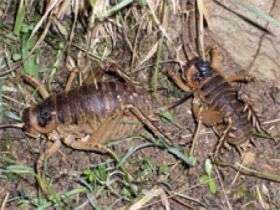
Finding a mate can take considerable legwork as recently illustrated by the flightless and nocturnal Cook Strait giant weta Deinacrida rugosa. This cricket relative is found in New Zealand and is one of the world's heaviest insects with females weighing in at 20 g, averaging twice the size of males.
In a field study on Maud Island, New Zealand, published in the September issue of The American Naturalist, evolutionary biologists from the University of Toronto at Mississauga discovered that male giant weta most successful at mating travel greater distances each night. Remarkably, it appears that being lightweight and having longer legs assist male wanderlust. Clint Kelly, Luc Bussière, and Darryl Gwynne found that males can walk more than 90 m each night in search of a mate – roughly equivalent to a 7000 m outing by a human male.
Kelly and colleagues gained unprecedented insight into mating habits of weta by radio-tracking them over several days. This allowed calculations of distance walked and identification of with whom each male and female "spent the day."
Because a male giant weta copulates repeatedly with his mate throughout the day, the biologists estimated how much sperm was transferred by counting the empty packets (spermatophores) piled beneath the pair. Not only do males travel more than twice as far as females but small, long-legged individuals walked further, acquired more mates, and transferred more spermatophores to females (no female traits predicted female mobility or mating success).
"Our findings are a rare example of sexual selection favoring a suite of traits that promote greater mobility in one sex only," stated Kelly, adding " this is exciting because it suggests that sexual selection for smaller, more mobile males could be responsible for some of the impressive sexual difference in body size in this species." Importantly, however, this phenomenon may also help to explain why males are smaller than females in some other animals.
Citation: Clint D. Kelly, Luc F. Bussière, and Darryl T. Gwynne, "Sexual Selection for Male Mobility in a Giant Insect with Female-Biased Size Dimorphism." American Naturalist (2008) 172:417-423.
Source: University of Chicago


