Astronomer Discovers Upper Mass Limit for Black Holes
September 5th, 2008 Astronomer Discovers Upper Mass Limit for Black Holes

Enlarge

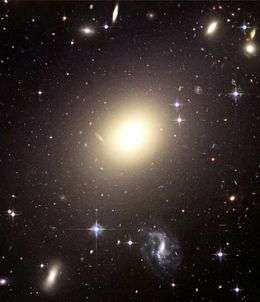
Natarajan found that ultra-massive black holes, which lurk in the centers of huge galaxy clusters like the one above, seem to have an upper mass limit of 10 billion times that of the Sun. (Credit: NASA)

There appears to be an upper limit to how big the universe’s most massive black holes can get, according to new research led by a Yale University astrophysicist.

Once considered rare and exotic objects, black holes are now known to exist throughout the universe, with the largest and most massive found at the centers of the largest galaxies. These “ultra-massive” black holes have been shown to have masses upwards of one billion times that of our own Sun. Now, Priyamvada Natarajan, an associate professor of astronomy and physics at Yale University and a fellow at the Radcliffe Institute for Advanced Study, has shown that even the biggest of these gravitational monsters can’t keep growing forever. Instead, they appear to curb their own growth – once they accumulate about 10 billion times the mass of the Sun.

These ultra-massive black holes, found at the centers of giant elliptical galaxies in huge galaxy clusters, are the biggest in the known universe. Even the large black hole at the center of our own Milky Way galaxy is thousands of times less massive than these behemoths. But these gigantic black holes, which accumulate mass by sucking in matter from neighboring gas, dust and stars, seem unable to grow beyond this limit regardless of where – and when – they appear in the universe. “It’s not just happening today,” said Natarajan. “They shut off at every epoch in the universe.”

The study, to appear in the Monthly Notices of the Royal Astronomical Society (MNRAS), represents the first time an upper mass limit has been derived for black holes. Natarajan used existing optical and X-ray data of these ultra-massive black holes to show that, in order for those various observations to be consistent, the black holes must essentially shut off at some point in their evolution.

One possible explanation put forth by Natarajan is that the black holes eventually reach the point when they radiate so much energy as they consume their surroundings that they end up interfering with the very gas supply that feeds them, which may interrupt nearby star formation. The new findings have implications for the future study of galaxy formation, since many of the largest galaxies in the universe appear to co-evolve along with the black holes at their centers.

“Evidence has been mounting for the key role that black holes play in the process of galaxy formation,” said Natarajan. “But it now appears that they are likely the prima donnas of this space opera.”

The authors of the paper are Priyamvada Natarajan (Yale University and the Radcliffe Institute for Advanced Study) and Ezequiel Treister (European Southern Observatory, Chile and University of Hawaii).

Provided by Yale University


print this article email this article download pdf blog this article bookmark this article     Digg this Stumble it share on Facebook share on Reddit add to delicious save to Yahoo! bookmarks
4.4/5 after 49 votes

Rank Filter

Move the slider to adjust rank threshold, so that you can hide some of the comments.


Display comments: newest first

  • panther_1504 - Sep 05, 2008
    • Rank: 2 / 5 (3)
    this paves a way for new thought that we might calculate the safety for our planet from the data which we get about the size of the black hole at the center of our very galaxy !
    hats off to you for the path breaking research !
  • ShadowRam - Sep 05, 2008
    • Rank: 3.3 / 5 (3)
    Was this upper limit found via observation or mathematically?

    Are they sure the upper limit isn't an upper limit of the way we are observing the black hole?

    (Kinda like saying after it goes black, we reached the upper limit of 'visibly' observing the star)
  • dfwrunner - Sep 05, 2008
    • Rank: 4 / 5 (2)
    It appears that they're just saying that they can get so large that they prevent other objects from forming near them, so nothing to "eat". But I doubt that you say this is a true upper limit, just a practical one.
  • Corban - Sep 05, 2008
    • Rank: 4 / 5 (2)
    A true upper limit would be where the black hole's force is in equilibrium with spacetime, to the point that the amount of mass required to grow an extra inch wouldn't be worth it. At that point, it stays in its hole.
  • x646d63 - Sep 05, 2008
    • Rank: not rated yet
    If its density is finite won't it eventually fill up to its own event horizon? There would simply be no more room inside the horizon for additional mass. Perhaps infinite density is not possible.
  • Sophos - Sep 05, 2008
    • Rank: not rated yet
    If its density is finite won't it eventually fill up to its own event horizon? There would simply be no more room inside the horizon for additional mass. Perhaps infinite density is not possible.


    I've wondered about this as well. Does the black hole fill up and if so, once matter breaches the event horizon does the black hole explode?
    (big bang?)
  • MarkG - Sep 05, 2008
    • Rank: 5 / 5 (3)
    I would expect the event horizon to expand at some proportional rate to the increase in mass of the black hole.
  • Geek_Prophet - Sep 05, 2008
    • Rank: 4.3 / 5 (3)
    If its density is finite won't it eventually fill up to its own event horizon? There would simply be no more room inside the horizon for additional mass. Perhaps infinite density is not possible.

    No, because as the black hole absorbs matter, its event horizon expands in proportion to its mass. This expansion is such that as time goes on, the average density of a black hole becomes lower, not higher. If a black hole eats enough, you eventually reach the point where the density is so low that it would float on a big enough ocean, if it had a surface that somehow prevented the ocean from just being eaten.
  • Xajel - Sep 05, 2008
    • Rank: 2 / 5 (1)
    Accourding to this site, there's already a 18 billion sun mass black hole
    http://space.news...red.html
  • manojendu - Sep 06, 2008
    • Rank: not rated yet
    If its density is finite won't it eventually fill up to its own event horizon? There would simply be no more room inside the horizon for additional mass. Perhaps infinite density is not possible.

    The radius of the event horizon of a (Schwartzchild) black hole is GM/c^2, with increase in mass teh event horizon also increases in size. And most importantly, inside the event horizon spatial dimensions become timelike (and vice versa, the time dimension becomes spacelike), which implies that inside the event horizon, one can not move back in space (just as outside the event horizon, in the spacetime in which we exist, we things can't progress back in time), so all the mass will eventually be pulled into the singularity, which is the centre of the black hole.
  • Alizee - Sep 06, 2008
    • Rank: 1.8 / 5 (4)
    The problem of Schwartzchild, it's steady-state solution, it doesn't care, how much of time it requires for its establishing. From AWT follows, the mass larger then five millions of sun mass cannot be achieved during Universe life by simple accretion, so if some massive holes exists, they should be formed by another mechanism.

    The common black hole is "black" because of giant vacuum density gradient, which is behaving like glass sphere or semitransparent mirror due the total reflection phenomena near the event horizon. The larger the black hole is, the larger is curvature of space around it. But every space-time curvature has its own energy density by Einstein field equations, and such energy density is equivalent to additional matter density of vacuum due the E=MC^2 equivalence. This dense vacuum is surrounding black hole and it's balancing its internal mass density by such way, it decreasing surface density gradient.

    If the black hole become sufficiently large, then the mass density of vacuum above black hole will compensate the mass density below event horizon, so only subtle density gradient can appear here. Therefore the vacuum density gradient will not reflect the energy from inside anymore and whole the object will change into giant glowing star, emanating both energy, both matter from inside, so called the quasar. We can compare the negative capillary waves of the sink model, which are getting faster for shorter wavelength, so they can penetrate the event horizon as well. The similar conclusion results from Yilmaz and Heim theories, you can find some transparent derivation for example here: http://arxiv.org/...1110.pdf

    By Aether Wave Theory most of sufficiently large galaxies inside of our Universe were created by evaporation of quasars, and the Milky Way is no exception. The black hole siting at the center of most of galaxies is supposedly a cold remnant of quasar, which has evaporated the excessive matter. This is because only black holes larger then certain mass limit can evaporate their matter by the above mechanism.
  • Alizee - Sep 06, 2008
    • Rank: 1.8 / 5 (4)
    Here are many other, less technical reasons, why the size of BH should be limited. For example, the pressure of acrettion radiation keeps a lot of matter at distance, whenever the black hole becomes larger (a sort of Leidenfrost effect).

    http://en.wikiped...t_effect
  • mattytheory - Sep 06, 2008
    • Rank: 4 / 5 (1)
    An upper mass limit for black holes? Imagine the following scenario: Two black holes, of masses approaching a mass limit (of arbitrary size) are orbiting each other and slowly falling into each other. When these two monster black holes merge, wouldn't their combined mass will greatly exceed the defined mass limit?

    Perhaps the apparent upper bound we observe is related to the density of the primordial universe. In other words, there was only so much stuff to create the black hole. Once you run out of stuff it is impossible for the black hole to become larger. Thus, the density of the early universe could be directly related to the maximum size of a black hole we see today.
  • ZeroDelta - Sep 06, 2008
    • Rank: 1 / 5 (1)
    "Here are many other, less technical reasons, why the size of BH should be limited. For example, the pressure of acrettion radiation keeps a lot of matter at distance, whenever the black hole becomes larger (a sort of Leidenfrost effect)."

    Did you read the article? Why re-state it? Or is this website a billboard for your hilarious theories?
  • Alizee - Sep 07, 2008
    • Rank: 1 / 5 (2)
    ...When these two monster black holes merge, wouldn't their combined mass will greatly exceed the defined mass limit?..
    By AWT such BH would behave like pair of mercury droplets, due their surface energy. Briefly speaking, the merging of such curved spacetimes requires the temporal formation of thin neck with negative curvature, which is the source of strong repulsive force.

    It means, the merging of such black holes is possible, but it requires a substantial time. And if it occurs at the end, it's followed by releasing a substantial energy in the form of gamma ray flash - a much higher, then the current relativity based field theory assumes. By such way, AWT explains a mysterium of ultrashort gamma ray flashes, which are so intesive, so they can travel through whole universe. http://en.wikiped...stronomy
  • Alizee - Sep 07, 2008
    • Rank: 1 / 5 (1)
    ..Or is this website a billboard for your hilarious theories?..
    Why hilarious? I discussed a black hole mass limit and its consequences here before a two years already. Now it was just a confirmed.

    http://www.physfo...pic=8904
  • Alizee - Sep 07, 2008
    • Rank: 1 / 5 (1)
    Was this upper limit found via observation or mathematically?
    This is an observational result. Note the apparent absence of medium-class black holes in this distribution. Albeit it be explained by other ways, such discrepancy supports my theory as well.

    http://arxivblog....oles.jpg

    It's all just about thinking and good knowledge of experimental results. If somebody doesn't know these results, it can consider my theories hilarious - but it's not my problem, indeed.

September 5th, 2008 all stories
Space & Earth / Astronomy

Comments: 17
Rank: 4.4/5 after 49 votes

  • Stumble this up

  • Digg this

  • Share it:
  • share on Facebook
  • share on MySpace
  • share on Slashdot
  • rss-newsfeed
  • share on Google
  • share on Reddit
  • add to delicious
  • save to Yahoo! bookmarks
  • share on Windows Live
  • Add to Mixx!
Rating: 4.4/5 after 49 votes

  • Related Stories

  • Astronomers discover upper mass limit for black holes
    created Sep 11, 2008 | popularity not rated yet | comments 0
  • VLBA locates superenergetic bursts near giant black hole
    created Jul 02, 2009 | popularity not rated yet | comments 0
  • New class of black holes discovered
    created Jul 01, 2009 | popularity not rated yet | comments 0
  • Intense heat killed the Universe's would-be galaxies, researchers say
    created Jul 01, 2009 | popularity not rated yet | comments 0
  • Galaxies coming of age in cosmic blobs
    created Jun 24, 2009 | popularity not rated yet | comments 0


  • Physicists Demonstrate Quantum Memory with Matter Qubits
    Physicists Demonstrate Quantum Memory with Matter Qubits
    Physics / General Physics
    created 23 hours ago | popularity 4.5 / 5 (11) | comments 1
  • 'Holey' Nanosheets for Wastewater Dye Removal
    Nanotechnology / Nanomaterials
    created Jul 01, 2009 | popularity 5 / 5 (5) | comments 1
  • Jellyfish Robot Swims Like its Biological Counterpart
    Jellyfish Robot Swims Like its Biological Counterpart
    Electronics / Robotics
    created Jun 26, 2009 | popularity 4.4 / 5 (7) | comments 1
  • Could Maxwell's Demon Exist in Nanoscale Systems?
    Could Maxwell's Demon Exist in Nanoscale Systems?
    Physics / General Physics
    created Jun 24, 2009 | popularity 4.4 / 5 (18) | comments 29
  • Living Safely with Robots, Beyond Asimov's Laws
    Living Safely with Robots, Beyond Asimov's Laws
    Electronics / Robotics
    created Jun 22, 2009 | popularity 4.6 / 5 (51) | comments 39
  • Other News

    Global warming tactic cools climate but won’t help corals, say researchers

    Space & Earth / Earth Sciences

    created 20 hours ago | popularity 2.3 / 5 (3) | comments 6

    (PhysOrg.com) -- “Geoengineering” experiments proposed to reduce global warming by blocking sunlight with atmosphere-injected particles may cool the world but still leave carbon dioxide levels dangerously high, Stanford scientists ...


    Coolest spacecraft ever in orbit around L2

    Coolest spacecraft ever in orbit around L2

    Space & Earth / Space Exploration

    created 22 hours ago | popularity 4.8 / 5 (5) | comments 3

    (PhysOrg.com) -- Last night, the detectors of Planck's High Frequency Instrument reached their amazingly low operational temperature of -273°C, making them the coldest known objects in space. The spacecraft ...


    Senator may have won fight over private rocket manufacturing

    Space & Earth / Space Exploration

    created 23 hours ago | popularity 4.5 / 5 (2) | comments 2

    For months, a powerful Republican senator from Alabama has fought the Obama administration to block $150 million that the White House wanted to spend to help private companies build rockets capable of reaching the international ...


    The least sea ice in 800 years

    The least sea ice in 800 years

    Space & Earth / Earth Sciences

    created Jul 01, 2009 | popularity 4.3 / 5 (57) | comments 44

    New research, which reconstructs the extent of ice in the sea between Greenland and Svalbard from the 13th century to the present indicates that there has never been so little sea ice as there is now. The ...


    Gas around young galaxy

    Intense heat killed the Universe's would-be galaxies, researchers say

    Space & Earth / Astronomy

    created Jul 01, 2009 | popularity 3.1 / 5 (18) | comments 23

    (PhysOrg.com) -- Our Milky Way galaxy only survived because it was already immersed in a large clump of dark matter which trapped gases inside it, scientists led by Durham University's Institute for Computational ...