Dental fillings without gaps
September 5, 2008 Dental Fillings Without Gaps

Enlarge

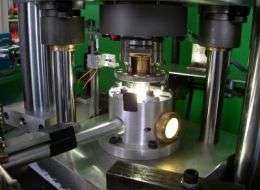
The researchers initially investigate how the material reacts to stresses, using a plastic filling in a standard geometry. Credit: Fraunhofer IWM

Tooth cavities are usually closed with plastic fillings. However, the initially soft plastic shrinks as it hardens. The tension can cause gaps to appear between the tooth and the filling, encouraging more caries to form. For the first time, researchers have simulated this process.

The patient's hands are clasped firmly around the armrests as the dentist drills away the caries-stricken sections of the tooth. Once the drilling is over, most toothache sufferers can begin to relax. All the doctor now has to do is to slightly etch the cavity, apply an adhesive film, and fill it with a special type of plastic.

The plastic is soft at first, so that the doctor can easily press it into the cavity. It only solidifies afterwards under the light of a small lamp. However, the material tends to shrink slightly as it hardens, occasionally producing tension that can cause tiny gaps to form between the plastic filling and the tooth. Bits of food can get caught in these gaps and lead to more caries. Manufacturers of filling materials therefore offer a variety of plastics to choose from. But which filling is best suited to which shape of cavity? This is where dentists have to draw on their experience.

"Until now, it has not been possible to establish a theoretical model of the hardening process. The tension occurring in the material always depends on the shape of the cavity, and can vary widely by a factor of up to ten, particularly at the edges," says Dr.-Ing. Christof Koplin, research assistant at the Fraunhofer Institute for Mechanics of Materials IWM in Freiburg. Measurements do not help either, as tension can only be measured selectively. Its precise course of development has never yet been observed.

A new method of simulation now enables tension in dental fillings to be accurately predicted, helping doctors to choose the least tension-prone plastic for each shape of cavity. Dentists can now draw on the results of the IWM to select the best material, and manufacturers can use the simulations to optimize their products.

"We theoretically subdivide the dental filling into thousands of small parcels and calculate how each element affects its neighbor. Experimental parameters are incorporated in the individual elements. We started our laboratory tests by using a standard geometry to find out how each material reacts to the stresses that occur when the volume shrinks, and how the flow capability of the material changes as it hardens," explains Koplin. The IWM researchers have now successfully simulated the development of tension in dental fillings for various cavity shapes and materials, and more will follow.

Source: Fraunhofer-Gesellschaft


Rate this story - 3.4 /5 (5 votes)

Rank Filter

Move the slider to adjust rank threshold, so that you can hide some of the comments.


Display comments: newest first


September 5, 2008 all stories

Comments: 1

3.4 /5 (5 votes)

  • hide
  • Related Stories

  • Fine-tuned: A wholly new approach to tuning a laser's frequency
    created Dec 04, 2009 | popularity not rated yet | comments 0
  • How 'random' lasers work
    created Jan 24, 2010 | popularity not rated yet | comments 0
  • Airline attack could lead to more scanners
    created Dec 31, 2009 | popularity not rated yet | comments 0
  • Tiny whispering gallery: Sensor can detect a single nanoparticle and take its measurement
    created Dec 18, 2009 | popularity not rated yet | comments 0
  • Tahoe faces new development battle: green vs. green
    created Dec 03, 2009 | popularity not rated yet | comments 0


  • hide
  • Relevant PhysicsForums posts

Other News

Study challenges bird-from-dinosaur theory of evolution - was it the other way around?

Study challenges bird-from-dinosaur theory of evolution - was it the other way around?

Other Sciences / Archaeology & Fossils

created 17 hours ago | popularity 3.7 / 5 (11) | comments 4 | with audio podcast

(PhysOrg.com) -- A new study just published in the Proceedings of the National Academy of Sciences provides yet more evidence that birds did not descend from ground-dwelling theropod dinosaurs, experts say, a ...


New research reveals burglars have changed their 'shopping list'

Other Sciences / Social Sciences

created 5 hours ago | popularity 3.5 / 5 (2) | comments 3

Globalisation, and particularly cheaper electronic goods from China and the Far East, has altered behaviour among Britain's burglars according research in progress at the University of Leicester.


TED takes on 'What the world needs now'

Other Sciences / Other

created 5 hours ago | popularity not rated yet | comments 0

Let the mind-bending begin! A TED conference that attracts brilliant minds and challenges them to solve humanity's ills got underway Tuesday in the southern California city of Long Beach.


'Counterfactual' thinkers are more motivated and analytical, study suggests

Other Sciences / Social Sciences

created 20 hours ago | popularity 4.4 / 5 (5) | comments 7 | with audio podcast

(PhysOrg.com) -- "If only I had..." Almost everyone has said those four words at some time. Rather than intensifying regret, '"what if" reflection about pivotal moments in the past helps people to weave a coherent life story, ...


Office romance? Not a problem most of time: study

Office romance? Not a problem most of time: study

Other Sciences / Social Sciences

created 18 hours ago | popularity not rated yet | comments 1

(PhysOrg.com) -- Pam and Jim on The Office. Meredith and McDreamy on Grey's Anatomy. Television shows depict many workplace romances, but in the real world how do co-workers view love on the job? According ...