Spiky Probe on NASA Mars Lander Raises Vapor Quandary
September 5, 2008
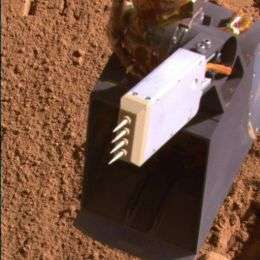
Phoenix inserted the four needles of its thermal and conductivity probe into Martian soil during the 98th Martian day, or sol, of the mission and left it in place until Sol 99 (Sept. 4, 2008). Image credit: NASA/JPL-Caltech/University of Arizona/Texas A&M University
(PhysOrg.com) -- A fork-like conductivity probe has sensed humidity rising and falling beside NASA's Phoenix Mars Lander, but when stuck into the ground, its measurements so far indicate soil that is thoroughly and perplexingly dry.
"If you have water vapor in the air, every surface exposed to that air will have water molecules adhere to it that are somewhat mobile, even at temperatures well below freezing," said Aaron Zent of NASA Ames Research Center, Moffett Field, Calif., lead scientist for Phoenix's thermal and electroconductivity probe.
In below-freezing permafrost terrains on Earth, that thin layer of unfrozen water molecules on soil particles can grow thick enough to support microbial life. One goal for building the conductivity probe and sending it to Mars has been to see whether the permafrost terrain of the Martian arctic has detectable thin films of unfrozen water on soil particles. By gauging how electricity moves through the soil from one prong to another, the probe can detect films of water barely more than one molecule thick.
"Phoenix has other tools to find clues about whether water ice at the site has melted in the past, such as identifying minerals in the soil and observing soil particles with microscopes. The conductivity probe is our main tool for checking for present-day soil moisture," said Phoenix Project Scientist Leslie Tamppari of NASA's Jet Propulsion Laboratory, Pasadena, Calif.
Preliminary results from the latest insertion of the probe's four needles into the ground, on Wednesday and Thursday, match results from the three similar insertions in the three months since landing.
"All the measurements we've made so far are consistent with extremely dry soil," Zent said. "There are no indications of thin films of moisture, and this is puzzling."
Three other sets of observations by Phoenix, in addition to the terrestrial permafrost analogy, give reasons for expecting to find thin-film moisture in the soil.
One is the conductivity probe's own measurements of relative humidity when the probe is held up in the air. "The relative humidity transitions from near zero to near 100 percent with every day-night cycle, which suggests there's a lot of moisture moving in and out of the soil," Zent said.
Another is Phoenix's confirmation of a hard layer containing water-ice about 5 centimeters (2 inches) or so beneath the surface.
Also, handling the site's soil with the scoop on Phoenix's robotic arm and observing the disturbed soil show that it has clumping cohesiveness when first scooped up and that this cohesiveness decreases after the scooped soil sits exposed to air for a day or two. One possible explanation for those observations could be thin-film moisture in the ground.
The Phoenix team is laying plans for a variation on the experiment of inserting the conductivity probe into the soil. The four successful insertions so far have all been into an undisturbed soil surface. The planned variation is to scoop away some soil first, so the inserted needles will reach closer to the subsurface ice layer.
"There should be some amount of unfrozen water attached to the surface of soil particles above the ice," Zent said. "It may be too little to detect, but we haven't inished looking yet."
The thermal and electroconductivity probe, built by Decagon Devices Inc., Pullman, Wash., is mounted on Phoenix's robotic arm. The probe is part of the lander's Microscopy, Electrochemistry and Conductivity instrument suite.
Provided by NASA
-
Russia opens talks with NASA and ESA with plans for manned lunar base
Jan 25, 2012 |
5 / 5 (15) |
16
-
Russian space probe to crash to Earth within hours
Jan 15, 2012 |
4.6 / 5 (5) |
3
-
Russian spacecraft to crash soon, risks unclear
Jan 12, 2012 |
4.2 / 5 (5) |
3
-
NASA unmanned aircraft measures low altitude greenhouse gases
Dec 06, 2011 |
not rated yet |
0
-
Scientists tie Colorado River flooding to San Andreas quakes
Jul 10, 2011 |
4.5 / 5 (6) |
3
-
Engineers build first sub-10-nm carbon nanotube transistor
Feb 01, 2012 |
4.9 / 5 (29) |
30
-
Something old, something new: Evolution and the structural divergence of duplicate genes
Jan 31, 2012 |
4.6 / 5 (7) |
1
-
The hidden nanoworld of ice crystals: Revealing the dynamic behavior of quasi-liquid layers
Jan 30, 2012 |
5 / 5 (3) |
1
-
Stock market network reveals investor clustering
Jan 27, 2012 |
3.9 / 5 (23) |
8
-
Of microchemistry and molecules: Electronic microfluidic device synthesizes biocompatible probes
Jan 26, 2012 |
5 / 5 (1) |
0
-
Real pictures of black hole eating a star?
12 hours ago
-
Hypothetical way to travel faster than light, but not technically exceed lightspeed
Feb 06, 2012
-
How do scientists monitor the Sun's activity?
Feb 05, 2012
-
Search patterns in observational studies
Feb 05, 2012
-
Derivation of Pogson's law
Feb 03, 2012
-
Landing on comet by Rosetta probe in 2014 (YouTube)
Feb 02, 2012
- More from Physics Forums - General Astronomy
More news stories
Bonding out: Making companies pay up front for potential environmental disasters
Whether its building an oil pipeline, drilling for fuel in the ocean or fracking to flush natural gas out of the Earth, were often asked to believe the process is safe, when companies want to do something ...
2 minutes ago |
not rated yet |
0
Amasia: As next supercontinent forms, Arctic Ocean, Caribbean will vanish first
(PhysOrg.com) -- Geologists at Yale University have proposed a new theory to describe the formation of supercontinents, the epic process by which Earths major continental blocks combine into a single ...
Space & Earth / Earth Sciences
14 hours ago |
4.1 / 5 (11) |
4
|
Astronomy team discovers nearby dwarf galaxy
(PhysOrg.com) -- A team led by UCLA research astronomer Michael Rich has used a unique telescope to discover a previously unknown companion to the nearby galaxy NGC 4449, which is some 12.5 million light years ...
13 hours ago |
4.3 / 5 (4) |
5
|
New images capture 'stealth merger' of dwarf galaxies
New images of a nearby dwarf galaxy have revealed a dense stream of stars in its outer regions, the remains of an even smaller companion galaxy in the process of merging with its host. The host galaxy, known ...
14 hours ago |
4 / 5 (2) |
0
|
Chandra finds Milky Way's black hole grazing on asteroids
(PhysOrg.com) -- The giant black hole at the center of the Milky Way may be vaporizing and devouring asteroids, which could explain the frequent flares observed, according to astronomers using data from NASA's ...
14 hours ago |
5 / 5 (5) |
6
|
Soraa LED light may dim 50-watt halogen rivals
(PhysOrg.com) -- Soraa, a Fremont, California company founded in 2008, this week launched its first product, a light that uses LEDS (light emitting diodes). The "Soraa LED MR16 lamp" is the "perfect" replacement for traditional ...
China's Alibaba raising $3bn for Yahoo! stake: report
Chinese online commerce giant Alibaba plans to borrow $3 billion to buy back the stake Yahoo! owns in the company, a report said Thursday, as the struggling US Internet firm overhauls its Asia holdings.
Study finds some medications may interact with common anti-recurrent preterm birth medication
In a study to be presented today at the Society for Maternal-Fetal Medicine's annual meeting, The Pregnancy Meeting, in Dallas, Texas, researchers will report findings that indicate that prescription medications may affect ...
Lenovo 3Q profit up by half, warns of disk supply
(AP) -- Lenovo Group Ltd., the world's second biggest personal computer maker, said Thursday that quarterly profit grew by more than half but warned hard drive costs would remain high amid a global shortage.
Life in Antarctic lake? It's everywhere else
If scientists find microbes in a frigid lake two miles beneath the thick ice of Antarctica, it will illustrate once again that somehow life finds a way to survive in the strangest and harshest places.
Researchers probe 200-year-old shipwreck off RI
(AP) -- For two centuries it rested a mile from shore, shrouded by a treacherous reef from the pleasure boaters and beachgoers who haunt New England's southern coast.