A new 'Pyrex' nanoparticle
September 7, 2008 A new 'Pyrex' nanoparticle

Enlarge

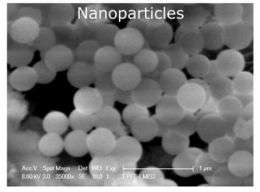
Borosilicate glass nanoparticles. Credit: Martin Gijs, EPFL

Researchers in Switzerland have developed a new method to fabricate borosilicate glass nanoparticles. Used in microfluidic systems, these "Pyrex"-like nanoparticles are more stable when subjected to temperature fluctuations and harsh chemical environments than currently used nanoparticles made of polymers or silica glass. Their introduction could extend the range of potential nanoparticle applications in biomedical, optical and electronic fields.

Thanks to their large surface-to-volume ratio, nanoparticles have generated wide interest as potential transporters of antibodies, drugs, or chemicals for use in diagnostic tests, targeted drug therapy, or for catalyzing chemical reactions.

Unfortunately, these applications are limited because nanoparticles disintegrate or bunch together when exposed to elevated temperatures, certain chemicals, or even de-ionized water. Using borosilicate glass (the original "Pyrex") instead of silica glass or polymers would overcome these limitations, but fabrication has been impossible to date due to the instability of the boron oxide precursor materials.

In this week's advance online issue of Nature Nanotechnology, a group of EPFL researchers, led by Professor Martin Gijs, reports on a new procedure to fabricate and characterize borosilicate glass nanoparticles. In addition to biomedical applications, the new nanoparticles could also have applications in the production of photonic bandgap devices with high optical contrast, contrast agents for ultrasonic microscopy or chemical filtration membranes.

Source: Ecole Polytechnique Fédérale de Lausanne


print this article email this article download pdf blog this article bookmark this article     Stumble it Digg this share on Facebook retweet share on Reddit add to delicious
Rate this story - 4.1 /5 (11 votes)


September 7, 2008 all stories

Comments: 0

4.1 /5 (11 votes)
  • Stumble this up

  • Digg this

  • share this

  • hide
  • Related Stories


  • hide
  • Relevant PhysicsForums posts

  • Poynting Effect, more than one meaning?
    created 3 hours ago
  • Pipeline Drying
    created 5 hours ago
  • Polymer Properties Question
    created Nov 08, 2009
  • Fatigue Properties of Chinese steel
    created Nov 04, 2009
  • More from Physics Forums - Materials & Chemical Engineering

Other News

Scientists develop DNA origami nanoscale breadboards for carbon nanotube circuits

Scientists develop DNA origami nanoscale breadboards for carbon nanotube circuits

Nanotechnology / Nanomaterials

created 4 hours ago | popularity 5 / 5 (4) | comments 0

In work that someday may lead to the development of novel types of nanoscale electronic devices, an interdisciplinary team of researchers at the California Institute of Technology has combined DNA's talent ...


Researchers invent new method for graphene growth

Researchers invent new method for graphene growth

Nanotechnology / Nanomaterials

created 7 hours ago | popularity 4.9 / 5 (9) | comments 0

(PhysOrg.com) -- A Cornell research team has invented a simple way to make graphene electrical devices by growing the graphene directly onto a silicon wafer.


New nanocrystalline diamond probes overcome wear

Nanotechnology / Nanophysics

created 5 hours ago | popularity 4.5 / 5 (2) | comments 0

Researchers at the McCormick School of Engineering and Applied Science at Northwestern University have developed, characterized, and modeled a new kind of probe used in atomic force microscopy (AFM), which images, measures, ...


carbon fiber

Ultra-Long Carbon Nanotubes Could Serve as Future Transmission Lines

Nanotechnology / Nanomaterials

created 3 hours ago | popularity 4.8 / 5 (8) | comments 6

(PhysOrg.com) -- When it comes to carbon nanotubes, the majority of research so far has focused on small-scale applications. But now, a team of researchers from Rice University has created carbon nanotubes ...


Engineers image nanostructure of a solid acid catalyst and boost its catalytic activity

Nanotechnology / Nanomaterials

created 22 hours ago | popularity 5 / 5 (2) | comments 2

The catalytic processes that facilitate the production of many chemicals and fuels could become much more environmentally friendly thanks to a breakthrough achieved by researchers from Lehigh and Rice Universities.