New concept for creating quantum states in many-body systems
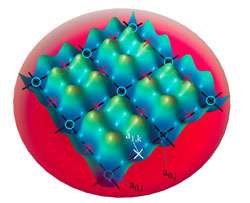
(PhysOrg.com) -- In the online edition of Nature Physics, theoretical physicists from the Institute for Quantum Optics and Quantum Information (IQOQI) and the University of Innsbruck today are presenting a completely new way of preparing quantum states in many-body systems. This means that for the first time even excited many-body states can be created in a targeted fashion, an important step in the exploration of solid states.
Analyzing many-body systems quantum-physically is of particular interest because they can be used as models for exploring the interior of solid states. Up to now the extremely high complexity of solid matter denied any penetrating quantum-physical gaze into it.
Theoretical physicists around Sebastian Diehl, Andrea Micheli, Barbara Kraus and Peter Zoller at the Institute of Theoretical Physics at the University of Innsbruck and at the Institute for Quantum Optics and Quantum Information (IQOQI) of the Austrian Academy of Sciences (Österreichische Akademie der Wissenschaften, ÖAW) have now developed a new theoretical proposal for preparing quantum states in many-body systems. Their method employs a trick: in classical physics dissipation describes, for instance, the transition from kinetic energy to thermal energy through friction.
“Normally dissipation dramatically raises the degree of disorder in any system, but we are turning it around,” explained Sebastian Diehl. “We use dissipation to create a perfectly pure many-body state of long-range order.”
Order through dissipation
The system that the scientists use to test their method theoretically consists of a large number of atoms trapped in an optical lattice of laser beams. The researchers are creating order by exciting the ensemble of particles with another laser while at the same time allowing spontaneous emission into an ultra-cold gas in the environment (dissipation).
“In this process the coherence of the exciting laser beam is transferred into the atomic matter system,” Diehl summed up the idea behind the new method. “What is surprising and follows the laws of quantum physics is the fact that while the atoms are manipulated only locally, order is created throughout the entire system.”
Even excited quantum states become possible
“In this model system we are combining methods from quantum optics and nuclear physics with techniques used in solid state physics,” professor Peter Zoller, head of the research group, explained. Such an interdisciplinary approach might also be relevant for applications in quantum information processing.
The theoretical physicists now want to apply their idea to even more complex systems, for example proposing experimental methods for studying high temperature superconductivity, a very prominent problem in solid state physics. Here their new method offers an advantage that existing approaches lack.
“With our method it becomes possible to prepare states that correspond to excited many-body states. Conventional cooling of a particle system could never achieve this in its pure form,” Sebastian Diehl and his research colleagues emphasize.
In their research the scientists are receiving support from the Austrian Science Fund (FWF), the Austrian Academy of Sciences and the European Union.
Publication: Quantum States and Phases in Driven Open Quantum Systems with Cold Atoms. Diehl S, Micheli A, Kantian A, Kraus B, Büchler HP, Zoller P. Nature Physics, Advanced Online Publication 7. September 2008 (doi: 10.1038/nphys1073)
Provided by Institut für Quantenoptik und Quanteninformation


