Mind the gap: VLT instrument hints at the presence of planets in young gas discs
September 8, 2008 Mind the gap: VLT instrument hints at the presence of planets in young gas discs

Enlarge

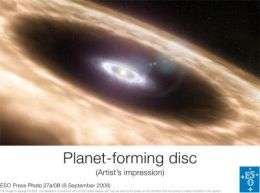
Astronomers have been able to study planet-forming discs around young Sun-like stars in unsurpassed detail, using ESO's Very Large Telescope. The studied discs were known to have gaps in the dusty discs (represented by the brownish color in the image) but the astronomers found that gas is still present inside these gaps (represented by the white color in the image). This can either mean that the dust has clumped together to form planetary embryos, or that a planet has already formed and is in the process of clearing the gas in the disc. Credit: ESO

Astronomers have been able to study planet-forming discs around young Sun-like stars in unsurpassed detail, clearly revealing the motion and distribution of the gas in the inner parts of the disc. This result, which possibly implies the presence of giant planets, was made possible by the combination of a very clever method enabled by ESO's Very Large Telescope.

Planets could be home to other forms of life, so the study of exoplanets ranks very high in contemporary astronomy. More than 300 planets are already known to orbit stars other than the Sun, and these new worlds show an amazing diversity in their characteristics. But astronomers don't just look at systems where planets have already formed - they can also get great insights by studying the discs around young stars where planets may currently be forming. "This is like going 4.6 billion years back in time to watch how the planets of our own Solar System formed," says Klaus Pontoppidan from Caltech, who led the research.

Pontoppidan and colleagues have analysed three young analogues of our Sun that are each surrounded by a disc of gas and dust from which planets could form. These three discs are just a few million years old and were known to have gaps or holes in them, indicating regions where the dust has been cleared and the possible presence of young planets.

The new results not only confirm that gas is present in the gaps in the dust, but also enable astronomers to measure how the gas is distributed in the disc and how the disc is oriented. In regions where the dust appears to have been cleared out, molecular gas is still highly abundant. This can either mean that the dust has clumped together to form planetary embryos, or that a planet has already formed and is in the process of clearing the gas in the disc.

For one of the stars, SR 21, a likely explanation is the presence of a massive giant planet orbiting at less than 3.5 times the distance between the Earth and the Sun, while for the second star, HD 135344B, a possible planet could be orbiting at 10 to 20 times the Earth-Sun distance. The observations of the third star, TW Hydrae, may also require the presence of one or two planets.

"Our observations with the CRIRES instrument on ESO's Very Large Telescope clearly reveal that the discs around these three young, Sun-like stars are all very different and will most likely result in very different planetary systems," concludes Pontoppidan. "Nature certainly does not like to repeat herself".

"These kinds of observations complement the future work of the ALMA observatory, which will be imaging these discs in great detail and on a larger scale," adds Ewine van Dishoeck, from Leiden Observatory, who works with Pontoppidan.

To study the gaps in dust discs that are the size of the Solar System around stars that are located up to 400 light-years away is a daunting challenge that requires a clever solution and the best possible instruments.

"Traditional imaging cannot hope to see details on the scale of planetary distances for objects located so far away," explains van Dishoeck. "Interferometry can do better but won't allow us to follow the motion of the gas."

Astronomers used a technique known as 'spectro-astrometric imaging' to give them a window into the inner regions of the discs where Earth-like planets may be forming. They were able not only to measure distances as small as one-tenth the Earth-Sun distance, but to measure the velocity of the gas at the same time.

"The particular configuration of the instrument and the use of adaptive optics allows astronomers to carry out observations with this technique in a very user-friendly way: as a consequence, spectro-astrometric imaging with CRIRES can now be routinely performed," says team member Alain Smette, from ESO.

Source: ESO


print this article email this article download pdf blog this article bookmark this article     Stumble it Digg this share on Facebook retweet share on Reddit add to delicious
Rate this story - 4.8 /5 (8 votes)


September 8, 2008 all stories

Comments: 0

4.8 /5 (8 votes)
  • Stumble this up

  • Digg this

  • share this

  • hide
  • Related Stories

  • A Look into the Hellish Cradles of Suns and Solar Systems
    created Aug 19, 2009 | popularity not rated yet | comments 0
  • Into the eye of the helix
    created Feb 25, 2009 | popularity not rated yet | comments 0
  • Free from the Atmosphere
    created Jun 13, 2007 | popularity not rated yet | comments 0
  • NASA approves construction of satellite to scan galaxies
    created Oct 19, 2006 | popularity not rated yet | comments 0
  • Watching how planets form
    created Sep 28, 2006 | popularity not rated yet | comments 0


  • hide
  • Relevant PhysicsForums posts

  • The shape of our solar system's orbits.
    created Nov 07, 2009
  • Above or Below the Line of Nodes
    created Nov 07, 2009
  • Supernova vs. Nova?
    created Nov 07, 2009
  • Supernova's Gamma Rays and Comets
    created Nov 06, 2009
  • More from Physics Forums - General Astronomy

Other News

NASA satellites see Ida spreading out before landfall

NASA satellites see Ida spreading out before landfall

Space & Earth / Earth Sciences

created 57 minutes ago | popularity not rated yet | comments 0

NASA's Aqua and Terra satellites are keeping a close eye on Tropical Storm Ida, and both have instruments aboard that show her clouds and rains are already widespread inland over the U.S. Gulf coast states. ...


Australian scientists call for urgent 'global cooling' to save coral reefs

Space & Earth / Environment

created 27 minutes ago | popularity not rated yet | comments 0

(PhysOrg.com) -- Australian marine scientists have issued an urgent call for massive and rapid worldwide cuts in carbon emissions, deep enough to prevent atmospheric CO2 levels rising to 450 parts per million (ppm).


L-R: Chiwetel Ejiofor, Amanda Peet and John Cusack at the premiere of "2012"

NASA on crusade to debunk 2012 apocalypse myths

Space & Earth / Space Exploration

created 5 hours ago | popularity not rated yet | comments 0

The world is not coming to an end on December 21, 2012, the US space agency insisted Monday in a rare campaign to dispel widespread rumors fueled by the Internet and a new Hollywood movie.


Antarctica glacier retreat creates new carbon dioxide store

Antarctica glacier retreat creates new carbon dioxide store

Space & Earth / Earth Sciences

created 9 hours ago | popularity 4.3 / 5 (3) | comments 0

Large blooms of tiny marine plants called phytoplankton are flourishing in areas of open water left exposed by the recent and rapid melting of ice shelves and glaciers around the Antarctic Peninsula. This ...


NASA satellites make a movie and get rainfall, wind info on Ida

NASA satellites make a movie and get rainfall, wind info on Ida (w/ Video)

Space & Earth / Earth Sciences

created 5 hours ago | popularity not rated yet | comments 0

NASA satellites are amazing examples of technology. The TRMM satellite peers into tropical cyclones and can tell how much rain is falling per hour and where. QuikScat uses microwave technology to measure Ida's ...