An advance on new generations of chemotherapy and antiviral drugs
September 8, 2008 Polymerase

Enlarge

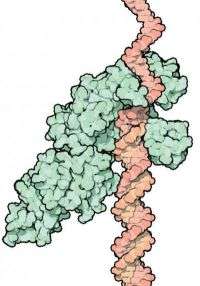
Above is an illustration of DNA polymerase moving along the length of a DNA strand. Researchers are targeting new chemotherapy drugs that efficiently block uncontrolled DNA replication while minimizing side effects. Credit: The Protein Data Bank

Researchers are describing progress toward developing a new generation of chemotherapy agents that target and block uncontrolled DNA replication — a hallmark of cancer, viral infections, and other diseases — more effectively than current drugs in ways that may produce fewer side effects. Their article is scheduled for the Aug. 27 issue of ACS' Biochemistry.

In the article, Anthony J. Berdis updates and reviews worldwide research efforts to develop drugs that target DNA polymerases, the enzymes responsible for assembling DNA from its component parts.

Several promising strategies are already in use that inhibit uncontrolled DNA replication, particularly in anticancer therapy, but most produce severe side effects and are hampered by drug resistance, the researcher notes.

Berdis says that one of the more promising strategies to date involves the use of so-called nucleoside analogues, artificial pieces of DNA that inhibit replication by substituting for natural segments. Most nucleoside analogues directly target the active site of the polymerase enzyme, a non-specific approach that can also harm healthy cells which contain the enzyme.

Berdis describes an alternative approach in which the drugs directly target damaged DNA while avoiding healthy DNA, side-stepping the polymerase enzymes of normal cells. The development, which shows promise in preliminary lab studies, could lead to improved nucleoside analogues with fewer side effects, he says.

Article: "DNA Polymerases as Therapeutic Targets"; http://dx.doi.org/10.1021/bi801179f

Source: American Chemical Society


print this article email this article download pdf blog this article bookmark this article     Stumble it Digg this share on Facebook retweet share on Reddit add to delicious
Rate this story - 4 /5 (1 vote)


September 8, 2008 all stories

Comments: 0

4 /5 (1 vote)
  • Stumble this up

  • Digg this

  • share this

  • hide
  • Related Stories

  • MIT researchers see alternative to common colorectal cancer drug
    created Jun 17, 2008 | popularity not rated yet | comments 0
  • Age-specific evaluation of HPV DNA testing vs. cytology screening
    created 29 minutes ago | popularity not rated yet | comments 0
  • Darwin meets Facebook
    created 2 hours ago | popularity not rated yet | comments 0
  • Researchers discover key to vital DNA, protein interaction
    created 12 hours ago | popularity not rated yet | comments 0
  • Hundreds of genes distinguish patients likely to survive advanced melanoma
    created 14 hours ago | popularity not rated yet | comments 0


Other News

H1N1 Virus Can Be Killed by Acidic Ozone Water

H1N1 Virus Can Be Killed by Acidic Ozone Water

Chemistry / Biochemistry

created 20 hours ago | popularity 5 / 5 (17) | comments 7

(PhysOrg.com) -- Scientists have found that acidic ozone water can deactivate H1N1 viruses very effectively, offering a promising disinfectant for the millions of people trying to avoid the disease. Acidic ...


New imagining technique could lead to better antibiotics and cancer drugs

Chemistry / Biochemistry

created 13 hours ago | popularity 5 / 5 (2) | comments 0

A recently devised method of imaging the chemical communication and warfare between microorganisms could lead to new antibiotics, antifungal, antiviral and anti-cancer drugs, said a Texas AgriLife Research scientist.


Wet ethanol production process yields more ethanol and more co-products

Chemistry / Biochemistry

created 18 hours ago | popularity 1 / 5 (1) | comments 1

Using a wet ethanol production method that begins by soaking corn kernels rather than grinding them, results in more gallons of ethanol and more usable co-products, giving ethanol producers a bigger bang for their buck - ...


Look ma, no mercury in fillings!

Chemistry / Materials Science

created 19 hours ago | popularity 5 / 5 (1) | comments 0

Tooth enamel is hardest material in the human body because it's made almost entirely of minerals. As tough as it may be, however, enamel can be broken down by bacteria, forming cavities and eventually destroying the tooth. ...


Ice cream researchers making sweet strides with 'functional foods'

Ice cream researchers making sweet strides with 'functional foods' (w/ Video)

Chemistry / Other

created 13 hours ago | popularity not rated yet | comments 0

A comfort food, a tasty treat, an indulgence - ice cream conjures feelings of happiness and satisfaction for millions. Ice cream researchers at the University of Missouri have discovered ways to make ice cream ...