As Andean glacier retreats, tiny life forms swiftly move in, study shows
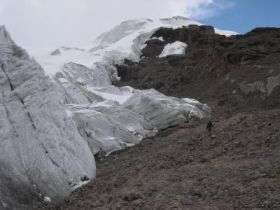
A University of Colorado at Boulder team working at 16,400 feet in the Peruvian Andes has discovered how barren soils uncovered by retreating glacier ice can swiftly establish a thriving community of microbes, setting the table for lichens, mosses and alpine plants.
The discovery is the first to reveal how microbial life becomes established and flourishes in one of the most extreme environments on Earth and has implications for how life may have once flourished on Mars, said Professor Steve Schmidt of CU-Boulder's ecology and evolutionary biology department. The study also provides new insights into how microorganisms are adapting to global warming in cold ecosystems on Earth.
A paper on the subject was published online Aug. 27 in the Proceedings of the Royal Society B, the United Kingdom's national academy of science. Co-authors included CU-Boulder's Sasha Reed, Diana Nemergut, Stuart Grandy, Andrew Hill, Elizabeth Costello, Allen Meyer, Jason Neff and Andrew Martin as well as the University of Montana's Cory Cleveland and the University of Toledo's Michael Weintraub.
The researchers found that three species of a photosynthetic microbe known as cyanobacteria colonized the soil within the first year, either by dropping in from tiny pockets of dirt wedged in the receding glacier or blowing in as spores. Just three years later there were 20 different species of bacteria, growing by snatching gaseous forms of carbon and nitrogen from the atmosphere, Schmidt said.
"The most startling finding was how much the diversity increased in just four years in what was seemingly barren soil," said Schmidt, whose study was funded by the National Science Foundation's Microbial Observatories Program. The CU-Boulder team conducted their research from 2000 to 2005 on the Puca Glacier in Peru -- which is receding uphill about 60 feet a year -- by collecting samples and measuring soil chemistry and strength.
In 2005, Schmidt's group was awarded a five-year, $1.75 million NSF grant to identify and analyze a potpourri of microbes new to science residing in harsh, cold climates around the world. The team is using a novel technique that extracts DNA from the soil to pinpoint new groups of microbes and polymerase chain reaction, or PCR, to amplify and identify them, providing a snapshot of the microscopic diversity in high alpine regions.
Another unexpected finding on the Puca Glacier was how microbes stabilized the soil and prevented erosion on the slope by using their filament-like structure to weave soil particles together in a matrix, Schmidt said. The CU-Boulder researchers also found the microbes excrete a glue-like sugar compound to further bond soil particles.
In addition, they discovered that nitrogen fixation rates -- the process in which nitrogen gas is converted by bacteria into compounds in the soil like ammonia and nitrate -- increased by about 100-fold in the first five years. "Overall, our results indicate that photosynthetic and nitrogen-fixing bacteria play important roles in acquiring nutrients and facilitating ecological succession in soils near some of the highest-elevation receding glaciers on Earth," wrote the team in Proceedings of the Royal Academy.
Global climate change has accelerated the pace of glacial retreat in high latitude and high-elevation environments, exposing lands that have been devoid of vegetation for centuries or millennia, said Schmidt. He likened the high Andes to the harsh Dry Valleys of Antarctica, under study by researchers from NASA's Astrobiology Institute because of hostile conditions believed to be similar to those on portions of Mars.
"This kind of research should help us understand how the cold regions of Earth function, and how the biosphere will respond to future climate change," said Schmidt. The research also could lead to the discovery of new antibiotics, as well as industrial enzymes that function at cold temperatures and could be used to drive chemical reactions normally requiring large amounts of heat, he said.
Because of rapid climate change at high elevations, time is of the essence for researchers at CU-Boulder and elsewhere working on tiny organisms in extreme environments. "We are racing to identify new species and archive them in the laboratory before bigger changes occur and they disappear," said Schmidt.
Source: University of Colorado at Boulder


