Real-life robots obey Asimov’s laws
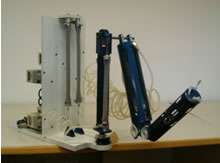
(PhysOrg.com) -- European researchers have developed technology enabling robots to obey Asimov’s golden rules of robotics: to do no harm to humans and to obey them.
Issac Asimov, widely regarded as the spiritual father of science fiction, outlined three rules that all robots in his future worlds must obey. The most important two were: a robot may not injure a human being or, through inaction, allow a human being to come to harm; and a robot must obey orders given to it by human beings, except where such orders would conflict with the First Law.
However, robotics in the real world has trouble striking a workable balance between these two requirements. Robots can perform tasks efficiently in controlled environments away from humans, or they can interact with humans if properly equipped with sensors to avoid any harm. But that degree of ‘sensing’ also creates complexity and a lack of robustness to hardware and software failures which, in turn, affects safety. Of course, robots could be safe if they move slowly enough, or work far away enough from humans – but then, their dexterity and effectiveness are dramatically reduced.
“Despite the scenarios science fiction has been depicting for decades of concrete human-robot interactions, we are still a long way from that reality,” says Antonio Bicchi of the University of Pisa’s Faculty of Engineering. “Most robots today can only work safely if segregated from humans, or if they move very slowly. The trade-off between safety and performance is the name of the game in physical human-machine interactions.”
Building solid Phriendships
Bicchi coordinates the EU-funded Phriends project to create a new generation of robots which is both intrinsically safe and versatile enough to interact with humans. “The most revolutionary and challenging feature of Phriends is designing and building robots capable of guaranteeing safety in physical human-robot interactions (pHRI),” the robotics specialist explains.
For Phriends, safety means ensuring no accidents occur, even in the event of programming bugs, sensor glitches, or hardware and software failure. But creating a robot that is both completely safe and can perform useful functions requires what Bicchi calls a “paradigm shift” in approach.
This involved going back to the drawing board and rethinking how robots are designed and function. “The classical robotics approach is to design and build robots with a specific task in mind,” Bicchi notes. “The robots developed by Phriends will be intrinsically safe, since the safety is guaranteed by their very physical structure, and not by external sensors or algorithms that can fail.”
The project has worked on developing new actuators – the devices which move and control the robot – concepts and prototypes; new dependable algorithms for supervision and planning; as well as new control algorithms for handling safe human-robot physical interactions. These components are then integrated into functionally meaningful subsystems, and evaluated and tested empirically. The project is also contributing to ongoing international efforts to establish new standards for collaborative human-robot operation.
Flexing design muscle
Before we get carried away at the idea of having android friends and colleagues working beside us at the office or even at home, it should be pointed out that Phriends is taking what could be described as a one limb at a time approach.
The project’s main focus is on robot arms and the partners have turned to nature for inspiration in developing a prototype Variable Stiffness Actuator (VSA). Just as human and animal muscles move in opposite directions to move limbs, the VSA achieves simultaneous control of the robot arm by using two motors antagonistically to manipulate a non-linear spring which acts as an elastic transmission between each of the motors and the moving part.
One of the Phriends partners, the E Piaggio Centre for Robotics and Bioengineering at the University of Pisa (IT) has developed a second version of the VSA which uses a more sophisticated antagonistic concept to move robot joints directly.
“This approach makes the robot arm lighter because its structure is ‘soft’ when the robot moves fast and can collide with humans, and it becomes ‘hard’, or tensed, when performing tasks requiring precision,” describes Bicchi.
Crash courses in safety
Phriends, which received more than €2 million in funding from the EU’s Sixth Framework Programme for research, has followed both a proactive and reactive approach to accidents. It has designed its robots to anticipate potential collisions with humans and avoid them. But in the unpredictable world we live in accidents will happen, and collisions may occur anywhere along the arm.
Two of the project’s partners – DLR in Germany and the University of Rome in Italy – have developed an ingenious solution which, like humans, relies on ‘proprioception’ to determine the relative position of neighbouring components using special sensors. Such ‘self-awareness’ enables the robot to react promptly to collisions or crashes and resume safe operations.
But even a rapid correction may be no good if the robot is heavy and solid, as industrial arms traditionally are. Phriends has explored a number of ways to make impacts gentler, including lightweight robot design, soft visco-elastic covering on the links, and mechanically decoupling the heavy motor inertia from the link inertia.
Shockingly complex simplicity
In the greater scheme of things, Phriends is one small step for robotics, but one massive leap for pHRI. “The real challenge for the future of robotics is not to do something shockingly complex, but to do even simple things in a way that is safe, dependable, and acceptable to ordinary people, thus making human-robot coexistence possible,” remarks Bicchi. “The economic impact of safe and dependable robots in manufacturing is huge in terms of simplifying plant layouts, increasing the productivity of workers and machines, and for overall competitiveness.”
The project has already elicited industry interest. Germany’s Kuka Robotics, one of the world’s leading manufacturers of industrial robots, is a partner in Phriends. Kuka will release a new robot arm in 2008 which incorporates some features developed by Phriends.
Outside the EU, companies in Japan and South Korea, which are also working on similar technologies, have contacted Phriends requesting their assistance in developing new technologies and products.
The technology the project has developed also has potential applications in other fields, including in sports training and physical rehabilitation.
Provided by ICT Results


