'Omnivorous engine' hopes to run on many fuels
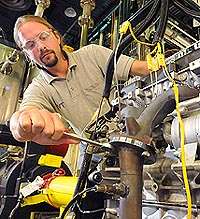
(PhysOrg.com) -- The 'omnivorous engine' is no picky eater. Gasoline? Down the hatch. Ethanol? Butanol? It'll slurp those up too. The creators of the omnivorous engine, engineers at the U.S. Department of Energy's Argonne National Laboratory, seek to fashion an engine that can run on just about any type of spark-ignited fuel.
Unlike regular automobile engines, which typically run solely on gasoline or, in rare instances, on a blend of gasoline and ethanol, the omnivorous engine would be able to run on any blend of conventional gasoline, ethanol or butanol, another organic alcohol that scientists are beginning to consider as a potential biofuel. Even more significantly, the omnivorous engine would use a suite of sensors to calibrate itself so that it burns available fuel as efficiently as possible.
Since the Ford Model T, the first car built to run on both gasoline and ethanol, automakers have introduced a variety of these flexible-fuel vehicles, or FFVs. Since both gasoline and ethanol engines rely on a spark plug to ignite the air-fuel mixture, it doesn't take a lot of effort to equip an engine to burn both kinds of fuel, according to mechanical engineer Thomas Wallner of Argonne's Energy Systems Division.
"Just because an engine is compatible with different fuels doesn't mean that it has the ability to run at peak efficiency regardless of the fuel mixture," Wallner said. "That's where the benefits of the omnivorous engine lie."
According to Wallner, all single-fuel and most flex-fuel engines are typically calibrated to run on a single, usually all-gasoline, fuel source. To calibrate an engine, engineers and auto manufacturers typically tune the engine for several variables, including the amount of fuel injected into the engine per cycle, the time at which the fuel is injected and the timing of the igniting spark.
Each of these parameters will have different optimum values for different fuel blends, Wallner said. Without an omnivorous engine, cars cannot adapt themselves independently to other fuel concentrations and therefore cannot maximize fuel economy.
"If you just ran on a blend of gasoline and ethanol, it wouldn't be too difficult to find out just what proportions of each you have in your tank," Wallner said. "But if you want to add some butanol in there, discovering how to efficiently burn that whole medley of fuels becomes a much more challenging task."
"The ultimate goal is not to know what's in the tank, but to have it run as efficiently as possible on whatever comes down the fuel line," he added. "This engine can run on pretty much any liquid fuel that can be ignited with a spark."
Instead of examining the contents of the fuel tank, the omnivorous engine will use a suite of different sensors to evaluate the characteristics of the combustion inside the engine as well as its chemical signature, or ionization. If these sensors determine that the engine is not running at peak efficiency, the engine controller will make adjustments to several parameters, including injection strategy and spark timing.
The proposed approach is also relatively simple and cost-effective, Wallner said, enabling the rapid commercialization of the omnivorous engine. The omnivorous engine will run efficiently on a wide range of liquid fuels while running especially well on biofuels, giving the consumer an incentive to use fuels other than gasoline.
The omnivorous engine would benefit the U.S. economy by reducing dependence on foreign oil while increasing the demand for domestically produced biofuels. "The American public will benefit from engines that perform better and that can switch between a wide variety of fuels based on their availability," said Steve McConnell, one of the principal investigators on the omnivorous engine project at Argonne.
The omnivorous engine represents one of several new vehicle technologies in Argonne's Center for Transportation Research, where Wallner and his colleagues work. Research on the "omnivorous engine" was originally supported by resources from Argonne's Laboratory-Directed Research and Development program and is now supported by the Vehicle Technologies Program in the Department of Energy's Office of Energy Efficiency and Renewable Energy.
Provided by Argonne National Laboratory


