Researchers showcase automated bus that uses magnets to steer through city streets
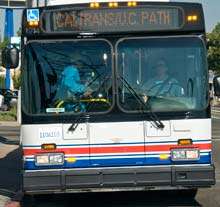
(PhysOrg.com) -- The thought of a bus moving along city streets while its driver has both hands off the wheel is alarming. But a special bus introduced today (Friday, Sept. 5), steered not by a driver, but by a magnetic guidance system developed by engineers at the University of California, Berkeley, performed with remarkable precision.
The 60-foot research bus was demonstrated along a one-mile stretch of E. 14th Street in San Leandro that was embedded with a series of magnets. Special sensors and processors on board the bus detected the magnets in the pavement and controlled the steering based upon the information it received. The driver maintained control of braking and acceleration, but the steering was completely automated, allowing the bus to pull into stops to within a lateral accuracy of 1 centimeter, or about the width of an adult pinky finger.
Researchers say such precision docking would help shave precious seconds off of the time to load and unload passengers at each stop, adding up to a significant increase in reliability and efficiency over the course of an entire bus route. For example, precision docking could potentially negate the need to deploy wheelchair ramps and make passenger queuing more efficient.
Moreover, the ability to more precisely control the movement of the bus reduces the width of the lane required for travel from 12 feet - the current standard - to 10 feet, researchers say.
The California Department of Transportation (Caltrans) has provided $320,000 to fund this Automated Bus Guidance System demonstration project, conducted by the California Partners for Advanced Transit and Highways (PATH) program based at UC Berkeley.
"Today's demonstration marks a significant step in taking the technology off of the test track at UC Berkeley's Richmond Field Station towards deployment onto real city streets," said Wei-Bin Zhang, PATH transit research program leader at UC Berkeley. "We have seen increasing interest among transit agencies in this technology because of its potential to bring the efficiency of public bus service to a level approaching that of light rail systems, but at a much lower overall cost."
California PATH researchers have been studying magnetic guidance systems as a means of controlling vehicle movement for nearly 20 years with significant funding from Caltrans and the U.S. Department of Transportation. They have showcased how the technology can control a platoon of passenger cars speeding along high occupancy vehicle (HOV) lanes in Southern California, as well as industrial vehicles such as snowplows and tractor trailers in Northern California and Arizona. Today's test run along E. 14th Street marks the first application of magnetic guidance technology for use in transit buses on a public road.
"It is our mission to improve mobility across California, and maximizing transportation system performance and accessibility through this technology helps us to achieve our mission," said Larry Orcutt, chief of the Caltrans Division of Research and Innovation. "The rising cost of fuel has created greater interest in public transit. This technology could convince more people to get out of their cars and onto buses, and as a result, reduce congestion."
In the system demonstrated today, sensors mounted under the bus measured the magnetic fields created from the roadway magnets, which were placed beneath the pavement surface 1 meter apart along the center of the lane. The information was translated into the bus's lateral and longitudinal position by an on-board computer, which then directed the vehicle to move accordingly. For a vehicle traveling 60 miles per hour, data from 27 meters (88 feet) of roadway can be read and processed in 1 second.
Zhang added that the system is robust enough to withstand a wide range of operating conditions, including rain or snow, a significant improvement to other vehicle guidance systems based upon optics. Researchers also pointed out that magnetic guidance technology allows for a bus to safely follow closely behind another. Extra vehicles, much like extra cars on light rail trains, could thus be added during peak commute times.
In the E. 14th Street demonstration, the magnetic guidance system was only used to control the steering for the bus, but on test tracks it has been used for full vehicle control - including braking and accelerating - creating a true "auto-pilot" system for the bus. At any time, the driver can resume manual control of the bus.
Potential applications for the system include automating bus passage through narrow tollbooths and vehicle routing in bus maintenance yards. The system could be integrated into traditional bus routes, as shown on E. 14th Street, or used as part of more advanced bus rapid transit (BRT) systems that could include a dedicated traffic lane. Many cities throughout the world, including 20 in the United States, have deployed some form of BRT, although only a few include dedicated bus-only lanes.
Today's demonstration included a special industry presentation attended by dozens of representatives from California transit agencies interested in whether PATH's magnetic guidance technology might fit with their own BRT plans.
On some routes in the Bay Area, AC Transit currently operates a version of bus rapid transit that includes electronic signs informing riders of when to expect the next bus. However, the transit agency is currently in the midst of preparing an Environmental Impact Report for a proposed BRT project that could include bus-only lanes along an 18-mile stretch from downtown Berkeley near the UC Berkeley campus south to San Leandro's Bay Fair BART station.
"AC Transit is a leader promoting advanced technologies for transit buses. As such, we are continually investigating new technologies to improve the performance, safety and comfort of buses," said Chris Peeples, president of AC Transit's board of directors. "The magnetic guidance system developed at UC Berkeley can both improve safety and provide a smoother ride for our passengers. The system has the potential to make bus rapid transit routes - particularly those that involve bus-only lanes - as efficient as light rail lines, which in turn will make buses more effective in getting people out of their cars."
AC Transit puts the cost of its BRT proposal at $273 million, while a comparable light rail system would cost around $2 billion. Zhang said that adding the magnetic guidance technology to AC Transit's proposed BRT project would help it run more like a light rail system for an additional $5 million. The Valley Transportation Agency has also compared the costs of BRT and light rail systems for its planned Santa Clara Alum Rock Transit Improvement Project. The estimated cost for BRT came in at $128 million, compared with $393 million for light rail.
AC Transit is joining Caltrans and the U.S. Department of Transportation in funding the next stage of the Automated Bus Guidance System project as it becomes part of the federal Vehicle Assist and Automation Program. The project will expand to AC Transit routes along Interstate 880 and the San Mateo Bridge, and to a dedicated BRT route in Eugene, Ore.
"Ultimately, it's up to the community to decide which transit option is best for its members," said Zhang. "Our job is to develop the technology that can help improve whatever form of transportation is used."
Provided by UC Berkeley


