Valley networks on Mars formed during long period of episodic flooding
September 8, 2008 Valley networks on Mars formed during long period of episodic flooding

Enlarge

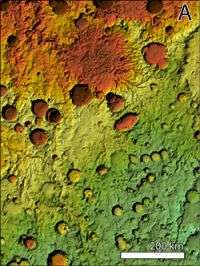
Ancient river-like features called valley networks carve the surface of Mars, as seen in the image above of the Parana Valles, which cuts across a region roughly the size of California. The images below show results from computer models used to simulate erosion of the valleys under different climate scenarios.

(PhysOrg.com) -- A new study suggests that ancient features on the surface of Mars called valley networks were carved by recurrent floods during a long period when the martian climate may have been much like that of some arid or semiarid regions on Earth. An alternative theory that the valleys were carved by catastrophic flooding over a relatively short time is not supported by the new results.

Often cited as evidence that Mars once had a warm environment with liquid water on the surface, valley networks are distinctive features of the martian landscape. In the new study, researchers used sophisticated computer models to simulate the processes that formed these features.

"Our results argue for liquid water being stable at the surface of Mars for prolonged periods in the past," said Charles Barnhart, a graduate student in Earth and planetary sciences at the University of California, Santa Cruz.

Barnhart conducted the study as a Graduate Student Research Program scholar at NASA Ames Research Center, working with NASA planetary scientist Jeffrey Moore and Alan Howard of the University of Virginia. A paper describing their findings has been accepted for publication in the Journal of Geophysical Research--Planets and is currently available online.

"For several decades, scientists worked to determine whether or not there had ever been precipitation on Mars. Only in the last 10 years has NASA acquired high-resolution topographic data that cinched the case for massive ancient erosion from precipitation and runoff," Moore said.

Scientists estimate that the valley networks on Mars were carved out more than 3.5 billion years ago. Studies based on climate models have suggested that catastrophic events such as asteroid impacts could have created warm, wet conditions on Mars, causing massive deluges and flooding for periods of hundreds to thousands of years.

But the new study shows that those conditions would result in features not seen in the martian landscape, because water would accumulate inside craters and overflow, carving exit breaches that cut through the crater walls, Barnhart said.

"Our research finds that these catastrophic anomalies would be so humid and wet there would be breaching of the craters, which we don't see on Mars," he said. "The precipitation needs to be seasonal or periodic, so that there are periods of evaporation and infiltration. Otherwise the craters overflow."

The researchers used a landform evolution model to simulate how the surface of Mars would evolve under different climate conditions. They ran more than 70 simulations under varied conditions and performed statistical analyses to determine which yielded the best match to the observed topography of martian valleys.

The results suggest that valley networks formed on Mars during a semiarid to arid climate that persisted for tens of thousands to hundreds of thousands of years. Episodic flooding alternated with long dry periods when water could evaporate or soak into the ground. Rainfall may have been seasonal, or wet intervals may have occurred over longer cycles. But conditions that allowed for the presence of liquid water on the surface of Mars must have lasted for at least 10,000 years, Barnhart said.

"Precipitation on Mars lasted a long time--it wasn't a brief interval of massive deluges," he said.

Provided by University of California - Santa Cruz


print this article email this article download pdf blog this article bookmark this article     Stumble it Digg this share on Facebook retweet share on Reddit add to delicious
Rate this story - 4.6 /5 (14 votes)

Rank Filter

Move the slider to adjust rank threshold, so that you can hide some of the comments.


Display comments: newest first

  • D666 - Sep 09, 2008
    • Rank: not rated yet
    I find it hard to believe that any surface feature carved out 3.5 billion years ago would still be there. Mars *does* have an atmosphere and weather (if only barely), and even the day/night expansion/contraction cycle would eventually wear things down, given that amount of time.

September 8, 2008 all stories

Comments: 1

4.6 /5 (14 votes)
  • Stumble this up

  • Digg this

  • share this

  • hide
  • Related Stories


  • hide
  • Relevant PhysicsForums posts

  • Telescope Recommendations Anyone?
    created 2 hours ago
  • Uranus' satellite Miranda question
    created Dec 07, 2009
  • black dwarf sun
    created Dec 06, 2009
  • Question about c = vλ
    created Dec 05, 2009
  • More from Physics Forums - General Astronomy

Other News

Mars

Life on Mars theory boosted by new methane study

Space & Earth / Space Exploration

created 10 hours ago | popularity 4.8 / 5 (14) | comments 4

Scientists have ruled out the possibility that methane is delivered to Mars by meteorites, raising fresh hopes that the gas might be generated by life on the red planet, in research published tomorrow in Earth an ...


Hubble's deepest view of universe unveils never-before-seen galaxies

Hubble's Deepest View of Universe Unveils Never-Before-Seen Galaxies (w/ Video)

Space & Earth / Astronomy

created 13 hours ago | popularity 4.7 / 5 (27) | comments 16

(PhysOrg.com) -- In 2004, Hubble created the Hubble Ultra Deep Field (HUDF), the deepest visible-light image of the Universe, and now, with its brand-new camera, Hubble is seeing even farther. This image was ...


Absence of evidence for a meteorite impact event 13,000 years ago

Absence of evidence for a meteorite impact event 13,000 years ago

Space & Earth / Earth Sciences

created 13 hours ago | popularity 4.4 / 5 (8) | comments 10

An international team of scientists led by researchers at the University of Hawaii at Manoa have found no evidence supporting an extraterrestrial impact event at the onset of the Younger Dryas ~13000 years ...


Aussie galaxy survey to lead to 'new physics'

Aussie galaxy survey to lead to 'new physics'

Space & Earth / Astronomy

created 8 hours ago | popularity 4.5 / 5 (10) | comments 2

(PhysOrg.com) -- Australian astronomers have released the first set of data from the first project to look at the effects of "dark energy" halfway back in the Universe's lifetime.


UN: 2000-2009 likely warmest decade on record (AP)

UN: 2000-2009 could be Earth's warmest decade ever

Space & Earth / Environment

created 16 hours ago | popularity 3.6 / 5 (7) | comments 9

(AP) -- A leaked Danish document at the U.N. climate conference provoked angry criticism Tuesday from developing countries who feared it would shift more of the burden to curb greenhouse gases on poorer countries.