Toward improved antibiotics using proteins from marine diatoms
September 8, 2008 Toward improved antibiotics using proteins from marine diatoms

Enlarge

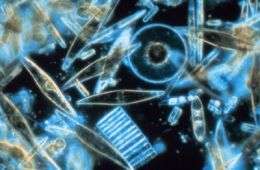
Researchers report a step toward development of a new type of antibiotic using proteins from marine diatoms. The above diatoms were living between crystals of sea ice in McMurdo Sound, Antarctica. Credit: NOAA

Researchers in Florida are reporting an advance toward tapping the enormous potential of an emerging new group of antibiotics identical to certain germ-fighting proteins found in the human immune system. Their study, which may help fight the growing epidemic of drug-resistant infections, is in the current (August) issue of ACS' Biomacromolecules.

In the new study, D. Matthew Eby, Glenn Johnson, and Karen Farrington point out that scientists have long eyed the germ-fighting potential of antimicrobial peptides (AMPs).

These small proteins fight a wide range of bacteria and fungi in the body and have the potential to be developed into powerful drugs to overcome infections that are resistant to conventional drugs. But scientists report difficulty producing effective AMPs because the antibiotics are fragile and easily destroyed in the body. An effective way to stabilize them is needed, they say.

In laboratory studies, the researchers showed that the coating protected the antibiotics from destruction by other chemicals while allowing the release of a controlled antibiotic dose for an extended period of time. These features are key to the effective use of AMPs as antibiotics, they say.

Article: "Synthesis of Bioinorganic Antimicrobial Peptide Nanoparticles with Potential Therapeutic Properties", http://dx.doi.org/10.1021/bm800512e

Source: ACS


print this article email this article download pdf blog this article bookmark this article     Stumble it Digg this share on Facebook retweet share on Reddit add to delicious
Rate this story - 5 /5 (2 votes)


September 8, 2008 all stories

Comments: 0

5 /5 (2 votes)
  • Stumble this up

  • Digg this

  • share this

  • hide
  • Related Stories


Other News

Accidental discovery produces durable new blue pigment for multiple applications

Accidental discovery produces durable new blue pigment for multiple applications

Chemistry / Biochemistry

created 5 hours ago | popularity 5 / 5 (3) | comments 3

An accidental discovery in a laboratory at Oregon State University has apparently solved a quest that over thousands of years has absorbed the energies of ancient Egyptians, the Han dynasty in China, Mayan ...


Scientists guide immune cells with light and microparticles

Scientists guide immune cells with light and microparticles (w/ Video)

Chemistry / Biochemistry

created 5 hours ago | popularity 5 / 5 (2) | comments 0

A team led by Yale University scientists has developed a new approach to studying how immune cells chase down bacteria in our bodies. Their findings are described in the November 15 issue of Nature Methods Advanc ...


Biodiesel

Genome Engineering Could Provide New Method of Creating Biodiesel

Chemistry / Biochemistry

created 8 hours ago | popularity 3.8 / 5 (5) | comments 0

When we think of genetic engineering, our minds often jump to giant tomatoes and animal cloning. However, this is not always the case.


Tiny particles can deliver antioxidant enzyme to injured heart cells

Tiny particles can deliver antioxidant enzyme to injured heart cells

Chemistry / Polymers

created 12 hours ago | popularity 5 / 5 (1) | comments 0

Researchers at Emory University and the Georgia Institute of Technology have developed microscopic polymer beads that can deliver an antioxidant enzyme made naturally by the body into the heart.


Tiny bubbles clean oil from water

Tiny bubbles clean oil from water

Chemistry / Materials Science

created 15 hours ago | popularity 4 / 5 (3) | comments 0

Small amounts of oil leave a fluorescent sheen on polluted water. Oil sheen is hard to remove, even when the water is aerated with ozone or filtered through sand. Now, a University of Utah engineer has developed ...