An accurate speedometer for astronomy
Events on a cosmic scale are often barely discernable on Earth. This explains why astronomers are currently not able to prove directly that the universe is expanding at an ever increasing rate, nor can they search for planets that are roughly the same size as Earth and revolve around a sun-like star.
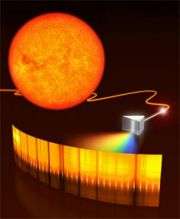
An international team of researchers working with staff at the Max Planck Institute of Quantum Optics has now tested a measurement method that will allow such measurements to be carried out. The scientists use a frequency comb to determine the colour of the light emitted by a celestial body with great accuracy. In a frequency comb, spectral lines, whose colour can be very accurately determined, are lined up in sequence.
The physicists then compare these spectral lines with the spectrum of astronomical sources. Their aim for the future is to use this method to determine velocity changes of astronomical bodies with an accuracy of one centimetre per second. This would make their method a thousand times more precise than the methods currently available, and would enable them to search for Earth-like planets or to test whether the expansion of the universe really is accelerating. (Science, September 5, 2008)
Planets outside of our solar system give themselves away only indirectly: As they revolve around their own particular star, the star experiences repulsion, and moves closer to or away from Earth in a periodic motion. Astronomers can measure this using the Doppler Effect: In the same way that the pitch of an ambulance siren seems to be higher when it is approaching than when it is driving away, the light of a moving star also shifts. If it is approaching, its light seems to shift towards blue; if it is moving away, it seems to be redder. Up until now, this method has only enabled the detection of planets the size of Jupiter or Saturn; only these exert a strong enough pull on their sun that the Doppler shift of its light is measurable on Earth.
Using the frequency comb, the scientists were able to determine the colour of the starlight much more accurately. "We are hoping that we will then even be able to measure shifts of one centimetre per second," says Thomas Udem, who heads the project at the Max Planck Institute of Quantum Optics in Garching, Germany. "At present, astronomers can only observe the Doppler effect for stars moving towards or away from Earth at a speed of ten meters per second. As a comparison: Earth gives the Sun a push of ten centimetres per second. This is ridiculously slow compared to the speed of 220 kilometres per second with which the Sun revolves around the centre of our galaxy."
The improved measurement accuracy could also help to determine whether the expansion of the universe is speeding up within a period of ten years or so. This is a conclusion drawn from the measurement of the cosmic microwave background. If the measured microwave spectrum is inserted into the equations of the theory of general relativity (which are assumed to be valid), this acceleration is obtained, if a mysterious dark energy constitutes the greater part of the energy in the universe. However, there is, as yet, no direct proof that the expansion of the universe really is accelerating. With the measurement accuracy that is currently achievable, astronomers would have to wait several thousand years to measure this predicted effect on a suitable object in space. "If we are not able to measure this, we must either reject or expand the theory of general relativity which, in contrast to the theory of special relativity, has not been well tested experimentally as yet," says Thomas Udem.
The frequency comb, for whose development Theodor Hänsch, Director at the Institute in Garching, was awarded the 2005 Nobel Prize, is expected to enable scientists to achieve this new measurement accuracy. In a frequency comb, physicists split up a laser beam into a series of spectral lines whose frequencies, that is colours, they can measure very accurately. "This depends only on the accuracy of the atomic clock, which is used to count the frequencies," explains Udem. "Even low-cost atomic clocks are sufficient for astronomical applications." The scientists then compare the spectrum of a star or other object they are measuring with the frequency comb. This enables them to calibrate the spectrograph, which analyzes the light of the object according to its different colour components. The instabilities from which even the best spectrographs suffer mean that two spectrographic measurements of one star will produce two slightly different spectra, even when the light from the star has not changed at all. "Since we know precisely where the lines of the frequency comb are, we can compensate for these variations in the measurements and thus drastically increase our measurement accuracy," says Thomas Udem.
Up to now, the team of scientists has used this new measurement method to correct instabilities of the spectrograph so that the velocity of an observed object seems only to vary by nine meters per second. This in itself is already a little better than the present standard. "We've only carried out the test with a solar telescope, which is not designed for this purpose at all," says Udem. Some telescopes, however, achieve results that are already more than ten million times more stable, even without any calibration whatsoever. And the Garching-based researchers also want to use such telescopes in the future. Moreover, the scientists have so far only used a frequency comb with a few hundred teeth. "We can, however, perform measurements using several tens of thousands of teeth," says to Udem. "We are therefore very confident that, with an optimum setup, we can even measure velocity variations of one centimetre per second."
Citation: Tilo Steinmetz, et al., Laser Frequency Combs for Astronomical Observations
Science, September 5, 2008 [DOI: 10.1126/science.1161030]
Source: Max-Planck-Gesellschaft


