Professor-turned-producer learns the movie biz
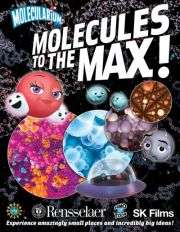
It's not every day that a research scientist and university professor gets to see his work on the silver screen. But in just a few months, Richard W. Siegel will get to watch his name scroll down the giant screen of a darkened IMAX theater with a new title that seems light years away from laboratory benches and lecture halls: Executive Producer.
The film, "Molecules to the MAX," has been a three-year labor of love for Siegel. From securing funding and hiring a production company to negotiating post-production and distribution deals, Siegel has been a champion and a driving force behind the newest Molecularium movie. His enthusiasm and vision have touched nearly every aspect of the 40-minute film, which is set to be previewed for the first time this week.
"It's been quite a ride, and we're thrilled to introduce our new movie to the world," Siegel said.
A world-renowned nanotechnology pioneer, Siegel is the Robert W. Hunt Professor of Materials Science and Engineering at Rensselaer Polytechnic Institute, as well as director of the university's nanotechnology center. The unique perspective from the helm of the Molecularium project has put the lifelong researcher in the unlikely situation of vetting the precision and impact of this work not with journal editors and peer-reviewers, but with an even cannier audience – his grandchildren.
And so far, the reception of Siegel's grandkids and the children of colleagues to the latest exploits of Oxy, Hydro, Hydra, and other Molecularium characters as they get an up-close-and-personal view of the molecular landscapes of snowflakes, chewing gum, a penny, among other environs, has been outstanding.
But a more rigorous test will show itself this winter, when the completed film version of "Molecules to the MAX" debuts, and Siegel's objective shifts from creating a memorable, entertaining, and engaging film based on scientifically accurate molecular modeling and simulations, to marketing the film and filling IMAX and other giant-screen theaters with eager moviegoers.
Siegel is intrigued to see how "Molecules to the MAX" will fare not only against Hollywood blockbusters, but also against the growing cadre of sharks, dinosaurs, insects, historic sites, and heavenly bodies that have become the bread and butter of the giant-screen movie industry. Though Siegel concedes that "Molecules to the MAX" may not be on a trajectory to become the next "Star Wars" or "Finding Nemo," he is confident that the new film is poised for considerable long-term success – both in the entertainment world, and in fulfilling the project's paramount goal of boosting global science literacy.
The first barometer of this success will come this week, when Siegel and Jonathan Barker, president of "Molecules to the MAX" distributor SK Films, unveil a clip from the film at the Giant Screen Cinema Association's 2008 International Conference and Trade Show held in New York City. SK Films and Siegel will also hold private screenings of a digital version of the full movie for theater owners and other industry VIPs. These initial viewings will be important not only for drumming up a buzz, but for landing deals to show the film in giant-screen theaters across the country and around the world.
"I may be somewhat biased, but I think the completed show, with its high-quality visuals and sound, is going to excite the giant-screen industry," Siegel said.
A few years ago, the depth of Siegel's knowledge and experience of the film world was limited to watching the occasional movie. But after his experience as executive producer on "Molecules to the MAX," alongside fellow Molecularium project executive producers and Rensselaer professors Linda Schadler and Shekhar Garde, he can now talk shop with the best in the business. In addition to establishing a distribution relationship with SK Films, Siegel has successfully solicited the sound and film post-production skills, respectively, of industry pros Cory Mandel at Technicolor and Ampersand, as well as Patricia and David Keighley at DKP 70MM Inc. and IMAX Corp. Along the way, Siegel also became a charter member of the Giant Screen Cinema Association, which was solidifying as an organization just as Oxy, Hydra, and Hydro's new adventure was moving from the sketch pad to the storyboard.
"At first, I was totally inexperienced in the film world," Siegel said. "But I tackled the situation like I would any scientific or business problem: I did as much research as possible, and then I sought out the wisdom and advice of people who know more about the subject than anyone else."
Siegel's motivation for this self-imposed crash course in the movie biz is the same basic tenant at the very heart of the Molecularium project: the critical need for instilling young people of all ages with a passion for science and a lifelong yearning to learn more about the world around them.
Embedded in the fabric of every creative and strategic decision that Siegel, Schadler, and Garde made concerning "Molecules to the MAX" was the notion of "stealth education." At the end of the day, "Molecules to the MAX" is about educating viewers and raising public science literacy, Siegel said. But to make the movie an effective vehicle to propagate this important scientific and educational message, it was imperative that the team not allow the core properties of the medium – immersive, engaging entertainment – to take a back seat.
"After watching the movie, parents, children, and teachers all rave about the storyline, the characters, the songs, and the animation – they just love it," Siegel said. "But we've also done before-and-after assessments that prove viewers coming out of the theater know a great deal more about atoms and molecules in the world around them than they did before they experienced the movie. They learned without even trying. That's why we call it 'stealth education.'"
"Molecules to the MAX" and Molecularium are owned, funded, and managed by Rensselaer, with additional funding support from the U.S. National Science Foundation. Schadler, professor of materials science and engineering at Rensselaer with a career-long interest in science education outreach to young people, created the concept of Molecularium circa 2001. She worked to develop and expand it with Siegel and Garde, who is a computer modeling expert and head of Rensselaer's Department of Chemical and Biological Engineering. Molecularium has since become the flagship educational outreach project of Rensselaer's NSF-funded Nanoscale Science and Engineering Center for Directed Assembly of Nanostructures, which is led by Siegel.
Schadler, Garde, and Siegel released the first Molecularium movie, "Riding Snowflakes," in early 2005. This 23-minute digital show, created specifically to be shown in planetarium domes, is still in distribution worldwide and is currently in the process of being translated into several different languages. The award-winning movie has been lauded by both educators and science advocacy groups as a triumph. Director V. Owen Bush, producer Kurt Przybilla, and art director Chris Harvey of the "Riding Snowflakes" production company, now called Nanotoon Entertainment, returned to work on "Molecules to the MAX," but the quality, animation, and technology behind the new show far outstrips the first, Siegel said. The script for the new movie was created through a collaboration of executive producers Siegel, Schadler, and Garde, along with Bush and Przybilla.
When watching either movie, it's easy for viewers to overlook the fact that they're witnessing some of the largest and most complex scientific computations ever conducted. The background animations of atoms and molecules in "Riding Snowflakes" and "Molecules to the MAX" are derived from accurate, state-of-the-art theoretical molecular modeling simulations created in Garde's laboratory. Creating this hidden camera into the nanoscale universe required simulations massive in both scale and complexity. For the new movie, it took five computer-processing hours to render a single frame in normal resolution and 50 hours to render a frame in the high-definition IMAX format. Each second of the new 40-minute movie is composed of 24 such frames.
While launching "Molecules to the MAX" in giant-screen theaters this winter, Siegel will endeavor to bring Oxy, Hydra, and Hydro to the small screen. He and the group are in discussions to move the project forward and reach out to more people by bringing the new movie to television, creating new Molecularium shows for television, and also making all of the new and previously released Molecularium content available on a series of DVDs.
Promoting science literacy to the public is no easy task, Siegel said, but he and his colleagues are in it for the long haul.
"If you're doing something that makes a positive impact, it drives you to keep pushing that idea further to reach wider audiences, and pushing yourself to do better," Siegel said. "And nothing justifies all of the effort and hard work more clearly than catching a glimpse of a group of children who just watched our movie, and seeing the excitement in their eyes and hearing the thrill in their voices."
For more information on "Molecules to the MAX" and the Molecularium project visit: www.molecularium.com .
Source: Rensselaer Polytechnic Institute


