Computational Biochemist Uncovers Molecular Clue to Evolution
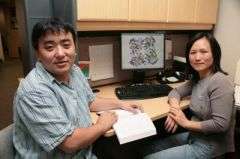
(PhysOrg.com) -- A Florida State University researcher who uses high-powered computers to map the workings of proteins has uncovered a mechanism that gives scientists a better understanding of how evolution occurs at the molecular level.
Such an understanding eventually could lead to the development of new and more effective antiparasitic drugs.
Wei Yang is an assistant professor in FSU’s Department of Chemistry and Biochemistry and a faculty member in the university’s Institute of molecular biophysics. Working with colleagues from FSU, Duke University and Brandeis University, he recently produced remarkable computer models of an enzyme that carries the unwieldy name of inosine monophosphate dehrydrogenase, or IMPDH for short. IMPDH is responsible for initiating certain metabolic processes in DNA and RNA, enabling the biological system to reproduce quickly.
“In creating these simulations of IMPDH, we observed something that hadn’t been seen before,” Yang said. “Previously, enzymes were believed to have a single ‘pathway’ through which they deliver catalytic agents to biological cells in order to bring about metabolic changes. But with IMPDH, we determined that there was a second pathway that also was used to cause these chemical transformations. The second pathway didn’t operate as efficiently as the first one, but it was active nevertheless.”
Why would an enzyme have two pathways dedicated to the same task? Yang and his colleagues believe that the slower pathway is an evolutionary vestige left over from an ancient enzyme that evolved over eons into modern-day IMPDH.
The finding is significant for several reasons, Yang said.
“First of all, this offers a rare glimpse of evolutionary processes at work on the molecular level,” Yang said. “Typically when we talk about evolution, we’re referring to a process of adaptation that occurs in a population of organisms over an extended period of time. Our research examines such adaptations at the most basic level, which helps scientists to develop a fuller picture of how evolution actually occurs.
“This also represents a big step forward in our efforts to create computational simulations of biological processes,” Yang said. “In this case, we first made a prediction of the enzyme structure via computer and later verified it through direct observation in a laboratory, rather than the other way around. This is a most unusual accomplishment, and one that indicates we are becoming more advanced in our ability to answer questions relating to biological functions at the molecular level.”
“Because of the key role that IMPDH plays, scientists have focused on developing new antiparasitic drugs that target it,” Yang said. “Our research will certainly contribute to this process.”
Joseph Schlenoff, the chairman of FSU’s Department of Chemistry and Biochemistry, praised Yang’s computational methods as “extremely powerful because they are rigorous, make few assumptions and approximate the complexity of the real world. The accurate predictions that result represent success that has been promised to us for so long by scientists using computers.”
Collaborating with Yang on the project were Gavin J.P. Naylor, an associate professor in FSU’s Department of Scientific Computing; Donghong Min, a postdoctoral associate in the Institute of Molecular Physics; Hongzhi Li, a former postdoc in the Institute of Molecular Physics; Clemens Lakner, a graduate assistant in the Department of Biological Science; David Swofford, a research scientist at Duke University and former FSU faculty member; Lizbeth Hedstrom, a professor of biochemistry at Brandeis University; and postdocs Helen R. Josephine and Iaian S. MacPherson, both of Brandeis.
Together the researchers wrote about their findings in a paper, “An Enzymatic Atavist Revealed in Dual Pathways for Water Activation,” that was published this summer in PLoS Biology, a peer-reviewed, open-access journal published by the Public Library of Science. Visit biology.plosjournals.org/perls … journal.pbio.0060206 to read the paper .
Dan Herschlag, a professor of biochemistry at Stanford University, edited the paper for PLoS Biology. He praised it for its innovative approach.
“This work reveals basic aspects of how enzymes work and how they have evolved,” Herschlag said. “The study melds experiment and computation in a powerful fashion and represents a model for how to use interdisciplinary research to answer important questions.”
Provided by Florida State University


