Gap junction protein vital to successful pregnancy, researchers find
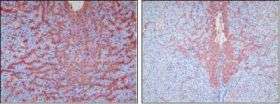
September 10, 2008 Blood Vessel Growth with and Without Connexin 43

Enlarge

Deleting the Cx43 gene in the uterus immediately after pregnancy in mice dramatically reduced blood vessel growth and in most cases prevented successful pregnancy. The image on the left shows normal blood vessel growth in the mouse uterus following pregnancy. On the right, a uterus lacking Cx43. Photo by Mary J. Laws

Researchers studying a critical stage of pregnancy – implantation of the embryo in the uterus – have found a protein that is vital to the growth of new blood vessels that sustain the embryo. Without this protein, which is produced in higher quantities in the presence of estrogen, the embryo is unlikely to survive.

This is the first study to detail the mechanism by which the steroid hormone estrogen spurs cell differentiation and blood-vessel growth in the uterus during pregnancy, the researchers report.

The findings, from researchers at the University of Illinois, Emory University, Baylor College of Medicine and New York University, appear in the journal Development.

Connexin 43 (Cx43) belongs to a family of proteins that form junctions between cells that regulate the flow of ions and small signaling molecules from cell to cell. At the time of embryo implantation, this gap junction protein is essential to the rapid growth of new blood vessels needed to support the development of the embryo and allow it to implant in the uterine wall, the researchers discovered.

The researchers chose to study Cx43 after analyzing genes that are activated in the presence of estrogen in uterine cells. They found that Cx43 was prominent among the genes whose expression was increased in cells after exposure to estrogen.

University of Illinois veterinary biosciences doctoral student Mary Laws studied the role of Cx43 in pregnant mice and in human endometrial cells. By deleting the Cx43 gene in the uterus immediately after pregnancy in mice, a technique developed by researchers at Baylor, Laws was able to reliably prevent implantation of the embryo in the uterus.

In human endometrial cells (provided by co-author Robert Taylor of Emory University), Cx43 enhanced the differentiation of cells that make up the stromal tissue of the uterus. These cells produce factors that promote the growth of new blood vessels.

One of the factors secreted by the endometrial cells, vascular endothelial growth factor (VEGF), is essential to angiogenesis. In the absence of Cx43, Laws found, the cells failed to differentiate or to produce enough VEGF to spur blood vessel growth.

"The formation of these new blood vessels is extremely critical for embryonic growth at this stage of pregnancy, when the embryo has begun to invade into the uterine tissue, but has yet to make a connection to the placenta where it ultimately gets its nutrients," said Illinois veterinary biosciences professor Indrani Bagchi, corresponding author on the study. "I think this is the first animal model that shows that disruption of one particular molecule or gene leads to a defect in uterine angiogenesis."

The findings have important implications for early pregnancy loss and female infertility, she said.

"A fundamental aspect of female reproductive biology is how these hormones signal in uterine tissue in order to support the pregnancy," said molecular and integrative physiology professor Milan Bagchi, an author on the study. "One of our major goals is to identify the genes that are regulated by estrogen and progesterone precisely at the time when the embryo implants in the uterine wall."

"Connexin 43 has been shown to be in the uterus in many animal systems – cows and pigs and rodents and humans," Laws said. "But this is the first time that it's been shown to be critical for pregnancy."

Source: University of Illinois at Urbana-Champaign


print this article email this article download pdf blog this article bookmark this article     Stumble it Digg this share on Facebook retweet share on Reddit add to delicious
Rate this story - 4.7 /5 (3 votes)

Rank Filter

Move the slider to adjust rank threshold, so that you can hide some of the comments.


Display comments: newest first


September 10, 2008 all stories

Comments: 1

4.7 /5 (3 votes)
  • Stumble this up

  • Digg this

  • share this

  • hide
  • Related Stories

  • Researchers working to develop, market embryonic test for bovine genetics
    created Sep 17, 2009 | popularity not rated yet | comments 0
  • World's first baby born from new egg-screening technique
    created Sep 02, 2009 | popularity not rated yet | comments 0
  • New developments in reproductive medicine
    created Aug 31, 2009 | popularity not rated yet | comments 0
  • Unlocking the key to human fertility
    created Aug 03, 2009 | popularity not rated yet | comments 0
  • Uterine cells produce their own estrogen during pregnancy
    created Jul 20, 2009 | popularity not rated yet | comments 0


  • hide
  • Relevant PhysicsForums posts

  • Chest x-ray???
    created 1hour ago
  • Multiple Sclerosis & CCSVI
    created 21 hours ago
  • 23 Years in a Vegetative State....or not?
    created Nov 25, 2009
  • Has the H1N1 vaccine been scientifically proven to work?
    created Nov 24, 2009
  • More from Physics Forums - Medical Sciences

Other News

Overeating can set stage for obesity, researchers say

Medicine & Health / Health

created 7 hours ago | popularity not rated yet | comments 1

It doesn't seem like a fair fight. In one corner loomed the Thanksgiving table, groaning with poultry, pie and mashed potatoes.


What a grind: Bruxism at night likely a sign of stress by day

Medicine & Health / Health

created 1hour ago | popularity not rated yet | comments 0

You can practically track Steve Barkley's stress by the level of activity in his temporomandibular joint, or TMJ, the hinge joint that connects the lower jaw to the temporal bone of the skull and helps one chew, talk and ...


eye

Over-the-counter eye drops raise concern over antibiotic resistance

Medicine & Health / Medications

created 13 hours ago | popularity 3.5 / 5 (2) | comments 1

(PhysOrg.com) -- The use of antibiotic eye drops for conjunctivitis has increased by almost half since they became available over the counter at chemists in 2005, data obtained by Oxford University researchers ...


New tools for prediction of disease progression in acute childhood leukemia

Medicine & Health / Cancer

created 8 hours ago | popularity not rated yet | comments 0

(PhysOrg.com) -- Researchers at Uppsala University and University Children’s Hospital in Uppsala have devised powerful new tools for typing cells from children with acute lymphatic leukemia and for prediction of how children ...


Nuclear science to fight sleeping sickness

Medicine & Health / Diseases

created 10 hours ago | popularity not rated yet | comments 0

The International Atomic Energy Agency on Friday announced an agreement to help African nations battle the tsetse fly, the main carrier of parasites that causes sleeping sickness with its bites.