Engineers create new gecko-like adhesive that shakes off dirt
September 10, 2008 Engineers create new gecko-like adhesive that shakes off dirt

Enlarge

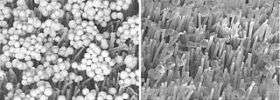
On the gecko-inspired synthetic adhesive shown above, microspheres contaminating the microfibrillar adhesive (left) are shed after repeated contacts with a surface (right). By contract, conventional soft polymer tape shows how the microspheres are simply spread around, rather than removed, by contact with a clean glass surface. (Fearing lab/UC Berkeley)

(PhysOrg.com) -- Researchers at the University of California, Berkeley, are continuing their march toward creating a synthetic, gecko-like adhesive, one sticky step at a time. Their latest milestone is the first adhesive that cleans itself after each use without the need for water or chemicals, much like the remarkable hairs found on the gecko lizard's toes.

"It brings us closer to being able to build truly all-terrain robots, which will in the future be able to scamper up walls and across ceilings in everyday environments rather than only on clean glass," said Ron Fearing, UC Berkeley professor of electrical engineering and computer sciences and head of the research team developing the new material. "We can envision robots being able to go anywhere they are needed, perhaps in the search for survivors after a disaster."

The adhesive's development is reported online today in Langmuir, a peer-reviewed journal of the American Chemical Society that covers a wide range of topics, including surface properties, nanostructures and biomimetic materials.

For years, scientists have been trying to develop a man-made version of the toe hairs that make the lizard's acrobatic feats possible. Earlier this year, Fearing's group developed another gecko-inspired adhesive using polymer microfibers that could easily attach to and detach from clean surfaces.

But researchers said replicating the gecko's ability to walk through dirty surfaces yet keep its feet clean enough to climb walls has been tricky. In 2005, research led by Kellar Autumn, associate professor of biology at Lewis & Clark College in Portland, Ore., and one of the nation's leading experts on gecko biomechanics, revealed for the first time that a gecko keeps its feet sticky but clean by shedding dirt particles with every step.

"It goes completely against our everyday experience with sticky tapes, which are 'magnets' for dirt and can't be reused," said Fearing. "With our gecko adhesive, we have been able to create the first material that is adhesive and yet cleans itself a little bit with every contact."

In the new study, supported by the National Science Foundation, the UC Berkeley researchers designed the adhesive with microfibers made from stiff polymers. Using microspheres that were 3 to 10 micrometers in diameter to simulate contaminants, the researchers were able to show that the microfibers pushed the microsphere particles toward the fiber tips when the adhesive was not in contact with a surface.

When the fibers were pressed against a smooth surface, the contaminants made greater contact with the surface than with the fibers. Since adhesion strength is proportional to contact area, the microsphere particles preferentially adhered to the glass rather than to the synthetic gecko fibers.

With each simulated step, designed to provide a force similar to a gecko's step, more and more microspheres were deposited onto the surface. After 30 simulated steps, the adhesive shed about 60 percent of the smaller-sized contaminants onto the glass surface.

"This new material likes to adhere to surfaces, but it does not like to collect dirt particles," said Jongho Lee, UC Berkeley graduate student in mechanical engineering and lead author of the new study. "We were able to recover one-third of the shear adhesion strength of clean samples after multiple steps."

The larger contaminants were harder to shake off because they contact a larger number of fibers, and then adhere better to the fibers than to the glass. The researchers said that to resolve this challenge, they will need to understand more features of the gecko toe, such as whether the size of the gaps between bundles of toe hairs helps remove dirt.

Fearing said the next phase of the research will focus on achieving adhesion over rough surfaces.

Source: University of California - Berkeley


print this article email this article download pdf blog this article bookmark this article     Stumble it Digg this share on Facebook retweet share on Reddit add to delicious
Rate this story - 4.8 /5 (14 votes)

Rank Filter

Move the slider to adjust rank threshold, so that you can hide some of the comments.


Display comments: newest first

  • NOM - Sep 10, 2008
    • Rank: 4 / 5 (1)
    This is just the sort of physorg article that the arch-fraudster Neil Farbstein likes to spam with his false claims of research breakthroughs by his bogus company Vulvox.

    ... so. Hi Neil. Go and lie to some other crowd.

September 10, 2008 all stories

Comments: 1

4.8 /5 (14 votes)
  • Stumble this up

  • Digg this

  • share this

  • hide
  • Related Stories

  • From nature, robots
    created Sep 25, 2009 | popularity not rated yet | comments 0
  • New angle on gecko research: Scientists discover trigger that deploys geckos' amazing grip
    created Aug 05, 2009 | popularity not rated yet | comments 0
  • Bizarre walking bat has ancient heritage
    created Jul 29, 2009 | popularity not rated yet | comments 0
  • Study of gecko feet leads to advances in the science of friction (w/Video)
    created Jun 04, 2009 | popularity not rated yet | comments 0
  • Mimicking gecko feet: Dry adhesive based on carbon nanotubes gets stronger
    created Oct 09, 2008 | popularity not rated yet | comments 0


Other News

Toward home-brewed electricity with 'personalized solar energy'

Toward home-brewed electricity with 'personalized solar energy'

Chemistry / Materials Science

created Nov 04, 2009 | popularity 3.4 / 5 (9) | comments 4

New scientific discoveries are moving society toward the era of "personalized solar energy," in which the focus of electricity production shifts from huge central generating stations to individuals in their ...


Scientists Reproduce a Building Block of Life in Laboratory

Scientists Reproduce a Building Block of Life in Laboratory

Chemistry / Biochemistry

created Nov 06, 2009 | popularity 4.8 / 5 (23) | comments 0

(PhysOrg.com) -- NASA scientists studying the origin of life have reproduced uracil, a key component of our hereditary material, in the laboratory.


Newly Discovered Fat Molecule: An Undersea Killer with an Upside

Newly Discovered Fat Molecule: An Undersea Killer with an Upside

Chemistry / Biochemistry

created Nov 05, 2009 | popularity 4.8 / 5 (10) | comments 0

(PhysOrg.com) -- A chemical culprit responsible for the rapid, mysterious death of phytoplankton in the North Atlantic Ocean has been found by collaborating scientists at Rutgers University and the Woods Hole ...


CU-Boulder map of human bacterial diversity shows wide interpersonal differences

Map of Human Bacterial Diversity Shows Wide Interpersonal Differences

Chemistry / Biochemistry

created Nov 05, 2009 | popularity 4.7 / 5 (11) | comments 0

(PhysOrg.com) -- A University of Colorado at Boulder team has developed the first atlas of bacterial diversity across the human body, charting wide variations in microbe populations that live in different ...


Mimicking nature, scientists can now extend redox potentials

Mimicking nature, scientists can now extend redox potentials

Chemistry / Biochemistry

created Nov 04, 2009 | popularity 4.8 / 5 (5) | comments 0

(PhysOrg.com) -- New insight into how nature handles some fundamental processes is guiding researchers in the design of tailor-made proteins for applications such as artificial photosynthetic centers, long-range ...