'Naked Eye' Gamma Ray Burst Was Aimed Squarely At Earth
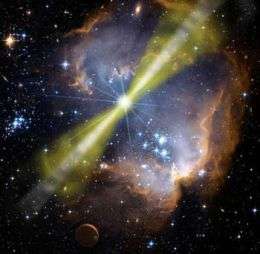
September 10, 2008 This artist's concept shows the "naked-eye" GRB close up

Enlarge

This artist's concept shows the "naked-eye" GRB close up. Observations suggest material shot outward in a two-component jet (white and green beams). Credit: NASA/Swift/Mary Pat Hrybyk-Keith and John Jones

(PhysOrg.com) -- The brightest explosion ever seen was observed in March this year. Now a team of astronomers from around the world, including the University of Leicester, the Mullard Space Science Laboratory of University College London and Liverpool John Moores University, have combined their data from satellites and observatories to explain what happened.

They show that the jet from a powerful stellar explosion in a galaxy halfway across the Universe was aimed almost directly at Earth. The event, called a Gamma-Ray Burst (GRB), was bright enough for human eyes to see.
'Naked Eye' Gamma Ray Burst Was Aimed Squarely At Earth
Enlarge

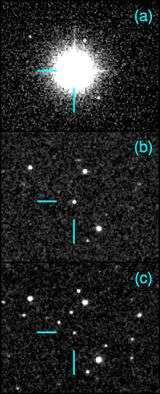
In the seconds after it first pointed at GRB 080319B, the infrared telescope PAIRITEL was blinded by the brilliant explosion (a). As the gamma-ray burst began to fade, PAIRITEL was able to track the light from the explosion for many hours (b and c). (Joshua Bloom/UC Berkeley)

GRBs are the Universe's most luminous explosions. Early in the morning of March 19, the Swift satellite, a joint NASA/UK/Italian mission, pinpointed an extremely bright GRB and immediately sent out an alert to observatories around the world. Two robotic wide-field optical cameras in Chile also observed the brief flash: "Pi of the Sky," which is operated by the Centre for Theoretical Physics in Warsaw, Poland, and TORTORA, based at ESO’s La Silla Observatory. TORTORA is operated by a Russian-Italian collaboration. Within minutes many more telescopes were observing, allowing for the most detailed study of a bright GRB ever undertaken using data from gamma-ray to radio wavelengths.

A team of astronomers led by Judith Racusin of Penn State University, present their findings in a paper to appear in the September 10 issue of the journal Nature, following work first presented at the May meeting of the Royal Astronomical Society. The team conclude that the extraordinary brightness of the March 19 burst arose from a narrow jet that shot material directly toward Earth at 99.99995 percent of the speed of light. The data clearly reveal the complexity of a GRB in which a narrow, ultra-fast jet is present within a wider, slightly slower jet.

Dr. Paul O’Brien of the University of Leicester, part of the Swift team, said “We normally detect only the wide jet of a GRB as the inner jet is very narrow, equivalent to not much more than 1/100th the angular size of the full Moon. It seems that to see a very bright GRB the narrow jet has to be pointing precisely at the Earth. We would expect that to happen only about once per decade. On March 19th, we got lucky.”

Dr. Patricia Schady of the Mullard Space Science Laboratory, also part of the Swift team, commented “The GRB was created when a massive star ran out of nuclear fuel. The star's core collapsed to form a black hole, driving powerful jets outward. These jets are amongst the fastest bulk flow of matter in the cosmos, moving close to the speed of light.”

By rapidly coordinating their efforts using data sent over the Internet, astronomers were able to ensure they made the best possible use of all available British and international telescopes to observe this extraordinarily bright event. Among the telescopes which responded to the alert from Swift was the UK’s largest robotic telescope, the Liverpool Telescope, located on the island of La Palma. Dr Robert Smith from the Liverpool John Moores University, which operates the telescope, said “As the GRB jets move outwards they strike gas previously shed by the star and heat it. This generates emission called the ‘afterglow’. The Liverpool Telescope and other telescopes detected this emission which confirmed the width of the jets.”

Dr. Jonathan Granot from the University of Hertfordshire, lead theorist on the paper, explained “What really makes this GRB unique is its extremely bright prompt optical emission (visible with the naked-eye), which coincides in time with the gamma-rays, and was recorded with amazing time resolution. The optical and gamma-rays are in distinct spectral components, produced by a different emission mechanisms, but most likely came from the same physical region, far from the progenitor star.”

Video of the first presentation of the work at the Royal Astronomical Society by Leicester University Research Associate Dr. Rhaana Starling
http://clients.mediaondemand.net/ras/09052008/player.aspx?externalRAS=externalRas123&id=3

Provided by Royal Astronomical Society


print this article email this article download pdf blog this article bookmark this article     Stumble it Digg this share on Facebook retweet share on Reddit add to delicious
Rate this story - 4.3 /5 (70 votes)

Rank Filter

Move the slider to adjust rank threshold, so that you can hide some of the comments.


Display comments: newest first

  • a3an - Sep 10, 2008
    • Rank: 4 / 5 (6)
    I think the title is misleading. It was impossible at that time to aim at earth, because it did not exist yet.
  • D666 - Sep 10, 2008
    • Rank: 3.8 / 5 (4)
    I think the title is misleading. It was impossible at that time to aim at earth, because it did not exist yet.


    I don't think there was an intent to mislead. Just the oversimplification that comes with Pop Science reporting. It wasn't actually even aimed. Just went off in the direction of the volume of space that Earth now occupies.

    It does sound kind of like an alien attack though.
  • wrack - Sep 10, 2008
    • Rank: 1.9 / 5 (7)
    Or another world trying to contact us!
  • brant - Sep 10, 2008
    • Rank: 1.5 / 5 (4)
    If I shown a laser at my eye would I think it was the brightest light "ever"???
  • Graeme - Sep 10, 2008
    • Rank: 2.5 / 5 (2)
    At that speed the jet will hit the earth in 3750 years, there should be a big burst of cosmic rays when the jet arrives.
  • smiffy - Sep 11, 2008
    • Rank: not rated yet
    Couldn't quote you the figures but I would guess that Earth, as well as the rest of the Milky Way would have moved on out of the jet by then.

    Makes me wonder how many jets we've moved into and how intense they are, and how intense they are supposed to be.
  • visual - Sep 11, 2008
    • Rank: not rated yet
    Well Graeme, we will live and see if that happens
  • smiffy - Sep 11, 2008
    • Rank: not rated yet
    Thinking about it a bit more - if the Earth gets poked in the eye by a GRB every 10 years then we should be immersed in a cosmic ray storm of high energy particles every 10 years on average?
  • jburchel - Sep 11, 2008
    • Rank: 5 / 5 (1)
    "Aim" implies conscious direction, which is stupid. It happened to fire off in our direction, not "AIMED".
  • RAL - Sep 15, 2008
    • Rank: not rated yet
    Great article PhysOrg! And thanks for the link to the slide presentation.

September 10, 2008 all stories

Comments: 10

4.3 /5 (70 votes)
  • Stumble this up

  • Digg this

  • share this

  • hide
  • Related Stories

  • Fermi Gamma-Ray Space Telescope Sees Most Extreme Gamma-Ray Blast Ever
    created Feb 19, 2009 | popularity not rated yet | comments 0
  • Astronomers use gamma-ray burst to probe star formation in the early universe
    created Jan 06, 2009 | popularity not rated yet | comments 0
  • The Case of the Missing Gamma-ray Bursts
    created Oct 23, 2008 | popularity not rated yet | comments 0
  • A Brief Mystery: What are Short Gamma-ray Bursts?
    created Oct 21, 2008 | popularity not rated yet | comments 0
  • Swift Catches Farthest Ever Gamma-Ray Burst
    created Sep 22, 2008 | popularity not rated yet | comments 0


  • hide
  • Relevant PhysicsForums posts

  • The shape of our solar system's orbits.
    created 2 hours ago
  • Above or Below the Line of Nodes
    created 6 hours ago
  • Supernova vs. Nova?
    created 13 hours ago
  • Supernova's Gamma Rays and Comets
    created Nov 06, 2009
  • Our Moon
    created Nov 06, 2009
  • Question about a Carl Zeiss lens
    created Nov 05, 2009
  • More from Physics Forums - General Astronomy

Other News

Seattle team wins $900,000 in Space Elevator Games (AP)

Seattle team wins $900,000 in Space Elevator Games

Space & Earth / Space Exploration

created 15 hours ago | popularity 5 / 5 (6) | comments 4

(AP) -- A Seattle team has collected a $900,000 prize in a NASA-backed competition to develop the concept of an elevator to space - an idea spurred by science fiction novels.


Russian rocket to launch from French Guiana in 2010

Space & Earth / Space Exploration

created 15 hours ago | popularity 5 / 5 (2) | comments 0

A Russian rocket will next year for the first time blast off from a European launch pad in South America, officials said Saturday, as the first rockets headed for the site on board a ship.


Success in 'space elevator' competition (AP)

Success in 'space elevator' competition (Update 3)

Space & Earth / Space Exploration

created Nov 05, 2009 | popularity 4.3 / 5 (32) | comments 51

(AP) -- A robot powered by a ground-based laser beam climbed a long cable dangling from a helicopter on Wednesday to qualify for prize money in a $2 million competition to test the potential reality of the ...


Space hotel taking bookings for 2012 opening

Space hotel taking bookings for 2012 opening

Space & Earth / Space Exploration

created Nov 05, 2009 | popularity 4.3 / 5 (19) | comments 11

(PhysOrg.com) -- The first orbiting space hotel is on track to open for its first customers in 2012, but hurry, as bookings are filling fast.


'Dropouts' pinpoint earliest galaxies

'Dropouts' pinpoint earliest galaxies

Space & Earth / Astronomy

created Nov 06, 2009 | popularity 4.1 / 5 (9) | comments 11

Astronomers, conducting the broadest survey to date of galaxies from about 800 million years after the Big Bang, have found 22 early galaxies and confirmed the age of one by its characteristic hydrogen signature ...