1843 stellar eruption may be new type of star explosion
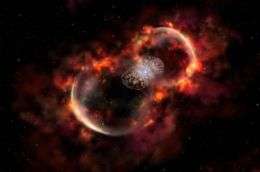
Eta Carinae, the galaxy's biggest, brightest and perhaps most studied star after the sun, has been keeping a secret: Its giant outbursts appear to be driven by an entirely new type of stellar explosion that is fainter than a typical supernova and does not destroy the star.
Reporting in the Sept. 11 issue of Nature, University of California, Berkeley, astronomer Nathan Smith proposes that Eta Carinae's historic 1843 outburst was, in fact, an explosion that produced a fast blast wave similar to, but less energetic than, a real supernova. This well-documented event in our own Milky Way Galaxy is probably related to a class of faint stellar explosions in other galaxies recognized in recent years by telescopes searching for extragalactic supernovae.
"There is a class of stellar explosions going off in other galaxies for which we still don't know the cause, but Eta Carinae is the prototype," said Smith, a UC Berkeley postdoctoral fellow.
Eta Carinae (η Car) is a massive, hot, variable star visible only from the Southern Hemisphere, and is located about 7,500 light years from Earth in a young region of star birth called the Carina Nebula. It was observed to brighten immensely in 1843, and astronomers now see the resulting cloud of gas and dust, known as the Homunculus nebula, wafting away from the star. A faint shell of debris from an earlier explosion is also visible, probably dating from around 1,000 years ago.
Presumably blown off by the star's fierce wind, the shells of gas and dust are moving slowly - at speeds of 650 kilometers per second (1.5 million miles per hour) or less - compared to the blast shell of a supernova.
Smith's recent observations using the international Gemini South 8-meter telescope and the Blanco 4-meter telescope at Cerro Tololo Inter-American Observatory in Chile reveal something new: Extremely fast filaments of gas moving five times faster than the debris in the Homunculus nebula were propelled away from Eta Carinae in the same event. The amount of mass in the relatively slow-moving Homunculus was already at the edge of plausibility in terms of what an extreme stellar wind could do physically, Smith said. The much faster and more energetic material he discovered poses even harsher difficulties for current theories.
Instead, the speeds and energies involved are reminiscent of material accelerated by the fast blast wave of a supernova explosion.
The fast speeds in this blast wave could roughly double earlier estimates of the energy released in the 1843 eruption of Eta Carinae, an event that Smith argues was not just a gentle surface eruption driven by the stellar wind, but an actual explosion deep in the star that sent debris hurtling into interstellar space. In fact, the fast-moving blast wave is now colliding with the slow-moving cloud from the 1,000-year-old eruption and generating X-rays that have been observed by the orbiting Chandra Observatory.
"These observations force us to modify our interpretation of what happened in the 1843 eruption," he said. "Rather than a steady wind blowing off the outer layers, it seems to have been an explosion that started deep inside the star and blasted off its outer layers. It takes a new mechanism to cause explosions like this."
If Smith's interpretation is correct, supermassive stars like Eta Carinae may blow off large amounts of mass in periodic explosions as they approach the end of their lives before a final, cataclysmic supernova blows the star to smithereens and leaves behind a black hole.
Much fainter than a supernova, the explosion that generated the fast-moving blast wave around Eta Carinae would have been similar to faint stellar explosions, sometimes called "supernova imposters," now being discovered in other galaxies by Earth-based robotic telescopes and other supernova searches. Such searches have been looking primarily for Type Ia supernovae that could help astronomers understand the accelerating expansion of the universe, but they also find other gems along the way, Smith said.
"Looking at other galaxies, astronomers have seen stars like Eta Carinae that get brighter, but not quite as bright as a real supernova," he said. "We don't know what they are. It's an enduring mystery as to what can brighten a star that much without destroying it completely."
Eta Carinae is a rare supermassive star in our galaxy, probably once having had a mass 150 times that of the sun. Such large stars burn brightly for only a few million years, all the while shedding mass as the intense light pushes the outer layers of the star away in a stellar wind. After 2 to 3 million years of this, Eta Carinae now weighs about 90 to 100 solar masses, having shed about 10 solar masses in its most recent 1843 eruption alone.
"These explosions may be the primary way by which massive stars can shed their outer hydrogen layers before they die," Smith said. "If Eta Carinae is able to shed 10 solar masses every thousand years or so, that's an efficient mechanism for peeling off a large fraction of the star."
Astronomers now believe that Eta Carinae and other luminous blue variable stars are nearing the end of their lives, having burned hydrogen in their cores into helium. If they explode at the stage where they still have an envelope of hydrogen shrouding the helium core, the resulting supernova will look vastly different from one that results from a star that sloughs off all its hydrogen before exploding.
Smith suggests that it is still unclear if supernova impostors are scaled-down versions of supernovae, failed supernovae, precursor events or entirely different kinds of explosions.
"This could be an important clue for understanding the last violent phases in the lives of massive stars," he said, noting that astronomers still cannot accurately predict the fate of stars that are 30 or more times the mass of the sun.
The observations reported in the Nature paper included visible spectra from the Blanco telescope, which is part of the U.S. National Optical Astronomy Observatory (NOAO), and near-infrared spectra taken with the Gemini South telescope. Both telescopes are in Chile's Andes mountains near an elevation of 9,000 feet. NOAO and the Gemini Observatory are operated by the Association of Universities for Research in Astronomy.
Source: University of California - Berkeley


