Can love change your mind? New project explores neuroscience of 'positive qualities'
What is happening in the minds of people who have developed a greater capacity for forgiveness and compassion? Can a quality like love — whether it’s shown toward a family member or a friend — be neurologically measured in the brain?
A new research project at UW–Madison offers the opportunity to apply hard science to these seemingly ethereal questions. UW–Madison psychology professor Richard Davidson, director of the Waisman Laboratory for Brain Imaging and Behavior, has received a $2.5 million grant from the Michigan-based Fetzer Institute to create a new research initiative on the neuroscience of compassion, love and forgiveness, investigating how these virtues manifest themselves in the human mind and whether we have the ability to nurture and expand them through practice.
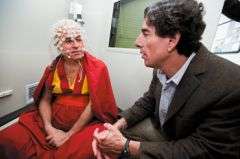
Davidson already has the foundation for probing these questions through his decade-long work exploring brain function and meditation. Davidson works with a population of Tibetan monks and lay practitioners who have incorporated meditation practices into their daily lives, looking into how that practice impacts their mental and physical health.
Using functional magnetic resonance imaging (fMRI) techniques, Davidson has been able to demonstrate that significant positive changes in brain behavior can be activated through meditation and other “contemplative practices.” The research has been very influential in providing evidence of “neuroplasticity,” the idea that brain function changes throughout life in response to experience and purposeful training.
“This is totally uncharted territory,” says Davidson of the Fetzer project. “This grant is really meant to launch a new field where the wisdom of the contemplative traditions can intersect with hard-nosed mainstream science to understand how the brain can be transformed, through certain exercises, to strengthen these kinds of positive qualities.”
Davidson’s ultimate goal is build a deep base of scientific evidence not only of the neurological machinery that supports these qualities, but of specific practices that can have an impact on mental health and point the way to new techniques to cultivate these virtues in children and adults, including those with disabilities.
“Most commentators agree that if the world contained more people who more often displayed qualities such as love, forgiveness, compassion and related characteristics, some of the myriad problems that plague modern society would be less severe,” Davidson says.
Davidson’s research team has already done studies on compassion, in which they examined how specific mental training exercises were able to elicit changes in a brain region called the insula, an area that is directly tied to interactions between the mind and body. When subjects are asked to respond to stimuli that depicts human suffering, for example, there are often parallel physical reactions in the body that can be measured. Those reactions may serve as motivators for the propensity to help others, Davidson says.
One big challenge will be how to define, isolate and measure what responses in the brain are directly connected with a construct such as love or forgiveness. Davidson says a great deal of their success will depend on whether specific studies can be designed to really hone in on a particular virtue. Adding to the challenge is the fact that many of these virtues may be related neurologically.
The question of measuring love may be especially challenging, but Davidson says there are some intriguing options. For example, when people talk about immediate family members — parents, children, spouses — it’s easy to identify qualities that most people would agree constitute love, such as a selflessness and a sense one “would do anything” for that person. But it’s much harder to explain beyond immediate family.
“It may well be that for most people, the experience of love is something that is pretty restricted to that close circle of people,” he says. “If that’s true, it actually allows us to see how a person’s response to people inside that sphere are different from those outside the sphere.”
As part of the Fetzer initiative, Davidson has named two graduate students who are working in the general area of contemplative neuroscience as Fetzer Fellows. The first two fellowships are held by Daniel Levinson, a first-year graduate student who completed his undergraduate studies at Stanford University, and third-year student Helen Weng, who completed her undergraduate work at Columbia University.
Levinson says he will study the ways in which meditation influences emotion and attention, and understand the brain processes that allow people to excel at those behaviors. Those same brain processes might inform work on love, compassion and forgiveness.
“It is a rare gift to be funded to do what you care about most deeply,” Levinson says.
Davidson adds that the Fetzer Institute work will be part of a larger center in development called the Center for Creating a Healthy Mind, which will open in about a year in newly renovated space at the Waisman Center.
The Fetzer Institute, based in Kalamazoo, Mich., is devoted to fostering awareness of the power of love and forgiveness in the emerging global community.
“The Fetzer Institute is pleased to join professor Davidson and his colleagues at the University of Wisconsin in this exciting new program,” says Tom Beech, Fetzer president and CEO. “It will bring the powerful methods of neuroscience to bear on one of the most pressing and fundamental issues that humanity faces today — namely, our capacity to love and forgive. We expect that this work will help us understand the fundamental nature of compassion and how to cultivate it in our daily lives.”
Source: University of Wisconsin


