Photo reveals rare okapi survived poaching onslaught
September 10, 2008 Okapi

Enlarge

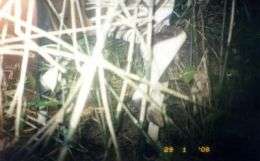
A rare okapi photographed by camera trap in Congo's Virunga National Park -- the first confirmed sighting in the park in 50 years. Credit: Wildlife Conservation Society

A set of stripy legs in a camera trap photo snapped in an African forest indicates something to cheer about, say researchers from the Wildlife Conservation Society. The legs belong to an okapi -- a rare forest giraffe -- which apparently has survived in the Democratic Republic of Congo's Virunga National Park, despite over a decade of civil war and increased poaching.

"This is the first time this species has been captured on film in this park. Known to occur in the park from the early 1900s it had not been seen here for over 50 years. Two years ago sightings of dung and other tracks were made in the park by a team of pygmy trackers who knew Okapi sign. It is very encouraging to see that this animal has survived," said WCS researcher, Deo Kujirakwinja, who organized the recent camera trap survey. "Many animals have suffered in this park as a result of the ten years of insecurity in the region, so it's encouraging to see that the okapi has survived."

Measuring up to 8 feet in length and standing up to 6 feet at the shoulder, the okapi has striped legs that give the animal a superficial resemblance to a zebra. It is, in fact, a close relative of the much larger giraffe. The animal's current range occurs in the Ituri Forest in northern DR Congo. They are classified as Near Threatened by the World Conservation Union (IUCN) and are at risk primarily from habitat destruction.

The photograph was taken during some field surveys of the northern forests of the Virunga Park, an area that has been little visited historically because of the density of the forest and its remoteness. This region has also been the hideout of a rebel group (ADF – Allied Democratic Front) who have been battling the government of Uganda unsuccessfully for over 20 years. They have been hiding in Congo for many years now and it is only recently that it has become safe to enter this part of the park. Funded by the USFWS, these surveys aimed to assess the impact of the war on the fauna and flora of this region. Preliminary results indicate that many antelope species are at low density but that some species such as chimpanzees have survived fairly well.

"The recent evidence that okapis still exist in the Virunga National Park is a good indication that large wildlife can rebound in areas impacted by unrest and poaching," said Dr. Andrew Plumptre, director of WCS's Albertine Rift Program.

Source: Wildlife Conservation Society


print this article email this article download pdf blog this article bookmark this article     Stumble it Digg this share on Facebook retweet share on Reddit add to delicious
Rate this story - 5 /5 (2 votes)

Rank Filter

Move the slider to adjust rank threshold, so that you can hide some of the comments.


Display comments: newest first

  • zevkirsh - Sep 10, 2008
    • Rank: not rated yet
    i'm really glad they post these photos so that the poachers know that there are some left to go poach. morons.
  • Chaz - Sep 13, 2008
    • Rank: not rated yet
    Yeah and i'm really glad that congolese poachers living in a mud hut in eastern DRC have access to the internet, moron

September 10, 2008 all stories

Comments: 2

5 /5 (2 votes)
  • Stumble this up

  • Digg this

  • share this

  • hide
  • Related Stories

  • Coral reefs inspire rare consensus -- just save them
    created Nov 05, 2009 | popularity not rated yet | comments 0
  • Wolves, moose and biodiversity: An unexpected connection
    created Nov 02, 2009 | popularity not rated yet | comments 0
  • Scientists discover largest orb-weaving spider
    created Oct 21, 2009 | popularity not rated yet | comments 0
  • Report documents the risks of giant invasive snakes in the US
    created Oct 13, 2009 | popularity not rated yet | comments 0
  • Man-Made Activities Affect Blue Haze (w/ Video)
    created Oct 06, 2009 | popularity not rated yet | comments 0


Other News

Scientists visualize how bacteria talk to one another

Scientists visualize how bacteria talk to one another

Biology / Cell & Microbiology

created 17 hours ago | popularity 4.9 / 5 (9) | comments 1

Using imaging mass spectrometry, researchers at the University of California, San Diego have developed tools that will enable scientists to visualize how different cell populations of cells communicate. Their ...


Laser etching safe alternative for labeling grapefruit

Laser etching safe alternative for labeling grapefruit

Biology / Other

created Nov 03, 2009 | popularity 4.4 / 5 (14) | comments 8

Laser labeling of fruit and vegetables is a new, patented technology in which a low-energy carbon dioxide laser beam is used to label, or "etch" information on produce, thereby eliminating the need for common ...


Caught in the act: Butterfly mate preference shows how 1 species can become 2

Caught in the act: Scientists find butterflies splitting into two species

Biology / Plants & Animals

created Nov 05, 2009 | popularity 4.5 / 5 (8) | comments 4

(PhysOrg.com) -- Breaking up may actually not be hard to do, say scientists who've found a population of tropical butterflies that may be on its way to a split into two distinct species.


Wolves, moose and biodiversity: An unexpected connection

Wolves, moose and biodiversity: An unexpected connection

Biology / Ecology

created Nov 02, 2009 | popularity 4.9 / 5 (7) | comments 4

Moose eat plants; wolves kill moose. What difference does this classic predator-prey interaction make to biodiversity?


Can biodiversity persist in the face of climate change?

Can biodiversity persist in the face of climate change?

Biology / Ecology

created Nov 06, 2009 | popularity 3 / 5 (8) | comments 2

(PhysOrg.com) -- Predictions made over the last decade about the impacts of climate change on biodiversity may be exaggerated, according to a paper published in the journal Science.