In spiders, size matters: Small males are more often meals
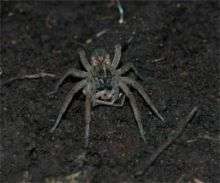
September 10, 2008 Female Wolf Spider Eating a Male

Enlarge

A female wolf spider, Hogna helluo, consuming a male. Credit: Shawn M. Wilder

Female spiders are voracious predators and consume a wide range of prey, which sometimes includes their mates. A number of hypotheses have been proposed for why females eat males before or after mating. Researchers Shawn Wilder and Ann Rypstra from Miami University in Ohio found, in a study published in the September issue of the American Naturalist, that the answer may be simpler than previously thought.

Males are more likely to be eaten if they are much smaller than females, which likely affects how easy they are to catch. In one species of spider, Hogna helluo, large males were never consumed while small males were consumed 80% of the time. This result was also confirmed when Wilder and Rypstra examined published data from a wide range of spider species. Males are more likely to be eaten in species where males are small relative to females.

Much research on sexual cannibalism has focused on a few extreme cases involving sexual selection and sperm competition. However, by looking at data on a wide range of spiders, Wilder and Rypstra discovered that the size of the male relative to the female (often referred to as sexual size dimorphism) determines how often sexual cannibalism occurs in a species.

"We were surprised to find that such a simple characteristic such as how small males are relative to females has such a large effect on the frequency of sexual cannibalism," states Shawn Wilder. In many cases, sexual cannibalism may not be a complex balancing act of costs and benefits for males and females but rather a case of a hungry female eating a male when he is small enough to catch.

In an interesting twist, evolution does not appear to be driving this relationship. For example, females would not become larger to consume more males because each male would then be a smaller meal to the larger female and males would not become smaller to be eaten more often because they would not get to mate as often. Rather, sexual cannibalism may be a byproduct of the evolution of large females and small males in a predatory species.

Shawn M. Wilder and Ann L. Rypstra, "Sexual size dimorphism predicts the frequency of sexual cannibalism within and among species of spiders" American Naturalist (2008) 172: 431

Source: University of Chicago


print this article email this article download pdf blog this article bookmark this article     Stumble it Digg this share on Facebook retweet share on Reddit add to delicious
Rate this story - not rated yet


September 10, 2008 all stories

Comments: 0

not rated yet
  • Stumble this up

  • Digg this

  • share this

  • hide
  • Related Stories

  • Toward explaining why hepatitis B hits men harder than women
    created Nov 18, 2009 | popularity not rated yet | comments 0
  • Studies suggest males have more personality
    created Nov 18, 2009 | popularity not rated yet | comments 0
  • For fish, bigger doesn’t always mean healthier
    created Nov 17, 2009 | popularity not rated yet | comments 0
  • The bizarre lives of bone-eating worms
    created Nov 09, 2009 | popularity not rated yet | comments 0
  • Mom was right: Why nice guys usually get the girls
    created Nov 05, 2009 | popularity not rated yet | comments 0


Other News

Rat pack: Scientists warming up to African rodent (AP)

Rat pack: Scientists warming up to African rodent

Biology / Plants & Animals

created 10 hours ago | popularity 5 / 5 (5) | comments 0

(AP) -- Naked mole rats don't get cancer. They shrug off brushes with acid and age so well, some are older than the college-aged researchers handling them.


Hammerhead shark

Wide heads give hammerheads exceptional stereo view

Biology / Plants & Animals

created Nov 27, 2009 | popularity 4.6 / 5 (8) | comments 4

Hammerhead sharks are some of the Ocean's most distinctive residents. 'Everyone wants to understand why they have this strange head shape,' says Michelle McComb from Florida Atlantic University. One possible ...


The six elephants in Sierra Leone were shot and "crudely butchered"

S.Leone elephants 'wiped out' by poachers: official

Biology / Ecology

created Nov 26, 2009 | popularity 5 / 5 (6) | comments 6

Poachers "wiped out" the entire elephant herd in Sierra Leone's only wildlife park, wildlife managers said Thursday after police said they had arrested a gang of 10 poachers.


First-ever blueprint of a minimal cell is more complex than expected

First-ever blueprint of a minimal cell is more complex than expected

Biology / Cell & Microbiology

created Nov 26, 2009 | popularity 4.9 / 5 (19) | comments 4

What are the bare essentials of life, the indispensable ingredients required to produce a cell that can survive on its own? Can we describe the molecular anatomy of a cell, and understand how an entire organism ...


Golden Oldie: Key Role for Ancient Protein in Algae Photosynthesis

Golden Oldie: Key Role for Ancient Protein in Algae Photosynthesis

Biology / Biotechnology

created Nov 27, 2009 | popularity 3 / 5 (2) | comments 2

The discovery that an ancient light harvesting protein plays a pivotal role in the photosynthesis of green algae should help the effort to develop algae as a biofuels feedstock. Researchers with the Lawrence ...