Next Mars Soil Scoop Slated for Last of Lander's Wet Lab Cells
September 10, 2008 Next Mars Soil Scoop Slated for Last of Lander's Wet Lab Cells

Enlarge

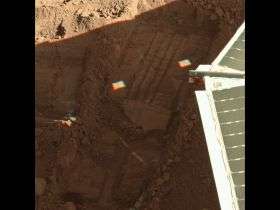
The informally named "Snow White" trench is the source for the next sample to be acquired by NASA's Phoenix Mars Lander for analysis. Image Credit: NASA/JPL-Caltech/University of Arizona/Texas A&M University

(PhysOrg.com) -- The next soil sample that NASA's Phoenix Mars Lander will deliver to its deck instruments will go to the fourth of the four cells of Phoenix's wet chemistry laboratory, according to the Phoenix team's current plans.

The chosen source for that sample is from the "Snow White" trench on the eastern end of the work area reachable with Phoenix's robotic arm. In July that trench yielded a sample in which another analytical instrument, the Thermal and Evolved Gas Analyzer (or TEGA), confirmed the presence of water ice. One of the three cells previously used on the wet chemistry laboratory also analyzed a sample from Snow White.

The wet chemistry laboratory mixes Martian soil with purified water brought from Earth as part of its process for identifying soluble nutrients and other chemicals in the soil. Scientists have used it to determine that the soil beside the lander is alkaline and to identify magnesium, sodium, potassium, chloride and perchlorate in the soil.

The Phoenix team plans to fill the last four of eight single-use ovens on the TEGA instrument without waiting for the analysis of each sample to be completed before delivering the next. The strategy is to get as many samples as possible delivered while there is still enough energy available for digging. The northern Martian summer is nearly half over. The amount of sunshine reaching Phoenix's solar panels, and consequently the amount of electricity produced by the panels, is declining.

"Now that the sun is not constantly above the horizon at our landing site we are generating less power every sol," said Phoenix Project Manager Barry Goldstein of NASA's Jet Propulsion Laboratory, Pasadena, Calif. "When we landed in late May, and through much of our mission, we generated about 3,500 watt-hours every sol. We are currently at about 2,500 watt-hours, and sinking daily. With the remaining sols we need to scurry to squeeze the last bit of science out of the mission."

One hundred watt-hours is equivalent to what is needed to illuminate a 100-watt bulb for one hour.

As TEGA bakes samples, it identifies the temperatures at which volatile ingredients in the soil are vaporized. It also has a mass spectrometer to identify the vapors. A valve that controls the flow of a carrier gas for transporting the vapors to the mass spectrometer is no longer reliable, but researchers anticipate that the remaining samples will yield enough vaporized water and carbon dioxide to carry any scarcer vapors to the spectrometer. The team is also examining possible operational workarounds for unanticipated opening of a valve controlling flow of calibration gas.

The Snow White trench is the chosen source for the next sample to go into a TEGA oven, as well as the next sample for the wet chemistry laboratory. For the TEGA sample, the team plans to use a rasp on the robotic arm to churn up ice-rich material from the hard floor of the trench. Ice-rich samples stuck inside the scoop during two attempts in July to deliver them to a TEGA oven. However, a test run on Aug. 30 verified that an ice-rich sample can be delivered using methods that minimize the time the sample is in the scoop and the exposure of the scoop to direct sunlight.

Provided by NASA


print this article email this article download pdf blog this article bookmark this article     Stumble it Digg this share on Facebook retweet share on Reddit add to delicious
Rate this story - 3.5 /5 (2 votes)


September 10, 2008 all stories

Comments: 0

3.5 /5 (2 votes)
  • Stumble this up

  • Digg this

  • share this

  • hide
  • Related Stories

  • Phoenix Gets Bonus Soil Sample
    created Oct 20, 2008 | popularity not rated yet | comments 0
  • Mid-Depth Soil Collected for Lab Test On NASA's Mars Lander
    created Aug 22, 2008 | popularity not rated yet | comments 0
  • Phoenix Mars Lander Explores Site by Trenching
    created Aug 21, 2008 | popularity not rated yet | comments 0
  • Soil Studies Continue at Site of Phoenix Mars Lander
    created Aug 11, 2008 | popularity not rated yet | comments 0
  • Phoenix Mars Team Opens Window on Scientific Process
    created Aug 06, 2008 | popularity not rated yet | comments 0


  • hide
  • Relevant PhysicsForums posts

  • Sideral question
    created 14 hours ago
  • Doppler shifted blackbody spectrum
    created 17 hours ago
  • Earth v. Moon
    created 19 hours ago
  • help me with coordinates and orbits
    created 19 hours ago
  • More from Physics Forums - General Astronomy

Other News

Astronauts finish another spacewalk, still no baby (AP)

Astronauts finish another spacewalk, still no baby

Space & Earth / Space Exploration

created 5 hours ago | popularity 3 / 5 (2) | comments 0

(AP) -- A spacewalking astronaut put aside the impending birth of his daughter and blazed through his first-ever venture outside the International Space Station on Saturday.


Unseasonably hot and dry weather combined with strong winds to fan scores of blazes in the country's southeastern states

Australia issues 'catastrophic' alerts as fires rage

Space & Earth / Environment

created 11 hours ago | popularity 4.5 / 5 (2) | comments 0

Australia has issued "catastrophic" alerts after record-breaking temperatures and wild lightning storms sparked more than 100 fires across the country, officials said Saturday.


Commuters wait on the platform shrouded by fog in London

Climate change not man-made, say majority of Britons: poll

Space & Earth / Environment

created Nov 15, 2009 | popularity 3.3 / 5 (15) | comments 45

Less than half of Britons believes that human activity is to blame for global warming, according to a poll carried out for The Times newspaper and published on Saturday.


Mysteriously warm times in Antarctica

Mysteriously warm times in Antarctica

Space & Earth / Earth Sciences

created Nov 18, 2009 | popularity 4.2 / 5 (21) | comments 28

(PhysOrg.com) -- A new study of Antarctica's past climate reveals that temperatures during the warm periods between ice ages (interglacials) may have been higher than previously thought. The latest analysis ...


UN: Fight climate change with free condoms (AP)

UN: Fight climate change with free condoms

Space & Earth / Environment

created Nov 18, 2009 | popularity 3.1 / 5 (11) | comments 22

(AP) -- The battle against global warming could be helped if the world slowed population growth by making free condoms and family planning advice more widely available, the U.N. Population Fund said Wednesday.