Hurricane Ike tracked by ESA's Envisat
(PhysOrg.com) -- Residents along the Gulf Coast are bracing for Hurricane Ike as it travels over the Gulf of Mexico after ripping through Cuba and Haiti. ESA's Envisat satellite is tracking the storm, which is forecast to make landfall on the Texas coast by 13 September.
Knowing the strength and path of hurricanes is critical for issuing timely warnings. Earth observation (EO) satellites are key means of providing synoptic data on the forces that power the storm, such as cloud structure, wind and wave fields, sea surface temperature and sea surface height.
Thanks to Envisat's unique capability to acquire optical and radar imagery over the same area of the Earth simultaneously, the top and bottom of a hurricane can be viewed at the same time. The unique view of Hurricane Ike on the left is an example of combined optical and radar images, showing the swirling cloud-tops and the shape of the wind-driven sea surface.
Moreover, satellite-based radar instruments have the capability of penetrating heavy clouds and precipitations and can provide day and night high-resolution observations of critical ocean parameters, such as local wind, waves and currents over a 400-km-wide region.
Using these capabilities specific to radar satellites, Dr Bertrand Chapron of IFREMER, the French Research Institute for Exploitation of the Sea, and Dr Fabrice Collard of France's CLS radar application division in Brest, have developed sets of algorithms that allow data from the Advanced Synthetic Aperture Radar (ASAR) instrument aboard Envisat to be processed in Near-Real Time (NRT) and to produce state-of-the-art ocean parameters.
Taking advantage of the broad availability of Envisat ASAR wide swath acquisitions taken over the hurricane region, the corresponding sea surface roughness map, wind speed map and surface current are made widely available on the SOPRANO ocean products demonstration website developed with ESA.
"The knowledge of hurricane eye details, the radius of very high winds, details on the swell fields, and the new information on atmosphere feedback to ocean surface velocity will certainly help coupled ocean-atmosphere models to better predict hurricane track and intensity," Dr Chapron said.
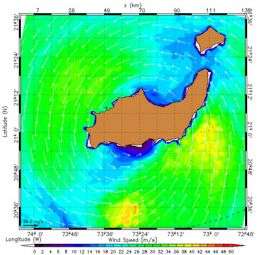
As clearly revealed for Hurricane Ike, wind speeds around the hurricane's eye can far exceed 40m/s (about 80 knots).
The sea surface roughness map clearly shows a minimum in the well-delineated eye where the conditions are relatively calm. Around the eye of the storm, the sea surface velocities also capture the circular direction of the prevailing wind and waves, as visible in this image over Great Inagua Island in the Bahamas on 7 September.
This analysis of the residual Doppler from the radar echoes allows for the retrieval of radial velocities which are used to provide systematically and in Near Real Time a map of the radial component of sea surface velocity.
The colour of the graphics shown in the 'current' section is representative of a very strong eastward motion in the southern part of the hurricane and a symmetrical strong westward motion in the northern part. These observations are clearly in line with the hurricane winds turning counter clockwise.
In the future, these combined instantaneous wind speed, wave heights and surface velocity maps will be integrated into models to improve storm track and intensity forecasts.
"Sentinel-1, the follow on to Envisat's SAR mission, will have an improved instrument capability with dual polarisation and higher imaging resolution, and will benefit from this demonstration to achieve better winds accuracy in extreme conditions," Dr Collard said.
Provided by European Space Agency


