MIT quantum discovery could lead to better detectors
September 11, 2008 By David Chandler Entangled photons

Enlarge

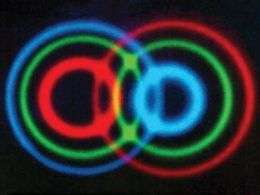
Entangled photons. Photo courtesy / Paul Kwiat and Michael Reck, University of Vienna

(PhysOrg.com) -- A bizarre but well-established aspect of quantum physics could open up a new era of electronic detectors and imaging systems that would be far more efficient than any now in existence, according to new insights by a leader in the field that will appear in the journal Science.

MIT Professor of Mechanical Engineering Seth Lloyd has found that a peculiar quantum-physics property called entanglement can be harnessed to make detectors — similar in principle to radar systems used to track airplanes in flight or ships at sea — that are as much as a million times more efficient than existing systems. In addition, beams of entangled light could be swept across a scene to reconstruct a detailed image, with a similar improvement in efficiency.

The new findings are purely theoretical, but Lloyd says that laboratory experiments have already proven the feasibility of both the light sources and the detectors needed for such a quantum-based photodetection system, so he anticipates that within a year it should be possible to build a laboratory-scale system to demonstrate the new concept.

“It should be possible to have at least a proof-of-principle demonstration within six months to a year,” Lloyd said.

For example, military applications could include improved night-vision systems, which send out beams of infrared light — invisible to the naked eye — to sweep across a scene, and then use an infrared detector to reconstruct an image from the light that is reflected back. A more efficient system, using the quantum-entanglement effect, would make it much more difficult for an adversary to detect the fact that such a system was being used, because there would be so much less infrared light needed to provide the illumination.

Theoretically, such a system could be used to allow medical diagnostic systems such as CT scans to work with a vastly reduced X-ray output, thereby making them much safer for the patient, but such applications would be much further in the future. It could also someday be used for safer microscope imaging of living organisms.

Entanglement is a strange property that was deduced theoretically on the basis of the laws of quantum physics, and has been demonstrated over the last several years in a variety of laboratory experiments. Under certain circumstances, when an atom gives off two photons of light at the same time, the two are “entangled” even as they go off in different directions, so that anything that changes one of the photons simultaneously changes the other as well.

This odd property makes it possible to perform seemingly impossible feats such as “quantum teleportation,” in which all of the properties of one subatomic particle are recreated in a different particle some distance away. It has also been demonstrated as a way of producing seemingly foolproof encryption systems for data transmission. But explanations of exactly what underlies the entanglement phenomenon remain controversial.

Lloyd says that he cannot provide a simple, intuitive explanation for why the quantum illumination system described in this report actually works, but is certain that the theoretical calculations demonstrating it are correct. "It is as if the two entangled photons retain a memory of each other long after any such memory should have faded away," he said.

Provided by MIT


print this article email this article download pdf blog this article bookmark this article     Stumble it Digg this share on Facebook retweet share on Reddit add to delicious
Rate this story - 4.5 /5 (35 votes)

Rank Filter

Move the slider to adjust rank threshold, so that you can hide some of the comments.


Display comments: newest first

  • Wasabi - Sep 11, 2008
    • Rank: 4 / 5 (1)
    Also sounds very promising for greatly improved nighttime/low light photography/videography for comsumer grade gear.
  • Graeme - Sep 12, 2008
    • Rank: not rated yet
    Are we just being tantalized by a hint, how does this work?
  • disco - Sep 15, 2008
    • Rank: not rated yet
    twisted ligth. atmosphere= no need for telescope
  • disco - Sep 15, 2008
    • Rank: not rated yet
    magnification=less image

September 11, 2008 all stories

Comments: 4

4.5 /5 (35 votes)
  • Stumble this up

  • Digg this

  • share this

  • hide
  • Related Stories

  • Calif. region is epicenter of U.S. nano-revolution
    created Aug 27, 2009 | popularity not rated yet | comments 0
  • Cisco announces its first servers, riling rivals
    created Mar 16, 2009 | popularity not rated yet | comments 0
  • Turning 'funky' quantum mysteries into computing reality
    created Feb 16, 2008 | popularity not rated yet | comments 0
  • Astronomers Obtain Highly Detailed Image of the 'Red Square'
    created Apr 13, 2007 | popularity not rated yet | comments 0
  • Researchers create a biologically-inspired artificial compound eye
    created Apr 27, 2006 | popularity not rated yet | comments 0


  • hide
  • Relevant PhysicsForums posts

  • I need some help with this project (optics and lens design)
    created 44 minutes ago
  • black hole gravity
    created 1hour ago
  • Photoelectric effect
    created 3 hours ago
  • Ranges of coherence lengths for......
    created 6 hours ago
  • More from Physics Forums - General Physics

Other News

Russian physicist Ginzburg dead at 93: academy

Physics / General Physics

created 1hour ago | popularity not rated yet | comments 0

Nobel Physics prize winner Vitaly Ginzburg, who helped develop the Soviet hydrogen bomb, has died at the age of 93, the Russian Academy of Sciences said Monday.


Stars Fueled by Dark Matter Could Hold Secrets to the Universe

Stars Fueled by Dark Matter Could Hold Secrets to the Universe

Physics / General Physics

created Nov 03, 2009 | popularity 4.5 / 5 (51) | comments 41

(PhysOrg.com) -- The first stars in the universe may have been very different from the stars we see today, yet they may hold clues to understanding some of the mysterious features of the universe. These "dark ...


Second Law of Thermodynamics May Explain Economic Evolution

Second Law of Thermodynamics May Explain Economic Evolution

Physics / General Physics

created Nov 02, 2009 | popularity 4.3 / 5 (31) | comments 28

(PhysOrg.com) -- Terms such as the "invisible hand," laissez-faire policy, and free-market principles suggest that economic growth and decline in capitalist societies seem to be somehow self-regulated. Now, ...


High-performance plasmas may make reliable, efficient fusion power a reality

High-performance plasmas may make reliable, efficient fusion power a reality

Physics / Plasma Physics

created Nov 02, 2009 | popularity 4.7 / 5 (40) | comments 34

In the quest to produce nuclear fusion energy, researchers from the DIII-D National Fusion Facility have recently confirmed long-standing theoretical predictions that performance, efficiency and reliability ...


'Teapot effect' solved

Solving Teapot Effect

Physics / General Physics

created Nov 02, 2009 | popularity 4.9 / 5 (11) | comments 10

(PhysOrg.com) -- A team of scientists from France have worked out why teapots dribble at low flow rates, and how to stop them. The effect is called the "teapot effect", and solving it could finally put an ...