Luck gave dinosaurs their edge
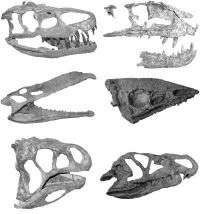
By comparing early dinosaurs to their closest competitors, the curuotarsans, Steve Brusatte of the American Museum of Natural History and colleagues have found that dinosaurs had no special ability to dominate the landscape for 160 million years. Curuotarsans looked better during the Triassic, having twice the disparity (or variation in body plans) and evolving at similar rates until rapid global warming spurred extinction of most groups (except crocodiles) while nearly all dinosaur groups survived.
T. rex and Triceratops: In the popular imagination, dinosaurs are extraordinary reptiles that ruled the world for over 160 million years. But Steve Brusatte, a doctoral student at Columbia University who is an affiliate of the American Museum of Natural History, and colleagues are challenging this idea with new fossil data and math. By comparing early dinosaurs to their competitors, the crurotarsan ancestors to crocodiles, they have found that dinosaurs were not "superior," as has long been thought. Rather, crurotarsans were the more successful group during the 30 million years they overlapped until the devastating mass extinction 200 million years ago, an event that dinosaurs weathered successfully.
This study, the first of its kind, appears in Science this week.
"For a long time it was thought that there was something special about dinosaurs that helped them become more successful during the Triassic, the first 30 million years of their history, but this isn't true," says Brusatte. "If any of us were standing by during the Triassic and asked which group would rule the world for the next 130 million years, we would have identified the crurotarsans, not dinosaurs."
Both dinosaurs and crurotarsans evolved and filled some of the same niches after a massive extinction event that occurred at the end of the Permian (250 million years ago). Of the crurotarsan group, crocodilians are the only living members. But in the Triassic, crurotarsans were amazingly diverse—from giant carnivorous rauisuchians to long–snouted, flesh eating phytosaurs to herbivorous armored aetosaurs—and they have often been mistaken for dinosaurs in the fossil record, the animals that they probably competed with for the same resources. Both groups survived an extinction event 228 million years ago, but only a few crurotarsans—the crocodiles—squeaked through a period of rapid global warming at the end of the Triassic 200 million years ago. Dinosaurs faired better during the latter extinction: most types of dinosaurs survived until an asteroid ended their dominance 65 million years ago. It is because of this stroke of luck that dinosaurs were assumed to be the better competitors.
Brusatte and colleagues tested this assumption by measuring the evolution in both competing groups. Based on a database of 437 features of the skeletons of 64 species of dinosaurs and crurotarsans, as well as a new phylogenetic tree of these groups, they performed two calculations to look at the evolutionary pattern. The first measurement is of the disparity, or the known range of different body plans, of the two groups. Disparity is a reliable indicator of the different lifestyles, diets, and habitats of a group of animals. Remarkably, Brusatte and colleagues found that crurotarsans had twice the disparity of dinosaurs: They were exploring twice the range of body plans as early dinosaurs. "With this information, it's difficult to argue that dinosaurs were 'superior' during the Triassic. They just lucked out when the crurotarsans were hit hard at the end Triassic extinction," says Brusatte.
The team also measured the rate of evolution in both dinosaurs and crurotarsans to see if dinosaurs were diversifying into new species at higher rates, as may be expected if they had special abilities or were outcompeting their rivals. But the comparison showed that the two groups were evolving at the same rate over the 30 million years that they overlapped.
"Many people like to think that evolution is progressive: mammals are better than dinosaurs because they came later. This is like progressive improvements in car technology—a Ford Taurus is demonstrably better than a Model T," says coauthor Michael Benton, a paleontologist at the University of Bristol in the United Kingdom. "So it may be hard for us to accept that dinosaurs achieved their dominant position on earth largely by chance, just as mammals did when the dinosaurs were later wiped out by a meteorite strike."
Citation: ‘Superiority, Competition, and Opportunism in the Evolutionary Radiation of Dinosaurs’ by Stephen L. Brusatte, Michael J. Benton, Marcello Ruta, Graeme T. Lloyd Science
Source: American Museum of Natural History


