NASA Developing Fission Surface Power Technology
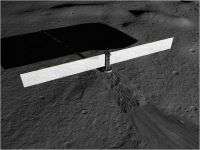
September 11, 2008 Notional Lunar Fission Surface Power System

Enlarge

An artist’s concept of a fission surface power system on the surface of the moon. The nuclear reactor has been buried below the lunar surface to make use of lunar soil as additional radiation shielding. The engines that convert heat energy to electricity are in the tower above the reactor, and radiators extend out from the tower to radiate into space any leftover heat energy that has not been converted to electricity. The power system would transmit a steady 40 kW of electric power, enough for about eight houses on Earth, to the lunar outpost. Credit: Courtesy NASA

(PhysOrg.com) -- NASA astronauts will need power sources when they return to the moon and establish a lunar outpost. NASA engineers are exploring the possibility of nuclear fission to provide the necessary power and taking initial steps toward a non-nuclear technology demonstration of this type of system.

A fission surface power system on the moon has the potential to generate a steady 40 kilowatts of electric power, enough for about eight houses on Earth. It works by splitting uranium atoms in a reactor to generate heat that then is converted into electric power.

The fission surface power system can produce large amounts of power in harsh environments, like those on the surface of the moon and Mars, because it does not rely on sunlight. The primary components of fission surface power systems are a heat source, power conversion, heat rejection and power conditioning and distribution.

"Our goal is to build a technology demonstration unit with all the major components of a fission surface power system and conduct non-nuclear, integrated system testing in a ground-based space simulation facility," said Lee Mason, principal investigator for the test at NASA's Glenn Center in Cleveland. "Our long-term goal is to demonstrate technical readiness early in the next decade, when NASA is expected to decide on the type of power system to be used on the lunar surface."

Glenn recently contracted for the design and analysis of two different types of advanced power conversion units as an early step in the development of a full system-level technology demonstration. These power conversion units are necessary to process the heat produced by the nuclear reactor and efficiently convert it to electrical power.

The first design concept by Sunpower Inc., of Athens, Ohio, uses two opposed piston engines coupled to alternators that produce 6 kilowatts each, or a total of 12 kilowatts of power. The second contract with Barber Nichols Inc. of Arvada, Colo., is for development of a closed Brayton cycle engine that uses a high speed turbine and compressor coupled to a rotary alternator that also generates 12 kilowatts of power.

"Development and testing of the power conversion unit will be a key factor in demonstrating the readiness of fission surface power technology and provide NASA with viable and cost-effective options for nuclear power on the moon and Mars," said Don Palac, manager for Glenn's Fission Surface Power Project.

After a one year design and analysis phase, a single contractor will be selected to build and test a prototype power conversion unit. When complete, the power conversion unit will be integrated with the other technology demonstration unit's major components. Glenn will develop the heat rejection system and provide the space simulation facility. Glenn will also work in conjunction with the Department of Energy and NASA's Marshall Space Flight Center in Huntsville, Ala. Marshall will develop and provide a non-nuclear reactor simulator with liquid metal coolant as the heat source unit for this technology demonstration.

A nuclear reactor used in space is much different than Earth-based systems. There are no large concrete cooling towers, and the reactor is about the size of an office trash can. The energy produced from a space reactor is also much smaller but more than adequate for the projected power needs of a lunar outpost.

Testing of the non-nuclear system is expected to take place at Glenn in 2012 or 2013. These tests will help verify system performance projections, develop safe and reliable control methods, gain valuable operating experience, and reduce technology and programmatic risks. This technology demonstration is being conducted as part of NASA's Exploration Technology Development Program.

Provided by NASA


print this article email this article download pdf blog this article bookmark this article     Stumble it Digg this share on Facebook retweet share on Reddit add to delicious
Rate this story - 4.3 /5 (18 votes)

Rank Filter

Move the slider to adjust rank threshold, so that you can hide some of the comments.


Display comments: newest first

  • Aloken - Sep 12, 2008
    • Rank: 1 / 5 (2)
    So ignore solar and use fission which would require a steady supply of fuel from earth?
  • earls - Sep 12, 2008
    • Rank: 5 / 5 (3)
    Night time on the moon runs weeks, solar, while it would seem like common sense, simply isn't viable.

    Maybe if we had an awesome energy storage solution... But. Oh well.

    Also, I fail to understand why you would assume fission would require a steady supply of fuel from Earth. I believe they stated it could run for about 30 years without "refueling."
  • Modernmystic - Sep 12, 2008
    • Rank: 3 / 5 (2)
    So ignore solar and use fission which would require a steady supply of fuel from earth?


    Yeah about once every hundred years....

    At least on the moon we're having some common sense about energy production. While here we still have to contend with people who prattle on about solar (which will NEVER...EEEVVVVER be able to supply our growing need for energy).
  • groovista - Sep 12, 2008
    • Rank: not rated yet
    Ah, to boldly go where went went 40 years ago...*sigh* Spaceflight, for America, has become a hobby we like but don't get around to much any more. The ultralite spends more time in the garage and it's not clear if the family budget can swing that new Cessna anytime soon. Too bad, when we once flew at Mach 2...
  • gopher65 - Sep 12, 2008
    • Rank: 5 / 5 (2)
    Right, what earls said. The reason why NASA is initially going to send people back to the poles of the moon is because the high points (crater rims and mountains) are bathed in essentially constant sunlight, which means they can use solar. But the poles aren't the only places that you might want to go on the moon. Since there is no geothermal, coal, oil, or natural gas, and solar is out of the question due to the fact that the nights are 2 weeks long, and we haven't invented reliable fusion yet, that leaves only fission.

    The process of elimination can be a helpful tool.

    I really hope someone sets up a robotic mining colony somewhere. Soon. Mining fuel for rockets and shipping it back to Earth Orbit would cost 1/10th the amount of money as mining it on Earth and launching it directly into orbit from here. It's counter-intuitive, but mining and refining fuel on the moon and shipping it back to LEO could be a giant boon for the private space industry.

    It would all have to be fission powered, since you mine where the resource is, not where the light is (poles).
  • KB6 - Sep 12, 2008
    • Rank: not rated yet
    The best solution if you wanted to go all-solar on the moon would be to set up a series of linked solar power stations so that at least one was always in sunlight. But that could require very long lines at substantial expense. Until we begin exploiting the moon or asteroids as manufacturing bases, using the native materials, it wouldn't be very practical to haul hundreds or thousands of miles of power line to the moon. A solution to the linking problem might be microwave transmission of the power. But that would still require an array of relay stations. A power relay satellite would need some way of keeping itself fixed in orbit; "geosynchronous" orbit for the moon is unfortunately co-terminus with the earth itself! Maybe power relay satellites or solar power generating stations could be placed at the L4 and L5 positions. From these positions most of the moon is visible. But that would require the development of not only the stations but very precise guidance for the microwave beams and the building of large microwave receivers on the moon. Then you're still stuck with transferring the power from the receiver to wherever you want to set up shop.
  • Soylent - Sep 14, 2008
    • Rank: not rated yet
    So ignore solar and use fission which would require a steady supply of fuel from earth?


    One pound of HEU is equivalent to 5 000 barrels of oil.

September 11, 2008 all stories

Comments: 7

4.3 /5 (18 votes)
  • Stumble this up

  • Digg this

  • share this

  • hide
  • Related Stories

  • Three of a kind: Revealing language’s universal essence
    created Nov 20, 2009 | popularity not rated yet | comments 0
  • Lehigh receives grant to reduce cost of carbon capture at coal-fired power plants
    created Nov 20, 2009 | popularity not rated yet | comments 0
  • Battery Research Aims To Store Renewable Energy
    created Nov 19, 2009 | popularity not rated yet | comments 0
  • Turning heat to electricity... efficiently
    created Nov 18, 2009 | popularity not rated yet | comments 0
  • Small optical force can budge nanoscale objects
    created Nov 17, 2009 | popularity not rated yet | comments 0


  • hide
  • Relevant PhysicsForums posts

  • dark energy can escape black holes.
    created 2 hours ago
  • Are there green, purple and pink stars?
    created 14 hours ago
  • Sideral question
    created Nov 21, 2009
  • Doppler shifted blackbody spectrum
    created Nov 21, 2009
  • More from Physics Forums - General Astronomy

Other News

Is global warming unstoppable?

Space & Earth / Environment

created 3 hours ago | popularity 3.3 / 5 (7) | comments 5

In a provocative new study, a University of Utah scientist argues that rising carbon dioxide emissions - the major cause of global warming - cannot be stabilized unless the world's economy collapses or society builds the ...


The shore of Deception Island in Antarctica, in 2008

Antarctic ice loss vaster, faster than thought: study

Space & Earth / Earth Sciences

created 18 hours ago | popularity 2.9 / 5 (17) | comments 24

The East Antarctic icesheet, once seen as largely unaffected by global warming, has lost billions of tonnes of ice since 2006 and could boost sea levels in the future, according to a new study.


Astronaut suit problem delays spacewalk No. 3 (AP)

Astronaut suit problem delays spacewalk No. 3

Space & Earth / Space Exploration

created 4 hours ago | popularity not rated yet | comments 0

(AP) -- The third and final spacewalk of space shuttle Atlantis' mission is being held up by a suit problem.


How green is your house? Recycling favorite activity among Brits says new survey

Space & Earth / Environment

created 2 hours ago | popularity not rated yet | comments 3

Seventy percent of households always separate their rubbish for recycling, but only 2 percent buy their energy on a green tariff, according to the early findings of a major new annual household survey, called "Understanding ...


Denmark: 65 world leaders for UN climate summit (AP)

Denmark: 65 world leaders for UN climate summit

Space & Earth / Environment

created 18 hours ago | popularity 2.3 / 5 (3) | comments 2

(AP) -- Sixty-five world leaders have said they will attend the Copenhagen climate summit in December, and several more have responded positively to invitations, Danish officials said Sunday.