My, what big teeth you had! Extinct species had large teeth on roof of mouth
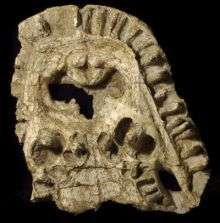
When the world's land was congealed in one supercontinent 240 million years ago, Antarctica wasn't the forbiddingly icy place it is now. But paleontologists have found a previously unknown amphibious predator species that probably still made it less than hospitable.
The species, named Kryostega collinsoni, is a temnospondyl, a prehistoric amphibian distantly related to modern salamanders and frogs. K. collinsoni resembled a modern crocodile, and probably was about 15 feet in length with a long and wide skull even flatter than a crocodile's.
In addition to large upper and lower teeth at the edge of the mouth, temnospondyls often had tiny teeth on the roof of the palate. However, fossil evidence shows the teeth on the roof of the mouth of the newly found species were probably as large as those at the edge of the mouth.
"Its teeth, compared to other amphibians, were just enormous. It leads us to believe this animal was a predator taking down large prey," said Christian Sidor, a University of Washington associate professor of biology and curator of vertebrate paleontology at the Burke Museum of Natural History and Culture at the UW.
Sidor is lead author of a paper describing the new species published in the September issue of the Journal of Vertebrate Paleontology. Co-authors are Ross Damiani of Staatliches Museum für Naturkunde Stuttgart in Germany and William Hammer of Augustana College in Rock Island, Ill. The work was funded in part by the National Science Foundation and the Alexander von Humboldt Foundation.
The scientists worked from a fossilized piece of the snout of K. collinsoni, analyzing structures present in more complete skulls for other temnospondyl species that had similar size characteristics.
"The anatomy of the snout tells us what major group of amphibian this fossil belonged to," Sidor said.
Teeth at the edge of the mouth, as well as on the palate roof, were clearly visible, and the presence of structures similar to those that allow fish and amphibians to sense changes in water pressure led the researchers to conclude that the species was aquatic.
The fossilized piece of snout also contains a nostril, which aided the scientists in judging proportions of the head when comparing it to other fossils. They estimated the skull was about 2.75 feet long and perhaps 2 feet across at its widest point.
"Kryostega was the largest animal in Antarctica during the Triassic," Sidor said.
The term "Kryostega" translates to 'frozen' and 'roof,' which refer to the top of the skull. The scientists named the species for James Collinson, a professor emeritus of Earth sciences at Ohio State University who made important contributions to the study of Antarctic geology.
Hammer collected the fossil in 1986 from an Antarctic geological layer called the Fremouw Formation. He has studied a number of other Antarctic fossils, including dinosaurs, collected at about the same time, and so the temnospondyl fossil was not closely examined until the last couple of years.
At the time K. collinsoni was living, all the world's land was massed into a giant continent called Pangea. The area of Antarctica where the fossil was found was near what is now the Karoo Basin of South Africa, one of the richest fossil depositories on Earth.
Sidor noted that in the early Triassic period, from about 245 million to 251 million years ago, just before the period that produced the K. collinsoni fossil, it appears that Antarctica and South Africa were populated by largely the same species. While Antarctica was still colder than much of the world, it was substantially warmer than it is today, though it still spent significant periods in complete darkness.
By the middle of the Triassic period perhaps only half the species were the same, he said, and in the early Jurassic period, around 190 million years ago, unique early dinosaur species were appearing in Antarctica.
"It could be that these animals were adjusting to their local environment by then, and we are seeing the results of speciation occurring at high latitude," Sidor said. "Here we have really good evidence that Antarctic climate wasn't always the way it is today. During the Triassic, it was warmer than it is today – it was warmer globally, not just in Antarctica."
Source: University of Washington


