Revising and re-sizing history: New work shows Ohio site to be an ancient water works, not a fort
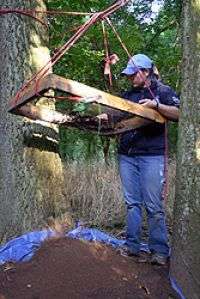
(PhysOrg.com) -- The site known as Miami Fort is no fort at all, and it is also much larger than previously believed – so large, in fact, that its berms stretch to almost six kilometers in length, making it twice as large as any other Native American earthworks in Ohio, and one of the largest in the nation.
Those are discoveries made this summer by members of UC's Ohio Valley Archaeology Field School project, who spent weeks working at the site in Hamilton County's Shawnee Lookout park. What they found actually offers great insight into the cultural priorities of the Shawnee – the incredible amounts of human labor that went into building the earthworks were done for agricultural purposes, not military. The earthworks were not a fort, but a water management system of dams and canals built to counter the impact of long-term drought.
"This site was originally described by William Henry Harrison as a great military fort. What we've discovered this summer is that it is not in any way, shape or form a military fort," says Ken Tankersley, a UC assistant professor of anthropology and faculty leader of the field school. A total of 28 students worked at the site this summer.
What Harrison – who lived in nearby North Bend, Ohio – interpreted on a hilltop high above the confluence of the Great Miami and Ohio rivers to be fortifications with wooden gates are really an ancient irrigation system that dates back 2,000 years, Tankersley says. The gates were locks and the berms were terraced dams for controlling water flow.
Harrison's observations of what was on top of the hill were also only the tip of what was concealed in thick undergrowth. "The engineering feat is remarkable. There's one place where the dam is almost 200 feet high," describes Tankersley. "It's a remarkable system. The irrigation system is almost six kilometers long."
The extent of the Shawnee Lookout site is nearly twice as large as the site previously thought to be the largest Native American earthworks in the state, Fort Ancient in Warren County.
Tankersley and his students set out to learn more about the site as part of UC's summer field school, which is a highly sought opportunity for students to get hands-on experience at an archaeological site. In discussing the possibilities of working in Shawnee Lookout park, Tankersley consulted with UC's department head in anthropology, Vern Scarborough.
"He's the one who suggested we might want to consider other possibilities for the site," Tankersley says.
"I had a student years ago who I had been with out at Fort Ancient, and in our discussions, he said that we might consider looking at (that site) from a water management point of view," says Scarborough, who himself studies Mayan cultures and their use of water. "When you're talking about building on these elevated settings, that's an important consideration to keep in mind."
To support such a theory, the field school team went in search of evidence. They found convincing amounts of it.
What Harrison had described as gates turned out to be fired logs and clay bricks that were used in damming. On the opposite side of the enclosure, drill cores were sunk by field school personnel deep into the earth and when extracted, revealed ponded water sediments and clay minerals, exactly what you ought to find for an area where water was being captured.
At the highest points that the earthworks extended to were found raceways for moving water across the terrain. The raceways originated in areas that contained artesian springs. Excavation in these areas found limestone rock used to line the areas where the water was captured, with overflow being channeled into the raceways for irrigation.
"Where the artesian springs were found were actually what had been labeled borrow pits, where it was thought the earth they were using in building these structures came from these holes," says Tankersley. "But a problem was that there were far too few of these pits to produce all of the earth that was used in making what they termed fortifications. Once we cored in and took samples, it became very clear that these were actually springs feeding these areas. The Shawnee would build these dams and then allow the spring water to fill these pits, and then they would capture the surface runoff."
Tankersley says there is a historical reason that makes this elaborate project a logical choice for the Shawnee – climatic records show the 500-year period leading up to 500 AD to be an unusually cold and dry era in this region. Drought would have been common during this time frame. Native Americans would have needed reliable alternatives to supplement the meat that would have been the staple of their winter diets, meaning they would have had to cultivate nut-producing trees and other crops on their lands.
This drastic change in interpretation of the structures leads Tankersley to conclude a re-interpretation of Shawnee culture may be in order.
Two points standout: one is that the engineering expertise required to conceive of such a massive irrigation system must have been far greater than what history has traditionally assigned to Native American groups from that time in history, and the second is that the cultural priority of engaging in such a massive undertaking as building these earthworks by hand was done by this culture not because of military motivations but for a more civil cause.
"It makes you rethink the stereotype for indigenous people," Tankersley says. "It was thought they were war-like. But they were sophisticated. As the climate was changing, they could adapt. Instead of engaging in warfare, these people were working in harmony."
Tankersley will be taking the new measurements collected from the Shawnee Lookout site into the lab this fall and use computer simulation to calculate the amount of dirt that had to have been moved to create these structures. "We know it has to be a massive amount," he says.
One more surprise from the site is who the evidence points to as the likely group that engaged in this construction. Physical evidence says it was probably the women of the Shawnees.
Moving massive amounts of dirt would have been done using tumplines that relied on the muscles of the head and neck. Remains found of Shawnee men from the time period show that they were petite and graceful, according to Tankersley. The women, on the other hand, were robust and muscular, and often exhibited developed muscles in the areas on and around the cranium.
"It amazes me that when you think of some of the great engineering feats in pre-history, we've always had this male bias that guys must have been doing this," Tankersley says. "But the evidence we have at hand turns this around and suggests that it is actually must have been the women who were doing this work."
More work remains to be done to further explore the ramifications of what was found this summer. A question that clearly is going to have to be addressed is whether the Shawnee Lookout site was singular in its purposes, or whether other similar Ohio sites from this same era such as Fort Ancient and Fort Hill in Highland County also need to be subjected to historically reinterpretation.
"The focus of our field school coming out here was to examine how people adapted to climate change," Tankersley says. "We knew this was a time period that was cold and dry, but to find out the true story of this massive engineering feat was a wonderful discovery."
Source: University of Cincinnati


