NASA Conducts First Test On New Motor For The Ares I Rocket
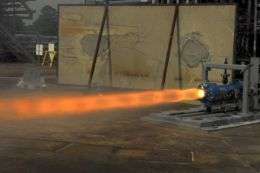
September 12, 2008 Ullage Motor Test

Enlarge

Engineers at NASA's Marshall Space Flight Center in Huntsville, Ala., completed first-round testing on Sept. 11 of a key motor for the next-generation Ares I rocket. The ullage settling motor is a small, solid rocket motor that will assist in vehicle stage separation and provide the forward motion needed to push fuel to the bottom of the fuel tanks during the launch to orbit of the Ares I rocket. Ares I is the first launch vehicle in NASA's new Constellation Program family of space vehicles that will transport astronauts to the International Space Station, the moon and beyond in coming decades. Image: NASA/MSFC

(PhysOrg.com) -- Engineers at NASA's Marshall Space Flight Center in Huntsville, Ala., have completed first-round testing of a critical motor for NASA's new Ares I rocket. The Ares I is a two-stage rocket that will launch astronauts aboard the Orion crew capsule on missions to the International Space Station and to the moon by 2020.

The ullage settling motor is a small, solid rocket motor that serves two key roles during the launch of the Ares I rocket. During first stage separation, which occurs 125.8 seconds into flight, the motor will fire for four seconds, producing the forward thrust needed to push the second, or upper, stage away from the first stage. This forward thrust also ensures the rocket's liquid fuel is properly pushed to the bottom of the upper stage fuel tank prior to ignition of the J-2X engine that powers the upper stage.

The successful hot-fire test of this new development motor -- the first test in this series -- was conducted Sept. 11 at Marshall. All test objectives were achieved, bringing NASA one step closer to developing America's new space transportation system. This first series of early development testing will consist of four motors. It is scheduled to run through 2009. The second test series is planned for February 2009.

"We are extremely excited about the success of this test that proves we are headed down the correct development path for this program," said Danny Davis, upper stage manager for Ares Projects at Marshall. "We have the right team in place, and we are working a design that will secure America's future in space."

The word "ullage" is taken from the French term "ouillage," which is used in winemaking to describe the space between wine and the top of a storage container, such as a barrel or bottle. In this case, it refers to the space at the top of the first stage fuel tank and the need to push the fuel, or settle it, to the bottom of the tank.

The ullage motor, 9 inches in diameter and 47 inches in length, is similar in design to the booster separation motor used on the space shuttle's reusable solid rocket motor. Eight ullage motors will be arranged in four pairs on the Ares I upper stage aft skirt, which also houses the reaction control system. The aft skirt is located between the upper stage core, which contains the liquid hydrogen and oxygen fuel tanks, and the interstage, which houses the rocket's roll control system.

"We are very excited about this opportunity for our team to practice the basic principles of solid rocket motor design for the Ares I," said Steve Harvison, ullage settling motor design lead at Marshall. "It has been especially beneficial to newer team members who are fresh out of college and eager for this challenge. We are working every engineering aspect of these motors, from technical analysis, modeling and simulations to propellant tailoring work and hands-on developmental testing."

The first Ares I test flight, called Ares I-X, is scheduled for 2009.

NASA's Johnson Space Center in Houston manages the Constellation Program, which includes the Ares I rocket, the Ares V heavy-lift launch vehicle, the Orion crew capsule and the Altair lunar lander. Marshall manages the Ares Projects.

Provided by NASA


print this article email this article download pdf blog this article bookmark this article     Stumble it Digg this share on Facebook retweet share on Reddit add to delicious
Rate this story - 4.1 /5 (9 votes)

Rank Filter

Move the slider to adjust rank threshold, so that you can hide some of the comments.


Display comments: newest first

  • deatopmg - Sep 14, 2008
    • Rank: 4 / 5 (1)
    wow, look at that exhaust plume! what is the fuel composition??????? certainly no aluminum or boron in there. sodium??
  • TrustTheONE - Sep 15, 2008
    • Rank: 1 / 5 (1)
    This is c.r.a.p. we are returning to 80ies tech!!
    Where is the space elevator??? This is the future!
  • notaphysicist - Sep 23, 2008
    • Rank: not rated yet
    TrustTheONE: A space elevator is no closer than 2020. Even then, heavy lift rockets will be needed to hoist the mass of the counterpoise and cable into orbit. Get over your need for the perfect and go with the feasible.
  • ProsperandHawksecho - Oct 31, 2008
    • Rank: not rated yet
    wow, look at that exhaust plume! what is the fuel composition??????? certainly no aluminum or boron in there. sodium??
    I would love to know the chemistry as well...

September 12, 2008 all stories

Comments: 4

4.1 /5 (9 votes)
  • Stumble this up

  • Digg this

  • share this

  • hide
  • Related Stories

  • NASA's Ares I-X moon rocket makes first test flight
    created Oct 28, 2009 | popularity not rated yet | comments 0
  • NASA is 'go' for crucial rocket test
    created Oct 25, 2009 | popularity not rated yet | comments 0
  • NASA Tests Load Limits for Ares I Rocket Main Parachute
    created Oct 09, 2009 | popularity not rated yet | comments 0
  • NASA and ATK Successfully Test Ares First Stage Motor
    created Sep 10, 2009 | popularity not rated yet | comments 0
  • Air Force report: Ares I crew couldn't survive blast in first minute
    created Jul 19, 2009 | popularity not rated yet | comments 0


  • hide
  • Relevant PhysicsForums posts

  • The shape of our solar system's orbits.
    created Nov 07, 2009
  • Above or Below the Line of Nodes
    created Nov 07, 2009
  • Supernova vs. Nova?
    created Nov 07, 2009
  • Supernova's Gamma Rays and Comets
    created Nov 06, 2009
  • More from Physics Forums - General Astronomy

Other News

Deep creep means milder, more frequent earthquakes along Southern California's San Jacinto fault

Deep creep means milder, more frequent earthquakes along Southern California's San Jacinto fault

Space & Earth / Earth Sciences

created 15 hours ago | popularity 4.7 / 5 (3) | comments 0

With an average of four mini-earthquakes per day, Southern California's San Jacinto fault constantly adjusts to make it a less likely candidate for a major earthquake than its quiet neighbor to the east, the ...


Success in 'space elevator' competition (AP)

Success in 'space elevator' competition (Update 3)

Space & Earth / Space Exploration

created Nov 05, 2009 | popularity 4.3 / 5 (33) | comments 50

(AP) -- A robot powered by a ground-based laser beam climbed a long cable dangling from a helicopter on Wednesday to qualify for prize money in a $2 million competition to test the potential reality of the ...


In a Galaxy Far, Far Away...

In a Galaxy Far, Far Away...

Space & Earth / Astronomy

created Nov 06, 2009 | popularity 4.8 / 5 (5) | comments 17

(PhysOrg.com) -- Astronomers have published the discovery of the farthest known object in the cosmos: a star that exploded when the universe was only 630 million years old -- only 4.6% of its current age. ...


'Dropouts' pinpoint earliest galaxies

'Dropouts' pinpoint earliest galaxies

Space & Earth / Astronomy

created Nov 06, 2009 | popularity 4.2 / 5 (10) | comments 13

Astronomers, conducting the broadest survey to date of galaxies from about 800 million years after the Big Bang, have found 22 early galaxies and confirmed the age of one by its characteristic hydrogen signature ...


Space hotel taking bookings for 2012 opening

Space hotel taking bookings for 2012 opening

Space & Earth / Space Exploration

created Nov 05, 2009 | popularity 4.4 / 5 (21) | comments 11

(PhysOrg.com) -- The first orbiting space hotel is on track to open for its first customers in 2012, but hurry, as bookings are filling fast.