Gene therapy for chronic pain gets first test in people
September 15th, 2008 Gene therapy for chronic pain gets first test in people

Enlarge

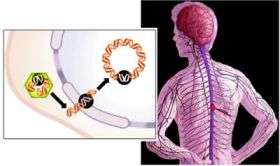
The gene transfer vector (left) is injected into the skin in the area of pain (red line, right). From the skin, the vector is carried into sensory nerves and releases the inhibitory neurotransmitter locally in the spinal cord (red oval). Image: University of Michigan

This week, University of Michigan scientists will begin a phase 1 clinical trial for the treatment of cancer-related pain, using a novel gene transfer vector injected into the skin to deliver a pain-relieving gene to the nervous system.

A gene transfer vector is an agent used to carry genes into cells. In this groundbreaking clinical trial, the investigators will use a vector created from herpes simplex virus (HSV) – the virus that causes cold sores – to deliver the gene for enkephalin, one of the body's own natural pain relievers.

"In pre-clinical studies, we have found that HSV-mediated transfer of enkephalin can reduce chronic pain," says David Fink, M.D., Robert Brear Professor and chair of the department of neurology at the U-M Medical School. Fink developed the vector with collaborators and will direct the study.

"After almost two decades of development and more than eight years of studies in animal models of pain, we have reached the point where we are ready to find out whether this approach will be effective in treating patients," Fink says. The investigators are recruiting 12 patients with intractable pain from cancer to examine whether the vector can be used safely to deliver its cargo to sensory nerves.

The trial represents two firsts, says Fink: It is the first human trial of gene therapy for pain, and the first study to test a nonreplicating HSV-based vector to deliver a therapeutic gene to humans. Fink says the technique may hold promise for treating other types of chronic pain, including pain from nerve damage that occurs in many people with diabetes.

The HSV vector, genetically altered so it cannot reproduce, has a distinct advantage, Fink says: "Because HSV naturally travels to nerve cells from the skin, the HSV-based vector can be injected in the skin to target pain pathways in the nervous system."

Gene therapy for pain

Chronic pain is an important clinical problem that, despite a wide array of therapeutic options, cannot be effectively treated in a substantial number of patients. Fink notes that one key problem in treating pain is that the targets of conventional pain-relieving medications tend to be widely distributed in the nervous system, so that "off target" side effects of the drugs often preclude the use of those drugs at fully effective doses.

"This provides the rationale for using gene transfer to treat pain," Fink says. "We use the vector to deliver and express a chemical that breaks down very quickly in the body. The targeted delivery allows us to selectively interrupt the transmission of pain-related signals and thus reduce the perception of pain."

Enkephalin is one member of the family of opioid peptides that are naturally produced in the body. Opioid peptides exert their pain-relieving effects by acting at the same receptor through which morphine and related opiate drugs achieve their pain-relieving effects. In this trial the enkephalin peptide, produced as a result of the gene transfer, will be released selectively in the spinal cord at a site involved in transmitting pain from the affected body part to the brain.

"We hope that this selective targeting will result in pain-relieving effects that cannot be achieved by systemic administration of opiate drugs, " Fink says. "This trial is the first step in bringing the therapy into clinical use. A treatment is at least several years off."

Preclinical studies led to human trial

The phase I clinical trial represents the culmination of studies performed by investigators working in the U-M laboratory co-directed by Fink and his wife, Marina Mata, M.D., also a professor of neurology at U-M, along with colleagues at the University of Pittsburgh led by Joseph Glorioso, Ph.D. In published studies, the researchers have demonstrated that HSV-mediated gene transfer is effective in rats with pain resulting from inflammation, nerve damage or spinal cord injury, and in mice with pain caused by cancer. The extensive preclinical data in animal models were reviewed by the Recombinant DNA Advisory Committee at the National Institutes of Health. The Food and Drug Administration approved an investigational new drug application for the therapy in February.

Source: University of Michigan


print this article email this article download pdf blog this article bookmark this article     Digg this Stumble it share on Facebook share on Reddit add to delicious save to Yahoo! bookmarks
5/5 after 4 votes


September 15th, 2008 all stories
Medicine & Health / Research

Comments: 0
Rank: 5/5 after 4 votes

  • Stumble this up

  • Digg this

  • Share it:
  • share on Facebook
  • share on MySpace
  • share on Slashdot
  • rss-newsfeed
  • share on Google
  • share on Reddit
  • add to delicious
  • save to Yahoo! bookmarks
  • share on Windows Live
  • Add to Mixx!
Rating: 5/5 after 4 votes

  • Related Stories

  • Gene therapy demonstrates benefit in patients with rheumatoid arthritis
    created Jan 26, 2009 | popularity not rated yet | comments 0
  • Researchers find relief for chronic pain
    created Jan 22, 2008 | popularity not rated yet | comments 0
  • Freeze-dried tendon implants prove effective in early studies
    created Jan 08, 2008 | popularity not rated yet | comments 0
  • Experimental gene therapy 'abolishes' arthritis pain and lessens joint damage
    created May 25, 2007 | popularity not rated yet | comments 0
  • A scientist probes the origins of 'ouch!'
    created Jul 02, 2009 | popularity not rated yet | comments 0


  • Physicists Demonstrate Quantum Memory with Matter Qubits
    Physicists Demonstrate Quantum Memory with Matter Qubits
    Physics / General Physics
    created Jul 03, 2009 | popularity 4.4 / 5 (17) | comments 1
  • 'Holey' Nanosheets for Wastewater Dye Removal
    Nanotechnology / Nanomaterials
    created Jul 01, 2009 | popularity 5 / 5 (5) | comments 1
  • Jellyfish Robot Swims Like its Biological Counterpart
    Jellyfish Robot Swims Like its Biological Counterpart
    Electronics / Robotics
    created Jun 26, 2009 | popularity 4.4 / 5 (8) | comments 1
  • Could Maxwell's Demon Exist in Nanoscale Systems?
    Could Maxwell's Demon Exist in Nanoscale Systems?
    Physics / General Physics
    created Jun 24, 2009 | popularity 4.4 / 5 (18) | comments 29
  • Living Safely with Robots, Beyond Asimov's Laws
    Living Safely with Robots, Beyond Asimov's Laws
    Electronics / Robotics
    created Jun 22, 2009 | popularity 4.6 / 5 (52) | comments 40
  • Other News

    Variations in 5 genes raise risk for most common brain tumors

    Medicine & Health / Genetics

    created 10 hours ago | popularity not rated yet | comments 1

    Common genetic variations spread across five genes raise a person's risk of developing the most frequent type of brain tumor, an international research team reports online in Nature Genetics.


    Researchers highlight new direction for drug discovery

    Medicine & Health / Research

    created 8 hours ago | popularity not rated yet | comments 0

    In a discovery that rebuffs conventional scientific thinking, researchers at Georgetown University Medical Center (GUMC) have discovered a novel way to block the activity of the fusion protein responsible for Ewing's sarcoma, ...


    MicroRNAs hold promise for treating diseases in blood vessels

    Medicine & Health / Research

    created 11 hours ago | popularity not rated yet | comments 0

    A newly discovered mechanism controls whether muscle cells in blood vessels hasten the development of both atherosclerosis and Alzheimer's disease, according to an article published online today in the journal Nature.


    Wind power may have its own environmental problems

    Medicine & Health / Health

    created 10 hours ago | popularity 3.8 / 5 (5) | comments 3

    Wind power generation is expected to be a clean and environmentally friendly natural energy source, but a new kind of environmental problem has surfaced as infrasonic waves caused by windmills are suspected of causing health ...


    Malaysian authorities seize 'Viagra coffee' : report

    Medicine & Health / Health

    created 14 hours ago | popularity not rated yet | comments 1

    Malaysia's health authorities have seized over 20,000 dollars worth of coffee mixed with sildenafil, the main ingredient in erectile dysfunction drug Viagra, a report said Sunday.