Giant grass offers clues to growing corn in cooler climes, researchers report
September 15, 2008 On the Menu: Cold Corn?

Enlarge

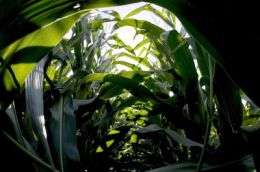
A protein that gives Miscanthus an advantage in cool weather may be used to develop cold-tolerant corn varieties. Photo by Don Hamerman

A giant perennial grass used as a biofuels source has a much longer growing season than corn, and researchers think they've found the secret of its success. Their findings offer a promising avenue for developing cold-tolerant corn, an advance that would significantly boost per-acre yields. The new study, from researchers at University of Illinois, appears this month in Plant Physiology Preview.

Miscanthus x giganteus is one of the most productive grasses known. It is able to capture the sun's energy even as cool temperatures shut down photosynthesis in other plants.

In Illinois, green Miscanthus leaves emerge up to six weeks before corn can be planted. Miscanthus thrives into late October, while corn leaves wither at the end of August.

Corn and Miscanthus are C4 plants, which are more efficient than C3 plants in converting sunlight into leaves and stalks. (C3 and C4 simply refer to the number of carbon atoms in a molecule critical to photosynthesis.)

"The C4 process differs from C3 in having just four extra steps in its metabolism," said Stephen Long, a professor of crop sciences and principal investigator on the study. "There are four extra proteins in this process, so we assumed that these proteins are related to low temperature tolerance."

When they compared the levels of these proteins in plants grown in warm and cold conditions, the researchers noticed that one of the proteins, pyruvate phosphate dikinase (PPDK), was present at much higher levels in the Miscanthus leaves grown at cool temperatures than in the leaves of either corn or Miscanthus grown in warmer conditions.

Although photosynthesis declined in both plants when they were first subjected to cool temperatures, after two days, photosynthesis rebounded in the Miscanthus.

The increase corresponded to the upsurge in PPDK in its leaves.

"After seven days PPDK was 10 times the level it was in the warm conditions," Long said.

In C4 plants, PPDK catalyzes a chemical reaction in the leaf critical to the cascade of reactions that convert carbon from carbon dioxide into starches that form the plant's tissues.

Previous studies had shown that PPDK is generally not very stable in cold conditions. The protein is made up of four subunits, which tend to come apart at low temperatures, Long said.

To test how cold temperatures affect the protein when it is expressed in cells at high concentrations, post-doctoral fellow Dafu Wang cloned the PPDK gene into E. coli bacteria to produce large quantities of the protein.

"What he showed in the test tube was that if you concentrate the protein, then it becomes more resistant to cold," Long said. "At higher concentration the protein creates its own microenvironment where in the cold it doesn't come apart. This appears to be the secret of success for Miscanthus at low temperature: Expressing more of the protein allows it to photosynthesize at low temperature where corn can't."

The next step for the researchers is to develop a corn plant in which this gene is expressed at high levels to determine if that will make the corn more tolerant of low temperatures, Long said. Cold weather after emergence of corn in the spring or in late summer during grain-filling can limit photosynthesis, he said.

"This change should make corn more resistant to these cold weather events."

Source: University of Illinois at Urbana-Champaign


print this article email this article download pdf blog this article bookmark this article     Stumble it Digg this share on Facebook retweet share on Reddit add to delicious
Rate this story - 5 /5 (2 votes)

Rank Filter

Move the slider to adjust rank threshold, so that you can hide some of the comments.


Display comments: newest first

  • Rick69 - Sep 15, 2008
    • Rank: 1.7 / 5 (6)
    Don't bother using this knowledge to try and improve living conditions in Africa and most European countries. They would rather starve to death than use plants that haven't developed the "natural way".
  • thinking - Sep 15, 2008
    • Rank: 1 / 5 (3)
    This is great news though.... if global cooling is underway.
  • Jones_Locker - Nov 16, 2008
    • Rank: not rated yet
    And Rightly so Rick69.
    The general idea is to stop effing with mother nature. When will these people get a clue.

September 15, 2008 all stories

Comments: 3

5 /5 (2 votes)
  • Stumble this up

  • Digg this

  • share this

  • hide
  • Related Stories

  • Key discovered to cold tolerance in corn
    created Aug 29, 2008 | popularity not rated yet | comments 0
  • Genomes of biofuel yeasts reveal clues that could boost fuel ethanol production
    created Nov 05, 2009 | popularity not rated yet | comments 0
  • Whole grain cereals, popcorn rich in antioxidants, not just fiber: study
    created Aug 18, 2009 | popularity not rated yet | comments 0
  • Biofuel production: a drink-or-drive issue?
    created Apr 30, 2009 | popularity not rated yet | comments 0
  • Doubling a gene in corn results in giant biomass
    created Mar 02, 2009 | popularity not rated yet | comments 0


Other News

New discovery allows scientists for the first time to experimentally annotate genomes

New discovery allows scientists for the first time to experimentally annotate genomes

Biology / Biotechnology

created 1hour ago | popularity 5 / 5 (1) | comments 0

Over the last 20 years, the sequencing of the human genome, along with related organisms, has represented one of the largest scientific endeavors in the history of mankind. The information collected from genome ...


Scientists successfully reprogram blood cells

Biology / Cell & Microbiology

created 2 hours ago | popularity 5 / 5 (1) | comments 0

Researchers have transplanted genetically modified hematopoietic stem cells into mice so that their developing red blood cells produce a critical lysosomal enzyme -preventing or reducing organ and central nervous system damage ...


Wasp

Well-traveled wasps provide hope for vanishing species

Biology / Plants & Animals

created 2 hours ago | popularity not rated yet | comments 0

They may only be 1.5mm in size, but the tiny wasps that pollinate fig trees can travel over 160km in less than 48 hours, according to research from scientists at the University of Leeds. The fig wasps are transporting ...


Study shows that some malignant tumors can be shut down after all

Biology / Cell & Microbiology

created 6 hours ago | popularity 5 / 5 (3) | comments 1

Oncologists have had their hands tied because more than half of all human cancers have mutations that disable a protein called p53. As a critical anti-cancer watchdog, p53 masterminds several cancer-fighting operations within ...


Drought resistance explained

Drought resistance explained

Biology / Cell & Microbiology

created 5 hours ago | popularity 5 / 5 (1) | comments 0

Much as adrenaline coursing through our veins drives our body's reactions to stress, the plant hormone abscisic acid (ABA) is behind plants' responses to stressful situations such as drought, but how it does ...