New ant species discovered in the Amazon likely represents oldest living lineage of ants
September 15, 2008 New Amazonian Ant

Enlarge

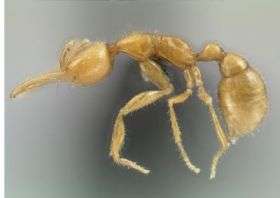
This new species of blind, subterranean, predatory ant, Martialis heureka, was discovered in the Amazon by Christian Rabeling at the University of Texas at Austin. It belongs to the first new subfamily of living ants discovered since 1923, and is a descendant of one of the first ant lineages to evolve over 120 million years ago. Credit: Christian Rabeling, the University of Texas at Austin

A new species of blind, subterranean, predatory ant discovered in the Amazon rainforest by University of Texas at Austin evolutionary biologist Christian Rabeling is likely a descendant of the very first ants to evolve.

The new ant is named Martialis heureka, which translates roughly to "ant from Mars," because the ant has a combination of characteristics never before recorded. It is adapted for dwelling in the soil, is two to three millimeters long, pale, and has no eyes and large mandibles, which Rabeling and colleagues suspect it uses to capture prey.

The ant also belongs to its own new subfamily, one of 21 subfamilies in ants. This is the first time that a new subfamily of ants with living species has been discovered since 1923 (other new subfamilies have been discovered from fossil ants).

Rabeling says his discovery will help biologists better understand the biodiversity and evolution of ants, which are abundant and ecologically important insects.

"This discovery hints at a wealth of species, possibly of great evolutionary importance, still hidden in the soils of the remaining rainforests," writes Rabeling and his co-authors in a paper reporting their discovery this week in the Proceedings of the National Academy of Sciences.

Rabeling collected the only known specimen of the new ant species in 2003 from leaf-litter at the Empresa Brasileira de Pesquisa Agropecuária in Manaus, Brazil.

He and his colleagues found that the ant was a new species, genus and subfamily after morphological and genetic analysis. Analysis of DNA from the ant's legs confirmed its phylogenetic position at the very base of the ant evolutionary tree.

Ants evolved over 120 million years ago from wasp ancestors. They probably evolved quickly into many different lineages, with ants specializing to lives in the soil, leaf-litter or trees, or becoming generalists.

"This discovery lends support to the idea that blind subterranean predator ants arose at the dawn of ant evolution," says Rabeling, a graduate student in the ecology, evolution and behavior program.

Rabeling does not suggest that the ancestor to all ants was blind and subterranean, but that these adaptations arose early and have persisted over the years.

"Based on our data and the fossil record, we assume that the ancestor of this ant was somewhat wasp-like, perhaps similar to the Cretaceous amber fossil Sphecomyrma, which is widely known as the evolutionary missing link between wasps and ants," says Rabeling.

He speculates that the new ant species evolved adaptations over time to its subterranean habitat (for example, loss of eyes and pale body color), while retaining some of its ancestor's physical characteristics.

"The new ant species is hidden in environmentally stable tropical soils with potentially less competition from other ants and in a relatively stable microclimate," he says. "It could represent a 'relict' species that retained some ancestral morphological characteristics."

Source: University of Texas at Austin


print this article email this article download pdf blog this article bookmark this article     Stumble it Digg this share on Facebook retweet share on Reddit add to delicious
Rate this story - 4.4 /5 (91 votes)

Rank Filter

Move the slider to adjust rank threshold, so that you can hide some of the comments.


Display comments: newest first

  • gmurphy - Sep 16, 2008
    • Rank: 3 / 5 (1)
    army ants (usually from Africa but also Australia) are blind and predatory. They use their antennae to detect prey (smell and touch) http://www.insect...dex.html
  • KB6 - Sep 16, 2008
    • Rank: 4 / 5 (2)
    "...the Cretaceous amber fossil Sphecomyrma, which is widely known as the evolutionary missing link between wasps and ants..."
    --
    There are no intermediate fossil forms!

    Just kidding ;)
  • hitch - Sep 17, 2008
    • Rank: 1 / 5 (6)
    "There are no intermediate fossil forms! just kidding"
    You shouldn't be. The only intermediates, not within the family, are speculated ones. So it's incorrect to assume an intermediate without proof. There is none. Indeed Darwinism must speculate intermediates by default because of it's underlying assumptions.

    A non neo-Darwinian evolutionist would not speculate that anything is an intermediate - based on morphological similarities - without sufficient evidence. Again, there is none.
    You must assume neo-Darwinian is true to even allow intermediates between families. No one disputes mere adaptations.

    One need only look at what neo-Darwinians consider to be the ancestor of the whale to see how ridiculous these speculations can get.

    No proof required, no evidence required just tell a nice speculative story and poof! There's your intermediate.
  • skelliot - Sep 18, 2008
    • Rank: 5 / 5 (4)
    No offense hitch, and I hate to go ad hominem but...you are an apologist moron. Every new fossil creates two new gaps right? Keep digging in your bible for confirmation, moron.
  • nano999 - Sep 19, 2008
    • Rank: 3.7 / 5 (3)
    hitch:

    Deuteronomy 23:12-14 - God gives us instructions for defecating. He says to carefully cover up all feces "for the Lord walketh in the midst of thy camp." (You wouldn't want the divine foot to step in your turds, would you?)
    (from skepticsannotatedbible.com)

    Are we supposed to respect this comedy?
  • KB6 - Sep 19, 2008
    • Rank: not rated yet
    "One need only look at what neo-Darwinians consider to be the ancestor of the whale to see how ridiculous these speculations can get."
    ---
    Here's some credible info about the "ridiculous" evolution of whales and the pertinent fossils:

    http://tinyurl.com/u3nok

    But I really doubt that it will change anyone's mind on the subject whatsoever. That doubt is based on years of frustrating experience.

September 15, 2008 all stories

Comments: 6

4.4 /5 (91 votes)
  • Stumble this up

  • Digg this

  • share this

  • hide
  • Related Stories

  • Like humans, ants use bacteria to make their gardens grow
    created Nov 19, 2009 | popularity not rated yet | comments 0
  • Rapacious Rasberry ants march north
    created Nov 13, 2009 | popularity not rated yet | comments 0
  • Ants are friendly to some trees, but not others
    created Nov 06, 2009 | popularity not rated yet | comments 0
  • When ants attack: Researchers recreate chemicals that trigger aggression
    created Oct 27, 2009 | popularity not rated yet | comments 0
  • Herbivory discovered in a spider
    created Oct 12, 2009 | popularity not rated yet | comments 0


Other News

The Monarchs' annual migration ritual has yet to be scientifically explained

Tree-eating bugs threaten Monarch butterfly in Mexico

Biology / Ecology

created 8 hours ago | popularity 4 / 5 (1) | comments 0

The mysterious Monarch butterfly, which migrates en masse annually between Canada and Mexico, is now facing a new peril: another insect thriving in Western Mexican forests.


Bigger not necessarily better, when it comes to brains

Bigger not necessarily better, when it comes to brains

Biology / Plants & Animals

created Nov 17, 2009 | popularity 4.5 / 5 (17) | comments 11

(PhysOrg.com) -- Tiny insects could be as intelligent as much bigger animals, despite only having a brain the size of a pinhead, say scientists at Queen Mary, University of London.


Extinct goat Myotragus balearicus

Extinct goat was cold-blooded

Biology / Plants & Animals

created Nov 18, 2009 | popularity 4.9 / 5 (33) | comments 10

(PhysOrg.com) -- An extinct goat that lived on a barren Mediterranean island survived for millions of years by reducing in size and by becoming cold-blooded, which has never before been discovered in mammals.


Right-handed chimpanzees provide clues to the origin of human language

Biology / Plants & Animals

created Nov 16, 2009 | popularity 3 / 5 (1) | comments 7

Most of the linguistic functions in humans are controlled by the left cerebral hemisphere. A study of captive chimpanzees at the Yerkes National Primate Research Center (Atlanta, Georgia), reported in the January 2010 issue ...


The creature was found at a depth of 161 metres

Japanese researchers film rare baby fish 'fossil'

Biology / Plants & Animals

created Nov 17, 2009 | popularity 4.7 / 5 (7) | comments 4

Japanese marine researchers said Tuesday they had found and successfully filmed a young coelacanth -- a rare type of fish known as "a living fossil" -- in deep water off Indonesia.