New study will make criminals sweat
September 16, 2008
New study will make criminals sweat

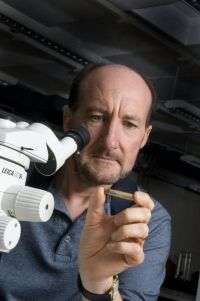
Dr. John Bond of Northamptonshire Police Scientific Support and Honorary Research Fellow at the University of Leicester's Forensic Research Center. Image: University of Leicester

(PhysOrg.com) -- The inventor of a revolutionary new forensic fingerprinting technique claims criminals who eat processed foods are more likely to be discovered by police through their fingerprint sweat corroding metal.

Dr John Bond, a researcher at the University of Leicester and scientific support officer at Northamptonshire Police, said processed food fans are more likely to leave tell-tale signs at a crime scene.

Speaking before a conference on forensic science at the University of Leicester, Dr Bond said sweaty fingerprint marks made more of a corrosive impression on metal if they had a high salt content.

And he revealed he was currently in early talks with colleagues at the University of Leicester to assess whether a sweat mark left at a crime scene could be analysed to reveal a 'sweat profile' ie more about the type of person who left the mark.

Dr Bond, from Northamptonshire Police Scientific Support Unit is an Honorary Research Fellow at the University of Leicester's Forensic Research Centre. He has developed a method that enables scientists to 'visualise fingerprints' even after the print itself has been removed. He and colleagues conducted a study into the way fingerprints can corrode metal surfaces. The technique can enhance – after firing– a fingerprint that has been deposited on a small calibre metal cartridge case before it is fired.

Dr Bond said: "On the basis that processed foods tend to be high in salt as a preservative, the body needs to excrete excess salt which comes out as sweat through the pores in our fingers.

"So the sweaty fingerprint impression you leave when you touch a surface will be high in salt if you eat a lot of processed foods -the higher the salt, the better the corrosion of the metal."

Dr Bond added there was therefore an indirect link therefore between obesity and the chances of being caught of a crime. "Other research has drawn links between processed foods and obesity and we know that consumers of processed foods will leave better fingerprints," he said.

Dr Bond said there was scope to take his research further and to look at the constituents of sweat itself in order to profile an individual: "We are currently in talks with the University of Leicester to see if there is scope to investigate sweat itself and whether it can identify the type of person who left that sweat mark.

"This is because the amount of sweat people leave varies and the components of the sweat varies. Important for us is how the salt varies but there is potential to investigate other elements to describe the kind of person who left the mark. It would give lifestyle information that, whilst nowhere near as good as identifying individuals with their fingerprints, it is still very good for police if they have got nothing else to go on.

"This would be particularly helpful for terrorist type crimes where the nature of the incident would tend to obliterate forensic evidence. So a sweat mark on a piece of metal or bomb fragment that might be recovered from an incident might be able to provide a clue to the type of person who perpetrated the incident."

"We would describe the study of sweat as a process of intelligent fingerprinting - using the fingerprint to tell us more about the individual rather than a simple identification."

Provided by University of Leicester

3.9 /5 (14 votes)  

Rank 3.9 /5 (14 votes)
Relevant PhysicsForums posts

More news stories

Hydrogen from acidic water: Researchers develop potential low cost alternative to platinum for splitting water

A technique for creating a new molecule that structurally and chemically replicates the active part of the widely used industrial catalyst molybdenite has been developed by researchers with the Lawrence Berkeley ...

Chemistry / Materials Science

created Feb 09, 2012 | popularity 4.8 / 5 (15) | comments 21 | with audio podcast

Fool's gold may prove an unlikely alternative to overexploited catalytic materials

Catalytic materials, which lower the energy barriers for chemical reactions, are used in everything from the commercial production of chemicals to catalytic converters in car engines. However, with current catalytic materials ...

Chemistry / Materials Science

created Feb 10, 2012 | popularity 4.4 / 5 (8) | comments 8 | with audio podcast

Research provides octagonal window of opportunity for carbon capture

(PhysOrg.com) -- Filtering carbon dioxide, a greenhouse gas, from factory smokestacks is a necessary, but expensive part of many manufacturing processes. However, a collaborative research team from the National ...

Chemistry / Materials Science

created Feb 08, 2012 | popularity 5 / 5 (1) | comments 5 | with audio podcast

Flexible paper robots

(PhysOrg.com) -- These inexpensive robots can stretch, bend and twist under control, and lift objects up to 120 times their own weight. Being soft, they can apply gentle and even pressure, and adapt to varied ...

Chemistry / Materials Science

created Feb 09, 2012 | popularity 5 / 5 (5) | comments 4 | with audio podcast

New form of hafnium oxide developed

(PhysOrg.com) -- A novel material developed by researchers at the University of Cambridge is opening up new possibilities for next generation electronic and optoelectronic devices, and paving the way for further ...

Chemistry / Materials Science

created Feb 07, 2012 | popularity 4.6 / 5 (5) | comments 4 | with audio podcast


Google might launch Drive for cloud storage soon

(PhysOrg.com) -- Google's next big move, according to the Wall Street Journal, is a cloud storage service called Drive. Hardly first to the plate, Google is simply catching up to introducing its cloud reposi ...

Latin America mining boom clashes with conservation

Latin America is experiencing a mining boom as prices rise fuelled by a hike in global demand, but the region is also being hit by a wave of violent protests, strikes and rallies by environmentalists.

Love a click away in Indonesia's Twitter Republic

He was a geeky kid from Yogyakarta, she a glamorous city girl in Jakarta. In a country with one of the world's most vibrant social networking scenes they fell in love on Twitter.

Walney offshore wind farm is world's biggest (for now)

(PhysOrg.com) -- The Walney wind farm on the Irish Sea--characterized by high tides, waves and windy weather--officially opened this week. The farm is treated in the press as a very big deal as the Walney ...

GPS court ruling leaves US phone tracking unclear

A US Supreme Court decision requiring a warrant to place a GPS device on the car of a criminal suspect leaves unresolved the bigger issue of police tracking using mobile phones, legal experts say.

Europeans protest controversial Internet pact

Tens of thousands of people marched in protests in more than a dozen European cities Saturday against a controversial anti-online piracy pact that critics say could curtail Internet freedom.