Fantastic photographs of fluorescent fish
September 16, 2008 Fantastic photographs of fluorescent fish

Enlarge

Image: BMC

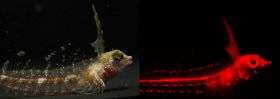
Scientists have discovered that certain fish are capable of glowing red. Research published today in BMC Ecology includes striking images of fish fluorescing vivid red light.

Due to absorption of ‘red’ wavelengths of sunlight by sea-water, objects which look red under normal conditions appear grey or black at depths below 10m. This has contributed to the belief among marine biologists that red colours are of no importance to fish.

Nico Michiels, from the University of Tübingen, Germany, led a team of researchers who captured the striking images in the article which, as he describes, “Shows that red fluorescence is widespread among marine fish. Our findings challenge the notion that red light is of no importance to marine fish, calling for a reassessment of its role in fish visual ecology”.

The authors identified at least 32 reef fish species belonging to 16 genera in 5 families that fluoresced visibly in red. Because the light is coming from the fish themselves and not filtering down from the surface, the red glow remains visible at depth and is easily seen at close distances. The authors speculate that red fluorescence may function as a communication or attraction signal, as proposed for other fluorescent animals, “We believe red fluorescence may be part of a private communication system in fish. Red fluorescence is at the borderline of what is visible to many marine fish, and due to rapid attenuation of red light by water, even those that can see red will be able to see it over short distances only. Fluorescent eye rings may function as an indicator of presence or reveal the direction of gaze.”

Citation: Red fluorescence in reef fish: a novel signaling mechanism? Nico K. Michiels, Nils Anthes, Nathan S. Hart, Juergen Herler, Alfred J. Meixner, Frank Schleifenbaum, Gregor Schulte, Ulrike E. Siebeck, Dennis Sprenger and Matthias F. Wucherer; BMC Ecology (in press)

Source: BioMed Central


print this article email this article download pdf blog this article bookmark this article     Stumble it Digg this share on Facebook retweet share on Reddit add to delicious
Rate this story - 4.2 /5 (18 votes)


September 16, 2008 all stories

Comments: 0

4.2 /5 (18 votes)
  • Stumble this up

  • Digg this

  • share this

  • hide
  • Related Stories

  • Nanoparticles in cosmetics/personal care products may have adverse environmental effects
    created Mar 26, 2009 | popularity not rated yet | comments 0
  • Mutated gene in zebrafish sheds light on blindness in humans
    created Mar 24, 2009 | popularity not rated yet | comments 0
  • How red blood cells nuke their nuclei
    created Feb 10, 2008 | popularity not rated yet | comments 0
  • Unknowlingly consuming endangered tuna
    created Nov 19, 2009 | popularity not rated yet | comments 0
  • Small nanoparticles bring big improvement to medical imaging
    created Nov 18, 2009 | popularity not rated yet | comments 0


Other News

Indian engineer invents device to stop rampaging elephants

Biology / Plants & Animals

created 27 minutes ago | popularity not rated yet | comments 0

An Indian inventor has created a device to stop rampaging elephants in their tracks, amid concern about human injuries and deaths when they run amok, his company said Monday.


It's a gas: New discovery may lead to heartier, high-yielding plants

Biology / Biotechnology

created 27 minutes ago | popularity 5 / 5 (1) | comments 0

In a research report published in the November 2009 issue of the journal Genetics, scientists show how a family of genes (1-aminocyclopropane-1-carboxylate synthase, or ACS genes) are responsible for production of ethyle ...


Measuring and modeling blood flow in malaria

Biology / Cell & Microbiology

created 3 hours ago | popularity not rated yet | comments 0

When people have malaria, they are infected with Plasmodium parasites, which enter the body from the saliva of a mosquito, infect cells in the liver, and then spread to red blood cells. Inside the blood cells, the parasites ...


Beyond sunlight: Explorers census 17,650 ocean species between edge of darkness and black abyss

Beyond sunlight: Explorers census 17,650 ocean species between edge of darkness and black abyss (w/ Video)

Biology / Plants & Animals

created 19 hours ago | popularity 4.9 / 5 (12) | comments 0

Census of Marine Life scientists have inventoried an astonishing abundance, diversity and distribution of deep sea species that have never known sunlight - creatures that somehow manage a living in a frigid ...


Bioengineers succeed in producing plastic without the use of fossil fuels

Biology / Biotechnology

created 2 hours ago | popularity 5 / 5 (1) | comments 0

A team of pioneering South Korean scientists have succeeded in producing the polymers used for everyday plastics through bioengineering, rather than through the use of fossil fuel based chemicals. This groundbreaking research, ...