Kopernikus, observing our planet for a safer world
September 16, 2008 Kopernikus, observing our planet for a safer world

Enlarge

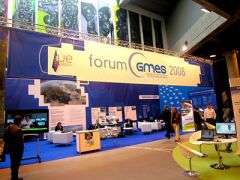
European GMES exhibition stand at the GMES 2008 Lille forum. Credits: CNES - Fabien Ploegaerts

The new name of the European GMES Programme (Global Monitoring for Environment and Security) has been unveiled: Kopernikus. The European Commission Vice President Günter Verheugen announced the name today at the GMES 2008 Lille forum.

Europe is presenting Kopernikus at the forum as the second flagship of the European Space Policy following Galileo, the first flagship. The GMES 2008 forum is organised in the framework of the European Union French Presidency.

All partners of the initiative have expressed strong political support for Kopernikus ahead of the 5th Space Council decisions to be tabled on 26 September 2008 in Brussels.

Pre-operational GMES/Kopernikus services in the areas of ocean, land, atmosphere, risks, climate change and security are being presented at the forum to decision makers and users. All actors are stressing the need for long-term sustainability of this public programme, as well as the need to grant continuity of data and services for the users.

At Lille, the European Commission (EC) stressed ESA's role as coordinator of the Kopernikus Space Component with its development and procurement role for the Sentinel Satellite series and its role of coordinator for contributing missions by Member States and other relevant partners of Kopernikus, such as the European Organisation for the Exploitation of Meteorological Satellites (EUMETSAT).

Over the last 30 years ESA has been developing Earth Observation satellites, notably all the European meteorological satellites in cooperation with EUMETSAT, but also the ERS-1, -2 and Envisat satellites, which are mostly oriented to perform measurements relevant for environmental and climate research.

Based on this long-lasting experience and on requirements derived from applications, ESA is already developing new missions called 'Sentinels'. The five Sentinel families under development will feature radar and multi-spectral imaging as well as ocean and atmospheric monitoring capacities. The industrial phase of the first three of the five satellites is already ongoing.

As the 15th century scientist Copernicus revolutionised the understanding of our universe, Kopernikus brings the Earth back to the 'centre' of our concerns and will help us care for a better and safer world.

Source: European Space Agency


print this article email this article download pdf blog this article bookmark this article     Stumble it Digg this share on Facebook retweet share on Reddit add to delicious
Rate this story - 3.7 /5 (3 votes)


September 16, 2008 all stories

Comments: 0

3.7 /5 (3 votes)
  • Stumble this up

  • Digg this

  • share this

  • hide
  • Related Stories


  • hide
  • Relevant PhysicsForums posts

  • Climate Science Update
    created 14 hours ago
  • The IPCC and the term "most"
    created Nov 23, 2009
  • Is global warming a fact?
    created Nov 23, 2009
  • Random variability of wind patterns
    created Nov 23, 2009
  • More from Physics Forums - Earth

Other News

Fermi Telescope Peers Deep into Microquasar

Fermi Telescope Peers Deep into Microquasar (w/ Video)

Space & Earth / Astronomy

created 10 hours ago | popularity 4.5 / 5 (6) | comments 0

(PhysOrg.com) -- NASA's Fermi Gamma-ray Space Telescope has made the first unambiguous detection of high-energy gamma-rays from an enigmatic binary system known as Cygnus X-3. The system pairs a hot, massive ...


The Energy Sources of Ultraluminous Galaxies

The Energy Sources of Ultraluminous Galaxies

Space & Earth / Astronomy

created 11 hours ago | popularity 4.3 / 5 (9) | comments 0

(PhysOrg.com) -- Ultraluminous infrared galaxies ((ULIRGs) are galaxies whose luminosity exceeds that of a trillion suns; for comparison, the Milky Way galaxy has a typical (and much more modest) luminosity ...


Space shuttle Atlantis, 7 astronauts back on Earth (AP)

Space shuttle Atlantis, 7 astronauts back on Earth

Space & Earth / Space Exploration

created 12 hours ago | popularity not rated yet | comments 0

(AP) -- Space shuttle Atlantis and its seven astronauts returned to Earth with a smooth touchdown Friday to end an 11-day flight that resupplied the International Space Station.


China is set to launch its second moon orbiter next October, state media have reported

China to launch second lunar probe: state media

Space & Earth / Space Exploration

created 16 hours ago | popularity 5 / 5 (4) | comments 0

China will launch its second moon orbiter next October, state media reported Friday, as it powers ahead with a space programme that has sparked concerns abroad.


Herschel takes a peek at the ingredients of the galaxies

Herschel takes a peek at the ingredients of the galaxies

Space & Earth / Astronomy

created 9 hours ago | popularity 4.3 / 5 (3) | comments 0

(PhysOrg.com) -- The European Space Agency has today released spectacular new observations from the Herschel Space Observatory, including the UK-led SPIRE instrument. Spectrometers on board all three Hershel ...