Arctic sea ice settles at second-lowest, underscores accelerating decline
September 16, 2008
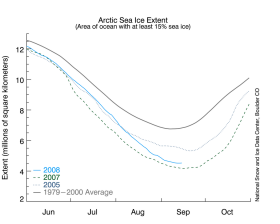
The graph above shows daily sea ice extent.The solid light blue line indicates 2008; the dashed green line shows 2007; the dotted line shows 2005; the solid gray line indicates average extent from 1979 to 2000. Sea Ice Index data. Credit: National Snow and Ice Data Center
The Arctic sea ice cover appears to have reached its minimum extent for the year, the second-lowest extent recorded since satellite record-keeping began in 1979, according to the University of Colorado at Boulder's National Snow and Ice Data Center, or NSIDC.
While slightly above the record-low minimum set on Sept. 16, 2007, this season further reinforces the strong negative trend in summertime sea ice extent observed over the past 30 years, according to NSIDC researchers.
NSIDC will issue a press release at the beginning of October with full analysis of the possible causes behind this year's low ice conditions, particularly interesting aspects of the melt season, the conditions going into the winter growth season ahead, and graphics comparing this year to the long-term record.
Source: University of Colorado at Boulder, NSIDC
-
In scientific coup, Russians reach Antarctic lake
Feb 08, 2012 |
4.3 / 5 (7) |
6
-
New study shows correlation between summer Arctic sea ice cover and winter weather in Central Europe
Feb 01, 2012 |
4.8 / 5 (5) |
0
-
What do killer whales eat in the Arctic?
Jan 30, 2012 |
4 / 5 (1) |
0
-
New study may answer questions about enigmatic Little Ice Age
Jan 30, 2012 |
4.7 / 5 (7) |
9
-
CU-Boulder-led team to assess decline of Arctic sea ice in Alaska's Beaufort Sea
Jan 26, 2012 |
5 / 5 (1) |
2
-
Fast photon control brings quantum photonic technologies closer
31 minutes ago |
5 / 5 (2) |
0
-
Engineers build first sub-10-nm carbon nanotube transistor
Feb 01, 2012 |
4.9 / 5 (33) |
30
-
Something old, something new: Evolution and the structural divergence of duplicate genes
Jan 31, 2012 |
4.6 / 5 (7) |
1
-
The hidden nanoworld of ice crystals: Revealing the dynamic behavior of quasi-liquid layers
Jan 30, 2012 |
5 / 5 (5) |
1
-
Stock market network reveals investor clustering
Jan 27, 2012 |
3.9 / 5 (23) |
8
-
Do some geologists actually act a lot like Randy Marsh?
Feb 11, 2012
-
Discrepancy between oxygen and carbon-dioxide levels
Feb 09, 2012
-
where gems are found in the world
Feb 09, 2012
-
Wind Waves in Reservoir ~ Wind run-up and Wind set-up
Feb 08, 2012
-
Balance of oxygen in the atmosphere
Feb 01, 2012
-
The case for a methanol-based economy
Jan 30, 2012
- More from Physics Forums - Earth
More news stories
Planck mission steps closer to the cosmic blueprint
(PhysOrg.com) -- ESA's Planck mission has revealed that our Galaxy contains previously undiscovered islands of cold gas and a mysterious haze of microwaves. These results give scientists new treasure to mine ...
2 minutes ago |
not rated yet |
0
|
Scientists drill two miles down to ancient Lake Vostok
(PhysOrg.com) -- Russian scientists last week finished penetrating more than two miles through the Antarctic ice sheet to Lake Vostok, a huge freshwater lake that has been buried under the ice for millions ...
Space & Earth / Earth Sciences
1 hour ago |
5 / 5 (1) |
0
Transforming galaxies
(PhysOrg.com) -- Many of the Universe's galaxies are like our own, displaying beautiful spiral arms wrapping around a bright nucleus. Examples in this stunning image, taken with the Wide Field Camera 3 on ...
1 hour ago |
5 / 5 (1) |
0
|
New European rocket lifts off on maiden flight
Europe on Monday successfully launched a new lightweight rocket carrying a test payload, culminating a more than 12-year quest to master the entire range of space launchers.
Space & Earth / Space Exploration
3 hours ago |
5 / 5 (5) |
2
Alien matter in the solar system: A galactic mismatch
This just in: The Solar System is different from the space just outside it.
Space & Earth / Space Exploration
1 hour ago |
4 / 5 (5) |
6
|
Fast photon control brings quantum photonic technologies closer
(PhysOrg.com) -- Using photons instead of electrons to transmit information could lead to faster and more secure ways to communicate, among other advantages. Now a team of physicists has taken another step toward realizing ...
New ability to regrow blood vessels holds promise for treatment of heart disease
(Medical Xpress) -- University of Texas at Austin researchers have demonstrated a new and more effective method for regrowing blood vessels in the heart and limbs a research advancement that could have ...
Nanostructured electrodes for rechargeable sodium-Ion batteries
Highly efficient 3V cathodes for rechargeable sodium-ion batteries have been developed by users from Argonne National Laboratory's Materials Science, Chemical Sciences & Engineering, and X-ray Sciences Divisions, ...
A lost world? How zooarchaeology can inform biodiversity conservation
A new study of tropical forests will provide a 50,000-year perspective on how animal biodiversity has changed, explored through an archaeological investigation of animal bones.
Myths and shame keep many from seeking bankruptcy protection
(PhysOrg.com) -- Two interesting facts that may counter modern ideas about bankruptcy: The overwhelming majority of U.S. filings belong to individuals rather than corporations or entities, and most of these ...
Teaching teens safety in the virtual world
A new cyber safety program on the dangers of social networking is being developed by Flinders University, in light of an alarming report which shows children as young as 12 are meeting internet strangers in ...
Sep 16, 2008
Rank: 3.5 / 5 (11)
Sep 16, 2008
Rank: 3.5 / 5 (11)
Sep 16, 2008
Rank: 2.4 / 5 (10)
http://environmen...998.html
Sep 16, 2008
Rank: 3.2 / 5 (9)
Sep 18, 2008
Rank: 3.7 / 5 (3)
Sep 20, 2008
Rank: 2 / 5 (4)
The overwelming majority of climate scientists agree on lots of things.
Virtually all aruments are either anti-science or cherrypicked facts taken out of context.
Not one argument will prove or debunk the current theory of climate.
If this is all a hoax show how it done, many have tried to discredit science as a whole but noone has succeeded.
Anti-science on the other hand is easy to dismiss as there is nothing coherent in it, but it keeps popping up in different forms.Its like an annoying weed that needs to be kept short before it start to hurt the good plants.
Sep 21, 2008
Rank: 3.7 / 5 (3)
If we all had to scramble the jets to debunk every silly notion that pops up on the fringe, none of us would ever get any useful work done. That's why the onus is traditionally on the person MAKING an extraordinary claim to establish a strong argument, support it with lots of evidence, and defend it against aggressive criticism.
I think it's also fair to point out that, while Academy Awards, Nobel Peace Prizes, and lucrative carbon-credit concerns are impressive in their way, they do NOT constitute a compelling hypothesis test.
On the other hand, there are plenty of assertions regarding anthropogenic climate change that ARE falsifiable. And I must admit that I--along with a lot of others who care about good science--find it rather disingenuous to have our pointed, TOPICAL criticism answered with PERSONAL abuse.
It makes us wonder who stands to gain if that kind of argument wins the day... and who will foot the bill.
Sep 22, 2008
Rank: 2.3 / 5 (3)
Sometimes i get pretty upset and get a little harsh in my replies, i suppose its needed at times.
There are a lot of silly and obvious wrong assertions, but there are some that arent easily discarded.
For instance there are mayor scienticic organisations representing many scientists that have made statements regarding climate change that sound pretty serious to me.
"A Growing Threat to Society"
AAAS Board of Directors Statement on Climate Change: "The scientific evidence is clear," the AAAS Board says in a new statement. "Global climate change caused by human activities...is a growing threat to society." The statement was approved on 9 December 2006 and released on 18 February at the AAAS Annual Meeting in San Francisco.
NAS-The task of mitigating and preparing for the impacts of climate change will require worldwide collaborative inputs from a wide range of experts, including natural scientists, engineers, social scientists, medical scientists, those in government at all levels, business leaders and economists. Although the scientific understanding of climate change has advanced significantly in the last several decades, there are still many unanswered questions. Society faces increasing pressure to decide how best to respond to climate change and associated global changes, and applied research in direct support of decision making is needed.
From-http://www7.natio...view.asp
This alone makes me pretty confident that its real and serious.
Sep 22, 2008
Rank: 1 / 5 (3)
Issue is, it was complete fantasy.
Sep 22, 2008
Rank: 1 / 5 (2)
The people who took it serious were pretty naive to listen to the radio and not checking tv and internet,oh wait wasnt that before the internet and television was in every house.So the only source of information pretended there was an alien invasion and there were people who thought it was real.
Sep 22, 2008
Rank: 5 / 5 (2)
Knowledge has its basis in fact. Most epistemologists would agree that the scientific method is--among other things--a machine that refines raw facts into generalized, structured knowledge. With respect to knowledge, the difference between experts and laypeople isn't that theirs is BETTER. It's that the experts generally get their hands on it FIRST... more often than not, because they tend to produce the stuff.
The point is that the quality of a piece of knowledge has nothing to do with who articulates it... a true statement is true whether spoken by an expert, an idiot, or the union of the two. All that matters is that the knowledge in question was produced by a rigorous and repeatable METHOD, which included testing its assertions against the ground truth provided by the Universe.
Opinions, on the other hand, are like a**holes... everybody has one, and they all stink.
Sep 22, 2008
Rank: 1 / 5 (1)
Sep 22, 2008
Rank: 1 / 5 (1)
Wouldnt you rather go with the knowledge of experts than with the knowledge of laymen?Experts have much to lose compared to laymen, as a wrong assertion would hurt their careers where laymen at worst get ridiculed.
Big scientific organisations even more so, they depend on their reputation to exist.Therefore i would argue that statements that warn us cannot just be discarded for being just an opinion.
ARE you saying i cant trust those statements?
Sep 22, 2008
Rank: 3 / 5 (2)
Sep 23, 2008
Rank: 1 / 5 (3)
I disagree. Big scientific organizations depend on funding from government and financial entities. Typically a big scientific organization will side with whoever is writing the biggest check, in this case the Green movement and the AGW crowd, who have a vested interest in disabling the economies of competing marketplaces that are heralded as "the worst polluters of the planet. Like India, China, and the expatriated businesses that shelter their economic wellbeing in these and other Asian coountries.
Truth is you can't trust anything that you don't fact check. A lie, told often enough, by enough people, is taken as truth.
Sep 23, 2008
Rank: 1 / 5 (1)
I do have a different opinion based on the most convincing information i can find.
Vellanarris, so you are saying that the biggest scientific organisations cannot be trusted? Sounds almost like a conspiracy.
Read the NSA report i linked to and consider its relevance.
Sep 23, 2008
Rank: 1 / 5 (3)
The scientists generating AGW papers are receiving large sums of money to invest in their own design while the scientists who did volunteer their time to the original IPCC reviews were shunned and run under, receiving no funding, but being credited on a paper that their research staunchly opposed.
I don't debate relevance of scientific method put to paper. I do disagree with this "paper's" interpretation of another's paper.
Sep 24, 2008
Rank: 1 / 5 (1)
Damn liberal hippies they have taken over and everyone is too stupid to see it its all a big CONSPIRACY!
Yes i agree, you have me convinced me with your logic, how do we get rid of THEM?
Sep 27, 2008
Rank: 1 / 5 (1)
Let's take a look at what's being said about groups like the NAS by the US government's elected environmental comittee members.
http://epw.senate...Releases&ContentRecord_id=9a6b3e3d-802a-23ad-4b28-ace55e0cc516
You'll have to copy and paste. Physorg mangles this link.
epw.senate.gov/public/index.cfm?FuseAction=Minority.PressReleases&ContentRecord_id=9a6b3e3d-802a-23ad-4b28-ace55e0cc516
Sep 28, 2008
Rank: 1 / 5 (1)
or http://epw.senate...om.Facts&ContentRecord_id=8f5c9829-c459-4d17-89bb-3e3b04d8d444&Region_id=&Issue_id=
But om the majority they seem to have a different view.
If you think this is an organisation thats like the National Academy of Science you are clearly wrong, go ahead but i suggest you at least read up on the two and understand what is what, then i like to hear whats the difference and whats "like an organisation as NAS" means, i suspect you wont say much, i mean you will talk but without saying anything specific, without getting caught up in your web of misconceptions.
Sep 28, 2008
Rank: 1 / 5 (1)
The links dont seem to work but i can recommend everyone to have a good look at the site and its intended purpose and compare it to NAS and its intended purpose, its interesting stuff if you like to get to understand politics.Make sure you read majority and minority and compare substance and form.
Sep 29, 2008
Rank: 1 / 5 (1)
Look at the EPA, their intended purpose was to protect American natural resources through promoting sustainable and renewable resources. Instead they shut down the logging industry and called it a success, leaving tens of thousands jobless and starting a brutal recession in the late 70's early 80's when the price of building materials shot through the roof. They were not solely responsible, it would be wrong of me to say that, but, they were a big part of it.
The government is only good at doing one thing, spending my money.
Sep 29, 2008
Rank: 1 / 5 (1)
What is the difference between the two and why?