Improving our ability to peek inside molecules
September 16, 2008
Improving our ability to peek inside molecules

Enlarge

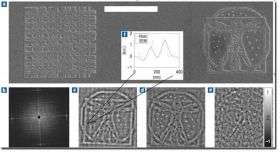
Massively parallel holography at high resolutions. a) A lithographic test sample imaged by scanning electron microscopy (SEM) next to a 30-nm-thick twin-prime 71 x 73 array with 44-nm square gold scattering elements. The scale bar is 2 mm. b) The diffraction pattern collected at the ALS (1 x 10 6 photons in a five second exposure, 200 mm from the sample). c) The real part of the reconstructed hologram. d) The simulation with 1 x 10^6 photons. The grey scale represents the real part of the hologram. e) A simulation with the same number of photons, but a single reference pinhole. f) Line through the two dots indicated in image c.

(PhysOrg.com) -- It's not easy to see a single molecule inside a living cell. Nevertheless, researchers at Lawrence Livermore National Laboratory are helping to develop a new technique that will enable them to create detailed high-resolution images, giving scientists an unprecedented look at the atomic structure of cellular molecules.

The LLNL team is collaborating with scientists across the country and in Germany and Sweden to utilize high-energy X-ray beams, combined with complex algorithms, to overcome difficulties in current technology.
Improving our ability to peek inside molecules
Enlarge

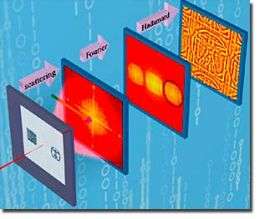
Experimental geometry and imaging A coherent X-ray beam illuminates both the sample and a Uniformly Redundant Array (URA) placed next to it. An area detector (a charged-coupled device, CCD, in these experiments) collects the diffracted X-rays. The Fourier Transform of the diffraction pattern yields the autocorrelation map with a holographic term (in the circle) displaced from the centre. The Hadamard Transform decodes the hologram.

The work began more than five years ago as a Laboratory Directed Research and Development (LDRD) project, headed by Stefano Marchesini. He has since transferred to Lawrence Berkeley Lab (LBNL), leaving the project in the hands of Stefan Hau-Riege, a materials science physicist at LLNL.

For now, the Advanced Light Source at LBNL and the FLASH facility in Hamburg, Germany, are being used to provide the X-ray beams. But a new facility under construction at Stanford University, the Linac Coherent Light Source (LCLS), will provide additional capabilities and greater imaging accuracy when it comes on line next year.

Another light source being built in Hamburg will be used as well. When completed in late 2013, the X-ray Free Electron Laser (XFEL) will be the world's longest artificial light source.

Using high-energy, extremely short-pulse - less than 100 femtoseconds, or one quadrillionth of a second - X-ray beams to examine nanoscale objects is not a new concept. The difficulty lies with the algorithms to convert the resulting patterns into usable images.

One method to increase the signal and resolution of the image is to include a second item with known features during the laser imaging. Known as a "reference object," it gives the researchers additional information with which to process the imaging data.

What is new is to use a very special reference object called a "uniformly redundant array" (URA). In this case, a combination of complex formulas known as a "Fourier Transform" and a "Hadamard Transform" are utilized to convert the data into an image that represents the object being examined. Hadamard transforms are commonly used in signal processing and data algorithms, including those used in photo and video compression.

According to Hau-Riege, "The resolution we achieved is among the best ever reported for holography of a micrometer-sized object, and we believe that it will improve in the future with the development of nano-arrays for Fourier Transform Holography at LCLS."

Details of the study appear in the August 1 edition of the journal Nature Photonics: http://www.nature. … 008.154.html

Source: Lawrence Livermore National Laboratory

4.8 /5 (12 votes)  

Filter


Move the slider to adjust rank threshold, so that you can hide some of the comments.


Display comments: newest first

E_L_Earnhardt
Sep 16, 2008

Rank: not rated yet
Easy on the X-Ray. It CHANGES things! Good Work!
Rank 4.8 /5 (12 votes)
Relevant PhysicsForums posts
  • Pith balls problem
    created1 hour ago
  • Electrostatics
    created1 hour ago
  • what is phase constant
    created1 hour ago
  • Basics In electromagnetic wave
    created1 hour ago
  • How to calculate theoretical initial velocity?
    created2 hours ago
  • Question about Gravity?
    created3 hours ago
  • More from Physics Forums - General Physics

More news stories

Putting the squeeze on planets outside our solar system

(PhysOrg.com) -- Using high-powered lasers, scientists at Lawrence Livermore National Laboratory and collaborators discovered that molten magnesium silicate undergoes a phase change in the liquid state, abruptly ...

Physics / Condensed Matter

created 12 hours ago | popularity 4.3 / 5 (7) | comments 0 | with audio podcast

Hovering not hard if you're top-heavy, researchers find

Top-heavy structures are more likely to maintain their balance while hovering in the air than are those that bear a lower center of gravity, researchers at New York University's Courant Institute of Mathematical Sciences ...

Physics / General Physics

created 13 hours ago | popularity 5 / 5 (1) | comments 1 | with audio podcast

SLAC, Stanford team focuses on high-energy electrons to treat cancer

Accelerator physicists at SLAC and cancer specialists from Stanford are working on a new technology that could dramatically reduce the time needed for cancer radiation treatments. The team ran an initial experiment ...

Physics / General Physics

created 16 hours ago | popularity 5 / 5 (2) | comments 0

Measurements from high-energy collisions lead to better understanding of why meson particles disappear

For several years, physicists at the Relativistic Heavy Ion Collider (RHIC) at Brookhaven National Laboratory (BNL), USA, have studied an unusual state of matter called the quark–gluon plasma, which they ...

Physics / General Physics

created 16 hours ago | popularity 4.5 / 5 (4) | comments 0

Explained: Sigma

It's a question that arises with virtually every major new finding in science or medicine: What makes a result reliable enough to be taken seriously? The answer has to do with statistical significance -- but ...

Physics / General Physics

created Feb 09, 2012 | popularity 5 / 5 (16) | comments 53


Anonymous knocks CIA website offline (Update)

The website of the Central Intelligence Agency was inaccessible on Friday after the hacker group Anonymous claimed to have knocked it offline.

Google users warned of threat to smartphone wallets

Users of Google smartphone wallets were being warned on Friday that there is a way to crack pass codes intended to thwart thieves from going on illicit shopping sprees.

New error-correcting codes guarantee the fastest possible rate of data transmission

Error-correcting codes are one of the triumphs of the digital age. They’re a way of encoding information so that it can be transmitted across a communication channel — such as an optical fiber o ...

Humans may have helped the decline of African rainforests 3000 years ago

(PhysOrg.com) -- Large areas of rainforests in Central Africa mysteriously disappeared over three thousand years ago, to be replaced by savannas. The prevailing theory has been that the cause was a change ...

New power source discovered

(PhysOrg.com) -- Researchers at the Massachusetts Institute of Technology (MIT) and RMIT University have made a breakthrough in energy storage and power generation.

Small modular reactor design could be a 'SUPERSTAR'

(PhysOrg.com) -- Though most of today's nuclear reactors are cooled by water, we've long known that there are alternatives; in fact, the world's first nuclear-powered electricity in 1951 came from a reactor ...