Scientists harness power of worms to treat arthritis
September 16, 2008 Scientists harness power of worms to treat arthritis

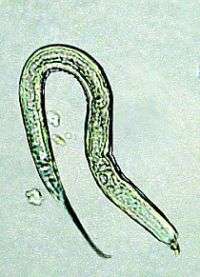
(PhysOrg.com) -- Glasgow scientists are aiming to harness a substance secreted by parasitic tropical worms to help them find a more effective treatment for inflammatory types of arthritis. A team of scientists at the Universities of Glasgow and Strathclyde plan to take advantage of the anti-inflammatory properties of a large molecule secreted by parasitic filarial nematode worm, called ES-62.

ES-62 circulates in the bloodstream of tens of millions of infected people in the Tropics, to prevent the massive inflammatory responses that the worms are otherwise capable of producing in conditions such as elephantiasis. ES-62 has no known adverse effect on general health, nor does it inhibit the ability of infected people to fight other infections.

The team, led by Professor Margaret Harnett, at the University of Glasgow’s Division of Immunology, Infection and Inflammation, aim to produce a synthetic derivative of ES-62 in order to ultimately develop novel anti-inflammatory drugs that will effectively combat auto-immune, inflammatory conditions such as rheumatoid arthritis.

“In our study, we will exploit a mechanism optimised by human/parasite interactions over millennia to develop anti-inflammatory drugs,” said Professor Harnett.

“This is because we will be focusing on mechanisms of combating hyper-inflammation that have developed naturally and with apparent acceptance by humans during their co-evolution with parasites,” said Professor William Harnett from the University of Strathclyde.

It is becoming increasingly clear within the scientific community that there is an inverse relationship between worm infections and conditions such as rheumatoid arthritis, inflammatory bowel disease, type-1 diabetes and multiple sclerosis, with auto-immune diseases being rare in countries endemic for parasitic worms.

“ES-62 appears to act like a ‘thermostat’ to effectively turn down disease-causing inflammation which leaving essential defence mechanisms intact to fight infection and cancer,” said another member of the research team, Professor Experimental Medicine at the University of Glasgow, Iain McInnes. “This property also makes ES-62 a unique tool for scientists to identifying how such disease-causing inflammation occurs.”

The team hopes that ultimately, it will be possible to correct a whole range of autoimmune inflammatory diseases by fine-tuning specific types of inflammation, by treating them with “cocktails” of several ES-62 derived drugs.

The research is being funded by a three-year grant of £213,700 from the Arthritis Research Campaign.

Provided by University of Glasgow


print this article email this article download pdf blog this article bookmark this article     Stumble it Digg this share on Facebook retweet share on Reddit add to delicious
Rate this story - 4.3 /5 (6 votes)


September 16, 2008 all stories

Comments: 0

4.3 /5 (6 votes)
  • Stumble this up

  • Digg this

  • share this

  • hide
  • Related Stories

  • Can EP4 agonist alleviate gastric lesions?
    created Nov 18, 2009 | popularity not rated yet | comments 0
  • Researchers find inflammation critical in aortic dissection
    created Nov 16, 2009 | popularity not rated yet | comments 0
  • Antioxidant found in vegetables has implications for treating cystic fibrosis
    created Nov 16, 2009 | popularity not rated yet | comments 0
  • Vaccine against chlamydia not far away
    created Nov 16, 2009 | popularity not rated yet | comments 0
  • Largest gene study of childhood IBD identifies 5 new genes
    created Nov 15, 2009 | popularity not rated yet | comments 0


  • hide
  • Relevant PhysicsForums posts

Other News

Swine flu vaccine effective despite mutations: experts

Medicine & Health / Diseases

created 19 hours ago | popularity 1 / 5 (1) | comments 1

Swine flu vaccines are still effective despite reported cases of mutations in the A(H1N1) virus, health experts in Europe and North America said Saturday.


Study raises concerns about outdoor second-hand smoke

Medicine & Health / Health

created Nov 18, 2009 | popularity 1.8 / 5 (5) | comments 21

Indoor smoking bans have forced smokers at bars and restaurants onto outdoor patios, but a new University of Georgia study in collaboration with the Centers for Disease Control and Prevention suggests that these outdoor smoking ...


smoking, cigarette

Vaccine being developed to help smokers quit

Medicine & Health / Medications

created Nov 20, 2009 | popularity 4.5 / 5 (11) | comments 10

(PhysOrg.com) -- Glaxo-SmithKline has joined forces with Nabi Pharmaceuticals to produce a vaccine to help smokers give up their addiction permanently.


Pilot study relates phthalate exposure to less-masculine play by boys

Medicine & Health / Research

created Nov 16, 2009 | popularity 4.8 / 5 (9) | comments 9

A study of 145 preschool children reports, for the first time, that when the concentrations of two common phthalates in mothers' prenatal urine are elevated their sons are less likely to play with male-typical toys and games, ...


wine

Alcohol helps lower heart disease risk for men: study

Medicine & Health / Health

created Nov 19, 2009 | popularity 4.2 / 5 (6) | comments 7

Men who drink alcohol every day see a nearly one-third average reduction in the risk of coronary heart disease, according to a long-term study among Spanish men published on Thursday.