I can't believe it's not fried: New oven fries food without oil
September 16, 2008 I can't believe it's not fried: New oven fries food without oil

Enlarge

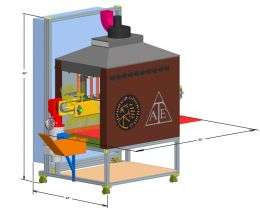
The radiant fryer, invented by Purdue food scientist Kevin Keener, is designed to quickly produce foods that appear and taste like they have been fried, except without using any additional oil. Engineers from partner Anderson Tool and Engineering Co. just completed this design and, in cooperation with Keener, plan to build a commercial prototype of the oven by the end of the year. (Anderson Tool image/Kevin Judd)

(PhysOrg.com) -- A new type of oven quickly produces foods that appear and taste identical to those that were fried, but, unlike traditional fryers, uses no additional oil. The "radiant fryer" could create products with 50 percent less oil, less fat and fewer calories than conventional fryers, said Purdue University food scientist and inventor Kevin Keener.

"The radiant oven has the capacity to replicate the frying process without placing the food in an oil bath," said Keener, an associate professor. "If we're successful, when you put the product from our oven next to one that's been traditionally fried, you won't be able to tell the difference."

Keener partnered with the Indiana-based Anderson Tool and Engineering Co. to produce a commercial prototype. The company recently completed a computer design of the oven and has begun to assemble some of its parts, said company president Ted Fiock. The team plans to have the oven built and working by the end of the year, he said.

The oven, which the team also refers to as a radiant fryer, works by emitting wavelengths of radiant energy to precisely cook food products. It may, for example, heat the inside of a food without cooking its exterior, Keener said. Because of this precision, the system requires specific instructions on how to cook each item. This makes it ideal for cooking preformed, similarly-shaped products like potato chips, chicken nuggets or fish sticks – or anything square, round or boot-shaped, he said.

"If we precisely control a product's size and shape, we can produce the same thing every time, like a perfectly browned, round chicken patty," Keener said.

This uniformity allows the oven to be quite speedy: one could churn out 300 dozen donuts per hour, Keener estimated. It also rapidly reheats refrigerated or frozen products, he said.

"If it works like we hope, we could take donuts from the freezer to the countertop – hot and ready to eat – within two minutes," Fiock said. "Currently, this is all but impossible."

The oven would most likely cook foods that have already been partially fried, or par-fried. Such products are traditionally fried at a central food manufacturer before being chilled or frozen and shipped to restaurants and retail outlets, where they're often refried before serving, Keener said.

"Many people don't realize that your typical French fry has been fried twice," Keener said.

If the prototype passes a series of tests later this year, the team hopes to commercialize the oven, Fiock said.

"All of these things we envision cooking with the oven are products the food industry would like to find out how to design with less fat," Keener said. "This might be one way."

Another benefit to the oven is that it would eliminate the use of hot oil, which is hazardous to discard, presents a fire risk and can burn workers if spattered or spilled, possibly causing serious injury, Fiock said.

Keener and Brian Farkas, a food scientist at North Carolina State University, are co-inventors of the patent-pending oven design. They completed a smaller prototype – about the size of a standard microwave oven – upon which many of the calculations for the commercial prototype are based, Keener said. Food from this first prototype proved indistinguishable from emergent-fried products to a panel of taste-testers, he said.

Provided by Purdue University


print this article email this article download pdf blog this article bookmark this article     Stumble it Digg this share on Facebook retweet share on Reddit add to delicious
Rate this story - 4.5 /5 (15 votes)

Rank Filter

Move the slider to adjust rank threshold, so that you can hide some of the comments.


Display comments: newest first

  • kerry - Sep 17, 2008
    • Rank: not rated yet
    "This uniformity allows the oven to be quite speedy: one could churn out 300 dozen donuts per hour, Keener estimated. It also rapidly reheats refrigerated or frozen products, he said."

    =D this is amazing!
  • Valentiinro - Sep 17, 2008
    • Rank: not rated yet
    Aw man. This isn't something one could use at home to fry fish then. I saw the headline and thought "I want one". But unless I programmed good instructions and cut a fish the exact same way every time it would not work for me even if they were selling them to individuals, which they probably wont.

September 16, 2008 all stories

Comments: 2

4.5 /5 (15 votes)
  • Stumble this up

  • Digg this

  • share this

  • hide
  • Related Stories

  • Inventing language
    created Nov 10, 2009 | popularity not rated yet | comments 0
  • A Mars Rover Named 'Curiosity'
    created Oct 30, 2009 | popularity not rated yet | comments 0
  • This is your brain on fatty acids
    created Oct 30, 2009 | popularity not rated yet | comments 0
  • Cooking Up Water From the Moon? NASA Studies Water Extraction With Microwaves
    created Oct 19, 2009 | popularity not rated yet | comments 0
  • Climate concerns turn city's smell into cash cow
    created Oct 17, 2009 | popularity not rated yet | comments 0


  • hide
  • Relevant PhysicsForums posts

Other News

Grand Canyon to change 'unfair' permit system

Other Sciences / Other

created 7 hours ago | popularity not rated yet | comments 1

(AP) -- Getting one of the roughly 11,500 permits granted each year to backpack overnight in the Grand Canyon has become so competitive and "unfair" that managers at the national park have decided to change the system.


Researcher: Faint writing seen on Shroud of Turin (AP)

Researcher: Faint writing seen on Shroud of Turin (Update)

Other Sciences / Archaeology & Fossils

created Nov 20, 2009 | popularity 2.3 / 5 (28) | comments 32

(AP) -- A Vatican researcher has rekindled the age-old debate over the Shroud of Turin, saying that faint writing on the linen proves it was the burial cloth of Jesus. Experts say the historian may be reading ...


Museum: Galileo's fingers, tooth are found (AP)

Museum: Galileo's fingers, tooth are found

Other Sciences / Archaeology & Fossils

created Nov 21, 2009 | popularity 4.3 / 5 (3) | comments 7

(AP) -- Two fingers and a tooth removed from Galileo Galilei's corpse in a Florentine basilica in the 18th century and given up for lost have been found again and will soon be put on display, an Italian museum ...


Maya

New insights into the life of the Maya

Other Sciences / Archaeology & Fossils

created Nov 16, 2009 | popularity 4.6 / 5 (15) | comments 7

(PhysOrg.com) -- Ancient artifacts are almost always concerned with rich and powerful religious and political leaders, but new excavations of an ancient Maya site have unearthed a pyramid decorated with murals ...


Three of a kind

Three of a kind: Revealing language’s universal essence

Other Sciences / Social Sciences

created Nov 20, 2009 | popularity 4.1 / 5 (13) | comments 6

(PhysOrg.com) -- On the surface, English, Japanese, and Kinande, a member of the Bantu family of languages spoken in the Democratic Republic of Congo, have little in common. It is not just that the vocabularies ...