Neighbors from hell: Infanticide rife in guillemot colony
September 17, 2008
Guillemot

Enlarge

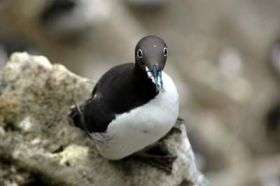
Guillemot on Isle of May, Scotland. Credit: Kate Ashbrook

One of Britain's best-known species of seabird is increasingly attacking and killing unattended chicks from neighbouring nests due to food shortages.

Researchers at the University of Leeds and the Centre for Ecology & Hydrology observed a dramatic increase in the number of adult guillemots deliberately attacking chicks of the same species in the last year. Hundreds of such attacks occurred, and many were fatal, with chicks being pecked to death or flung from cliff ledges.

These disturbing findings, published online today in the Royal Society journal Biology Letters, indicate that social harmony – even in long-established colonies – can break down when conditions get tough, for example if starvation looms. The study highlights a previously unsuspected parental dilemma: should both leave their chick unattended and spend more time feeding, or should one of them remain to protect the chick from attacks from neighbouring birds even if it gets less food?

"The attacks were brutal and usually involved more than one adult as chicks fled from the initial attacking neighbour" says lead author Kate Ashbrook, of Leeds' Faculty of Biological Sciences. "More than two thirds of all documented chick deaths in the sample area were caused by attacks from neighbouring parents. Yet this particular colony has been monitored for almost thirty years, and in that time chick attacks have been very rare occurrences."

Common guillemots (Uria aalge) are attentive parents and rear only one chick during the breeding season, which runs from April to July. Because chicks are vulnerable to attacks from predatory gulls, parents rarely leave them unattended, taking it in turns to find food. However, a decline in prey in recent years has led to both parents being forced to search for food at the same time. Researchers witnessed almost half of all chicks unattended at some point during the day.

Surrounded by neighbours and open to the elements, guillemot colonies are a risky place to raise a chick. Although aggression between adults is common - breeding pairs often are in physical contact and ledges can be densely packed with up to thirty breeding pairs in one square metre – aggression toward chicks is unusual.

The research focused on a large established colony of guillemots that inhabit the Isle of May in Scotland. Co-author Professor Sarah Wanless from the Centre for Ecology & Hydrology has been monitoring this colony since 1981. She comments: "This research highlights how fragile the social fabric of a seabird colony is. Having a stressed, hungry neighbour isn't good news if you're an unattended guillemot chick."

Source: University of Leeds


Rank not rated yet
Tags

Related Stories
Relevant PhysicsForums posts

More news stories

A mitosis mystery solved: How chromosomes align perfectly in a dividing cell

Although the process of mitotic cell division has been studied intensely for more than 50 years, Whitehead Institute researchers have only now solved the mystery of how cells correctly align their chromosomes during symmetric ...

Biology / Cell & Microbiology

created 8 hours ago | popularity 4.3 / 5 (14) | comments 0 | with audio podcast

Researchers find extensive RNA editing in human transcriptome

In a new study published online in Nature Biotechnology, researchers from BGI, the world's largest genomics organization, reported the evidence of extensive RNA editing in a human cell line by analysis of RNA-seq data, demons ...

Biology / Biotechnology

created 8 hours ago | popularity 5 / 5 (4) | comments 0 | with audio podcast

The proteins ensuring genome protection

Researchers from the University of Geneva (UNIGE), Switzerland, have discovered the crucial role of two proteins in developing a cell 'anti-enzyme shield'. This protection system, which operates at the level of molecular ...

Biology / Cell & Microbiology

created 8 hours ago | popularity 5 / 5 (3) | comments 0 | with audio podcast

Entire genome of extinct human decoded from fossil

(PhysOrg.com) -- In 2010, Svante Pääbo and his colleagues presented a draft version of the genome from a small fragment of a human finger bone discovered in Denisova Cave in southern Siberia. The ...

Biology / Biotechnology

created Feb 07, 2012 | popularity 4.7 / 5 (60) | comments 51 | with audio podcast

Why are there so few fish in the Earth's oceans?

(PhysOrg.com) -- A Stony Brook University researcher has found that, contrary to popular belief, there are not plenty of fish in the sea.

Biology / Plants & Animals

created Feb 08, 2012 | popularity 4.2 / 5 (18) | comments 27 | with audio podcast


Scientists discover molecular secrets of 2,000-year-old Chinese herbal remedy

For roughly two thousand years, Chinese herbalists have treated Malaria using a root extract, commonly known as Chang Shan, from a type of hydrangea that grows in Tibet and Nepal. More recent studies suggest that halofuginone, ...

New method to examine batteries -- MRI from the inside

There is an ever-increasing need for advanced batteries for portable electronics, such as phones, cameras, and music players, but also to power electric vehicles and to facilitate the distribution and storage of energy derived ...

Google might launch Drive for cloud storage soon

(PhysOrg.com) -- Google's next big move, according to the Wall Street Journal, is a cloud storage service called Drive. Hardly first to the plate, Google is simply catching up to introducing its cloud reposi ...

Lab study raises questions over nano-particle impact

Tests involving chickens have raised questions about the impact on health from engineered nano-particles, the ultra-fine grains commonly used in drugs and processed foods, scientists said on Sunday.

Overeating may double risk of memory loss

New research suggests that consuming between 2,100 and 6,000 calories per day may double the risk of memory loss, or mild cognitive impairment (MCI), among people age 70 and older. The study was released today and will be ...

Starve a virus, feed a cure? Findings show how some cells protect themselves against HIV

A protein that protects some of our immune cells from the most common and virulent form of HIV works by starving the virus of the molecular building blocks that it needs to replicate, according to research published online ...