Sophisticated monitoring array to address mystery of uranium plume
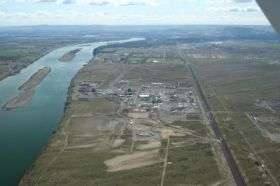
Scientists have puzzled for years about why uranium contamination in groundwater continues to exceed drinking water standards in an area located at the south end of the Hanford Site. The Department of Energy wants answers to why the uranium persists.
Now, an innovative system has been installed for field experiments to better understand this complex site and to support future cleanup decisions. The site is one of three Integrated Field Research Challenge, or IFRC, locations supported by DOE's Office of Science to investigate fundamental science issues important to contaminant transport and groundwater remediation.
New insights may offer scientific advances in environmental cleanup beyond Hanford.
Scientists at DOE's Pacific Northwest National Laboratory are closer to having answers to the mystery with a unique subsurface experimental system containing nearly three dozen monitoring wells equipped with sophisticated instrumentation. The entire subsurface surrounding the wells will be comprehensively characterized to enable a complete accounting of the processes that occur beneath the surface that contribute to the persistent groundwater contamination.
"The plume has baffled researchers for more than a decade," said PNNL Project Manager John Zachara, who leads a team of experts in subsurface geochemistry, hydrology and microbiology. "But we believe this new approach will allow us to better understand the sources and migration behavior of uranium in the subsurface."
The project promises to provide one of the most comprehensive evaluations of the complex 300 Area subsurface along the river in more than 40 years.
Positioned like a triangular chessboard within an approximate 100-meter plot of contaminated ground, the array of 35 monitoring wells is near the location where large volumes of contaminated wastewater were disposed. The waste originated from nuclear fuel fabrication facilities that supported the nation's weapons program decades ago.
Scientists have designed an elegant, yet adaptive site, to study the effects of groundwater level, flow direction and composition on uranium concentrations in groundwater, and uranium migration to the Columbia River.
The Hanford IFRC (http://ifchanford.pnl.gov/) project allows researchers to perform injection experiments using waters of different temperature and composition pumped from other locations in the 300 Area groundwater plume. The variability permits scientists to probe migration pathways through the subsurface and examine factors that control uranium release from the historically contaminated sediments.
Time-based water level and composition data gathered from the robust geophysical and geochemical monitoring system will enable researchers to develop three-dimensional plume maps helping to develop improved uranium migration models.
The effort will provide a major breakthrough in understanding how the rhythmical rise and fall of the river interacts with the groundwater and uranium sources, according to Mike Thompson, DOE physical scientist.
"There is no quick fix or off-the-shelf approach for dealing with this particular plume of uranium contamination. We're using real-time field science to solve these complex cleanup issues," said Thompson. "Results from the monitoring array will help us better understand the complex dynamics of the groundwater and design technologies to stabilize or treat the contamination."
Hydrologic and geophysical characterization of the well field began in late August and will continue through the fall. Scientists have scheduled the first injection experiment for November, followed by a series of science experiments to study the fundamental workings of the local groundwater system.
Over the past year, PNNL scientists worked with Department of Energy contractor Fluor Hanford to install the array of nearly three dozen wells at a cost of about $1.6 million.
Uranium study enables microbial research
Most of the monitoring wells in the IFRC well plot are about 60 feet deep. However, one well was installed along its margins that is 160 feet deep that penetrates all sediments above basalt. This well and core materials retrieved from it will allow PNNL microbiologist Allan Konopka and collaborators to identify microorganisms that are present in the Columbia River-groundwater interaction zone and understand their contributions to water quality.
"Some of the initial findings show zones of greater microbial abundance and activity," said Konopka. "Scientists have collected relatively few microbial samples at these depths on the Hanford Site, so conducting a molecular census of the microbial communities and isolating possibly novel microbes will be exciting."
Konopka believes the fundamental microbiology questions addressed in this study will be invaluable in developing strategies and helping make decisions to protect the river.
Source: Pacific Northwest National Laboratory


