What's in a dinosaur name?
September 17, 2008 What’s in a dinosaur name?

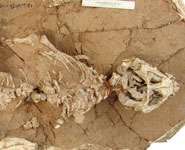
The type specimen of Yinlong downsi, a plant-eating dinosaur from the Jurassic of China, named by Xu Xing and colleagues in 2006. Xu Xing is the most prolific namer of new dinosaurs: this is his twenty-fifth new species. The type specimen is essentially complete, typical of the good practice of most workers today. Photo by Xu Xing

(PhysOrg.com) -- A new species of dinosaur is named somewhere in the world every two weeks. But are they all new species, or do the newly-discovered bones really belong to a dinosaur already identified?

Biologists have long been aware of the ‘alias problem’ which refers to the number of times when one species has been given more than one name. Recent studies on dinosaurs have shown that the error rate may be as high as 50 per cent.

In a study published today in Biology Letters, Professor Michael Benton of the Department of Earth Sciences at the University of Bristol looked at the original descriptions of all 1,047 species of dinosaurs ever named, from 1824 to the present day, and assessed the quality of the specimens on which the names were founded – the type specimens.

Professor Benton said: “The bane of the dinosaurologist’s life is species that have been named on the basis of incomplete specimens. In Victorian times, palaeontologists were keen to name new species, and in the excitement of the great ‘bone wars’ for example, from 1870 to 1890, they rushed into print with new names for every odd leg bone, tooth, or skull cap that came their way. Later work, on more complete specimens, reduced more than 1000 named dinosaurs to 500 or so.”

Professor Benton’s new research shows that although the ‘error rate’ in naming dinosaurs has been high in the past, scientific practice has improved enormously in recent years. This means that in fact most new dinosaur species announced today are likely to be correctly named.

Up to 1960, more than half of all new species were based on scrappy type specimens. But since 1960, the great majority of new species are founded on more or less complete specimens, sometimes even whole skeletons.

“This means that most of the new species will probably survive scrutiny,” said Professor Benton. “It’s not often you can demonstrate a real improvement in scientific practice, but this is one case we can be grateful for.”

Provided by University of Bristol


print this article email this article download pdf blog this article bookmark this article     Stumble it Digg this share on Facebook retweet share on Reddit add to delicious
Rate this story - 3 /5 (3 votes)


September 17, 2008 all stories

Comments: 0

3 /5 (3 votes)
  • Stumble this up

  • Digg this

  • share this

  • hide
  • Related Stories

  • Early carnivorous dinosaurs crossed continents
    created Dec 10, 2009 | popularity not rated yet | comments 0
  • Fossils shake dinosaur family tree
    created Dec 10, 2009 | popularity not rated yet | comments 0
  • Bye bye 'Hogwarts dinosaur'? New analyses of dinosaur growth may wipe out one-third of species
    created Oct 30, 2009 | popularity not rated yet | comments 0
  • Inside the First Bird, Surprising Signs of a Dinosaur
    created Oct 08, 2009 | popularity not rated yet | comments 0
  • Mini Dinosaurs Prowled North America (w/Video)
    created Mar 16, 2009 | popularity not rated yet | comments 0


Other News

Seeing how evolutionary mechanisms yield biological diversity

Biology / Evolution

created 10 hours ago | popularity not rated yet | comments 0

An international team of scientists has discovered how changes in both gene expression and gene sequence led to the diversity of visual systems in African cichlid fish.


Sniffing out clues to dogs' compulsive behavior

Sniffing out clues to dogs' compulsive behavior

Biology / Biotechnology

created 12 hours ago | popularity 3.8 / 5 (4) | comments 0

(PhysOrg.com) -- At first glance, a dog chasing its tail seems a harmless, if fruitless, pursuit. But for many dogs and their owners, the habit has a dark side, one that means endless hours and energy spent ...


Study sheds light on microscopic flower petal ridges

Study sheds light on microscopic flower petal ridges

Biology / Plants & Animals

created 12 hours ago | popularity 4 / 5 (2) | comments 0

(PhysOrg.com) -- Microscopic ridges contouring the surface of flower petals might play a role in flashing that come-hither look pollinating insects can't resist. Michigan State University scientists and colleagues ...


Mystery solved: Scientists now know how smallpox kills

Biology / Cell & Microbiology

created 14 hours ago | popularity 5 / 5 (6) | comments 0

A team of researchers working in a high containment laboratory at the Centers for Disease Control and Prevention in Atlanta, GA, have solved a fundamental mystery about smallpox that has puzzled scientists long after the ...


Fungal footage fosters foresight into plant, animal disease

Meddling in mosquitoes' sex lives could help stop the spread of malaria, says study

Biology / Plants & Animals

created 22 hours ago | popularity 5 / 5 (1) | comments 1

(PhysOrg.com) -- Stopping male mosquitoes from sealing their sperm inside females with a 'mating plug' could prevent mosquitoes from reproducing, and offer a potential new way to combat malaria, say scientists ...