To survive, tiger moths are bright for birds, click for bats
September 17th, 2008 By Krishna Ramanujan To survive, tiger moths are bright for birds, click for bats

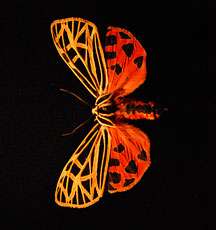
The virgin tiger moth, Grammia virgo, has evolved warning signals to remind predators of its noxious taste. It is conspicuously colored to deter birds during the day and sound producing to deter bats at night. Image: Marie Louise Nydam

(PhysOrg.com) -- If you ate a spoiled hamburger from a fast-food restaurant, chances are you would be reminded of the experience every time you saw the chain's logo.

Similarly, some tiger moths taste noxious to birds and bats. And to remind these predators not to come back for seconds, the moths have evolved bright coloring and clicking sounds as warning signals.

A study by Cornell researchers, published in the Sept. 4 issue of Nature, is one of the first to show that these "multimodal" signals -- those that use two different senses -- evolved independently as a response to a specific predator. That means that the bright coloring on some species of tiger moths are a visual signal of noxious taste to visually oriented birds, and the clicking sounds communicate the same message to acoustically oriented and nocturnal bats.

Different tiger moth species have the ability to display both or only one of these signals, but, the researchers discovered, there is no correlation between the two.

"We're interested in the evolution of these signals," said co-author Marie Nydam, a Cornell graduate student in ecology and evolutionary biology (EEB) who did the genetic analysis. John Ratcliffe, a former Cornell EEB postdoctoral researcher who is now at the University of Southern Denmark, is the paper's lead author.

"Most researchers focus on a single warning signal and a single sense," but this paper differs because it examines two signals directed toward two senses, Nydam added.

Evolutionary biologists have two main hypotheses for how these multimodal signals evolved, Nydam said. A single predator hypothesis proposes that two signals "might work together against a single predator," providing insurance that a predator is amply warned. A second hypothesis suggests that prey with multiple signals have different predators, and each signal has evolved to target a specific threat.

The researchers classified 26 species of tiger moths found at a site in southeastern Ontario, Canada, where both bats and birds live. Moth species were classified based on four characteristics: the date they emerged and whether they were active at night or during the day, were conspicuously colored and made ultrasonic clicks.

The timing of moth activity is important because foraging by nocturnal bats peaks from early July to mid-August. Birds, however, feed all year, with a slight plateau between early June and early July.

The researchers found that conspicuously white and brightly colored tiger moth species are more likely to fly during the day. During spring (when most bats are still hibernating), tiger moths do not produce clicks. Similarly, tiger moths that emerge later in the summer, when bats are prevalent, are more likely to defend themselves acoustically. Nocturnal moths also blend in more with their surroundings.

Provided by Cornell University


print this article email this article download pdf blog this article bookmark this article     Digg this Stumble it share on Facebook share on Reddit add to delicious save to Yahoo! bookmarks
4.5/5 after 11 votes

Rank Filter

Move the slider to adjust rank threshold, so that you can hide some of the comments.


Display comments: newest first

  • gmurphy - Sep 17, 2008
    • Rank: not rated yet
    selfish gene theory explains this perfectly, wow, I never cease to be amazed by this stuff. Most animals try to hide from predators but these animals colour themselves brightly and make clicking noises!. If they all carry similar genes (the same big family) and the occasional one is eaten, then its genes will be carried on by the other moths who have a greater chance of survival due its sacrifice

September 17th, 2008 all stories
Biology /

Comments: 1
Rank: 4.5/5 after 11 votes

  • Stumble this up

  • Digg this

  • Share it:
  • share on Facebook
  • share on MySpace
  • share on Slashdot
  • rss-newsfeed
  • share on Google
  • share on Reddit
  • add to delicious
  • save to Yahoo! bookmarks
  • share on Windows Live
  • Add to Mixx!
Rating: 4.5/5 after 11 votes

  • Related Stories

  • Expeditions reveal gulf of California's deep sea secrets, as well as human imprints
    created Dec 03, 2008 | popularity not rated yet | comments 0
  • Moths mimic sounds to survive
    created May 31, 2007 | popularity not rated yet | comments 0
  • Negative Vibes From Space
    created Dec 01, 2006 | popularity not rated yet | comments 0
  • Expressing comparisons is possible even without language, researchers find
    created Jun 30, 2009 | popularity not rated yet | comments 0
  • Most endangered feline brought back from the brink
    created Jun 21, 2009 | popularity not rated yet | comments 0


  • Physicists Demonstrate Quantum Memory with Matter Qubits
    Physicists Demonstrate Quantum Memory with Matter Qubits
    Physics / General Physics
    created Jul 03, 2009 | popularity 4.4 / 5 (17) | comments 1
  • 'Holey' Nanosheets for Wastewater Dye Removal
    Nanotechnology / Nanomaterials
    created Jul 01, 2009 | popularity 5 / 5 (5) | comments 1
  • Jellyfish Robot Swims Like its Biological Counterpart
    Jellyfish Robot Swims Like its Biological Counterpart
    Electronics / Robotics
    created Jun 26, 2009 | popularity 4.4 / 5 (8) | comments 1
  • Could Maxwell's Demon Exist in Nanoscale Systems?
    Could Maxwell's Demon Exist in Nanoscale Systems?
    Physics / General Physics
    created Jun 24, 2009 | popularity 4.4 / 5 (18) | comments 29
  • Living Safely with Robots, Beyond Asimov's Laws
    Living Safely with Robots, Beyond Asimov's Laws
    Electronics / Robotics
    created Jun 22, 2009 | popularity 4.6 / 5 (52) | comments 40
  • Other News

    California water plan aims to save Puget Sound orcas

    Biology / Ecology

    created 1hour ago | popularity not rated yet | comments 0

    A plan to restore salmon runs on California's Sacramento River also could help revive killer whale populations 700 miles to the north in Puget Sound, as federal scientists struggle to protect endangered species in a complex ...


    Scientists 'rebuild' giant moa using ancient DNA

    Biology / Plants & Animals

    created Jul 01, 2009 | popularity 5 / 5 (10) | comments 12

    (PhysOrg.com) -- Scientists have performed the first DNA-based reconstruction of the giant extinct moa bird, using prehistoric feathers recovered from caves and rock shelters in New Zealand.


    Pacific Giant Salamander (Dicamptodon tenebrosus)

    Salamanders, regenerative wonders, heal like mammals, people

    Biology / Microbiology

    created Jul 01, 2009 | popularity 4.9 / 5 (19) | comments 10

    The salamander is a superhero of regeneration, able to replace lost limbs, damaged lungs, sliced spinal cord -- even bits of lopped-off brain. But it turns out that remarkable ability isn't so mysterious after ...


    Genetically modified trees

    Anti-biotech groups obstruct forest biotechnology

    Biology / Biotechnology

    created Jun 30, 2009 | popularity 3.7 / 5 (7) | comments 5

    The potential of forest biotechnology to help address significant social and environmental issues is being "strangled at birth" by the rigid opposition of some groups and regulations that effectively preclude ...


    Super-sleepers could help super-sizers!

    Super-sleepers could help super-sizers!

    Biology / Plants & Animals

    created Jun 29, 2009 | popularity 5 / 5 (2) | comments 4

    Burrowing frogs can survive buried for several years without food or water. Scientists have discovered that the metabolism of their cells changes radically during the dormancy period allowing the frogs to ...