Engineer works to clean and improve engine performance
September 17, 2008
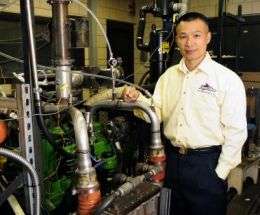
Song-Charng Kong, an Iowa State University assistant professor of mechanical engineering, and his students are studying engines in an effort to reduce emissions and improve efficiency. Photo by Bob Elbert/Iowa State University
The five engines in Song-Charng Kong's Iowa State University laboratory have come a long way since Karl Benz patented a two-stroke internal combustion engine in 1879. There are fuel injectors and turbochargers and electrical controls. There's more horsepower, better efficiency, cleaner burning and greater reliability.
But Kong – with the help of 15 graduate students and all kinds of sensors recording engine cylinder pressure, energy release and exhaust emissions – is looking for even more.
Kong, an Iowa State assistant professor of mechanical engineering who keeps a piston by his office computer, is studying engines with the goal of reducing emissions and improving efficiency.
"There is still a lot of work to be done to improve engine performance," Kong said. "All of this work will lead to incremental improvements."
And those small improvements can add up when you consider there are more than 250 million registered vehicles on U.S. highways, according to the U.S. Department of Transportation.
Kong and his students are working on a lot of combustion projects in the lab: They're studying diesel engines with the goal of reducing emissions. They're developing a computer model of a gasoline engine that will make it much easier and faster to research and develop new engine technologies. They're figuring out how to optimize new technologies such as multiple fuel injections per combustion cycle.
They're working with Terry Meyer, an Iowa State assistant professor of mechanical engineering, to use high-speed, laser-based sensors that can record images of injection sprays and combustion inside a cylinder. That can give researchers insights into combustion characteristics and ideas for improvements.
They're also studying how plastics dissolved in biodiesel affect engine performance. Biodiesel acts as a solvent on certain plastics and that has Kong checking to see if some waste plastic could be recycled by mixing it into fuel.
And they're studying the combustion of ammonia in engines. Ammonia is relatively easy to store, is fairly dense with hydrogen and doesn't produce greenhouse gases when it burns. So burning ammonia in engines could be an early step to developing a hydrogen economy.
Kong's work is supported by grants from Deere & Co., the Ford Motor Co., the U.S. Department of Energy's Los Alamos National Laboratory, the Ames-based Renewable Energy Group Inc. and the Iowa Energy Center based at Iowa State.
As he showed a visitor around his engine lab recently, pointing out a new turbocharger here or an experimental one-cylinder engine there, Kong said there's good reason to keep studying engines.
"We want to make these engines better," Kong said. "In my mind, the internal combustion engine may be the most important combustion system in daily life. Just by improving combustion efficiency by a fraction, we can save a lot of energy for the country and the world."
And yes, he said, "There is a future for internal combustion engines."
Source: Iowa State University
-
Iowa State engineer develops laser technologies to analyze combustion, biofuels
Dec 05, 2007 |
5 / 5 (2) |
0
-
Watching particles' jekyll-to-hyde transformation
Jun 21, 2011 |
4.8 / 5 (4) |
0
-
Iowa State hybrid lab combines technologies to make biorenewable fuels and products
Jun 20, 2011 |
not rated yet |
0
-
ISU, UI, UNI announce results of groundwater analysis at ash disposal site
Feb 21, 2011 |
not rated yet |
0
-
Iowa State engineer and Goodrich partner to develop next-generation fuel nozzle diagnostic systems
Dec 22, 2010 |
5 / 5 (1) |
0
-
Engineers build first sub-10-nm carbon nanotube transistor
Feb 01, 2012 |
4.9 / 5 (32) |
30
-
Something old, something new: Evolution and the structural divergence of duplicate genes
Jan 31, 2012 |
4.6 / 5 (7) |
1
-
The hidden nanoworld of ice crystals: Revealing the dynamic behavior of quasi-liquid layers
Jan 30, 2012 |
5 / 5 (4) |
1
-
Stock market network reveals investor clustering
Jan 27, 2012 |
3.9 / 5 (23) |
8
-
Of microchemistry and molecules: Electronic microfluidic device synthesizes biocompatible probes
Jan 26, 2012 |
5 / 5 (2) |
0
-
Need help reading 3-D
20 hours ago
-
A way to send and receive wireless data
Feb 11, 2012
-
Calling function with no input argument
Feb 10, 2012
-
Force free body diagram problem on gym equipment
Feb 10, 2012
-
Empirical data regarding shower heads and water
Feb 10, 2012
-
feed hold button on CNC lathe
Feb 09, 2012
- More from Physics Forums - General Engineering
More news stories
Iran blocks email, restricts net access: reports
Iran has further restricted access to the Internet and blocked popular email services for the past few days, in a move a top lawmaker said could "cost the regime dearly," media reports said on Sunday.
1 hour ago |
5 / 5 (1) |
2
Google might launch Drive for cloud storage soon
(PhysOrg.com) -- Google's next big move, according to the Wall Street Journal, is a cloud storage service called Drive. Hardly first to the plate, Google is simply catching up to introducing its cloud reposi ...
Love a click away in Indonesia's Twitter Republic
He was a geeky kid from Yogyakarta, she a glamorous city girl in Jakarta. In a country with one of the world's most vibrant social networking scenes they fell in love on Twitter.
9 hours ago |
4 / 5 (1) |
0
Walney offshore wind farm is world's biggest (for now)
(PhysOrg.com) -- The Walney wind farm on the Irish Sea--characterized by high tides, waves and windy weather--officially opened this week. The farm is treated in the press as a very big deal as the Walney ...
Navy to begin tests on electromagnetic railgun prototype launcher
The Office of Naval Research (ONR)'s Electromagnetic (EM) Railgun program will take an important step forward in the coming weeks when the first industry railgun prototype launcher is tested at a facility ...
Feb 06, 2012 |
4.7 / 5 (16) |
93
|
Lab study raises questions over nano-particle impact
Tests involving chickens have raised questions about the impact on health from engineered nano-particles, the ultra-fine grains commonly used in drugs and processed foods, scientists said on Sunday.
Salvage workers begin pumping fuel from Italian shipwreck
Salvage workers Sunday began pumping fuel from the shipwrecked Italian cruise liner Costa Concordia, a day ahead of schedule, officials said.
Scientists discover molecular secrets of 2,000-year-old Chinese herbal remedy
For roughly two thousand years, Chinese herbalists have treated Malaria using a root extract, commonly known as Chang Shan, from a type of hydrangea that grows in Tibet and Nepal. More recent studies suggest that halofuginone, ...
New method to examine batteries -- MRI from the inside
There is an ever-increasing need for advanced batteries for portable electronics, such as phones, cameras, and music players, but also to power electric vehicles and to facilitate the distribution and storage of energy derived ...
A mitosis mystery solved: How chromosomes align perfectly in a dividing cell
Although the process of mitotic cell division has been studied intensely for more than 50 years, Whitehead Institute researchers have only now solved the mystery of how cells correctly align their chromosomes during symmetric ...
Starve a virus, feed a cure? Findings show how some cells protect themselves against HIV
A protein that protects some of our immune cells from the most common and virulent form of HIV works by starving the virus of the molecular building blocks that it needs to replicate, according to research published online ...
Sep 17, 2008
Rank: not rated yet
we can start with something that already exists. all production cars and trucks should be required to have automattic anti-idling stop start ignitions. period. just like seat belts, tire pressure sensors, and airbags.