More Soil Delivered to Phoenix Lander Lab
September 17, 2008 More Soil Delivered to Phoenix Lander Lab

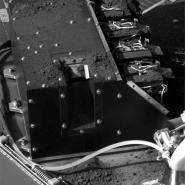
This image, taken by NASA's Phoenix Mars Lander's Surface Stereo Imager, documents the delivery of a soil sample from the "Snow White" trench to the Wet Chemistry Laboratory. A small pile of soil is visible on the lower edge of the second cell from the top. This deck-mounted lab is part of Phoenix's Microscopy, Electrochemistry and Conductivity Analyzer (MECA). The delivery was made on Sept. 12, 2008, which was Sol 107 (the 107th Martian day) of the mission, which landed on May 25, 2008. (NASA/JPL-Caltech/University of Arizona/Texas A&M University)

Scientists working on the Phoenix Mars Mission are analyzing soil delivered to the spacecraft's Wet Chemistry Laboratory.

Preliminary analysis of this soil confirms that it is alkaline, and composed of salts and other chemicals such as perchlorate, sodium, magnesium, chloride and potassium.

This information validates prior results from that same location, said Michael Hecht of NASA's Jet Propulsion Laboratory, Pasadena, Calif., the lead scientist for the Microscopy, Electrochemistry and Conductivity Analyzer, or MECA.

The Wet Chemistry Laboratory mixes Martian soil with an aqueous solution from Earth as part of a process to identify soluble nutrients and other chemicals in the soil.

In the coming days, the Phoenix team will also fill the final four of eight single-use ovens on another soil-analysis instrument, the Thermal and Evolved Gas Analyzer, or TEGA. The team's strategy is to deliver as many samples as possible before the power produced by Phoenix's solar panels declines due to the end of the Martian summer.

The Phoenix Mission is led by the University of Arizona, Tucson, on behalf of NASA. Project management of the mission is by NASA's Jet Propulsion Laboratory, Pasadena, Calif. Spacecraft development is by Lockheed Martin Space Systems, Denver.

Provided by NASA


print this article email this article download pdf blog this article bookmark this article     Stumble it Digg this share on Facebook retweet share on Reddit add to delicious
Rate this story - 3.2 /5 (6 votes)

Rank Filter

Move the slider to adjust rank threshold, so that you can hide some of the comments.


Display comments: newest first

  • Modernmystic - Sep 17, 2008
    • Rank: 3.7 / 5 (3)
    And?
  • holmstar - Sep 18, 2008
    • Rank: 1 / 5 (1)
    And now we know more about martian soil than we did before. Its science... this is a science news site.
  • Modernmystic - Sep 18, 2008
    • Rank: not rated yet
    And now we know more about martian soil than we did before. Its science... this is a science news site.


    Actually we already knew what the results would be. That information is in the article.

September 17, 2008 all stories

Comments: 3

3.2 /5 (6 votes)
  • Stumble this up

  • Digg this

  • share this

  • hide
  • Related Stories

  • Frost-Covered Phoenix Lander Seen in Winter Images
    created Nov 05, 2009 | popularity not rated yet | comments 0
  • Scientists see water ice in fresh meteorite craters on Mars
    created Sep 24, 2009 | popularity not rated yet | comments 0
  • Biosphere 2 Opens Phoenix Mars Lander Exhibit
    created Sep 18, 2009 | popularity not rated yet | comments 0
  • Mars data published in Science this week
    created Jul 02, 2009 | popularity not rated yet | comments 0
  • Mars explorer says we'll find life on other planets within 10 years
    created Apr 21, 2009 | popularity not rated yet | comments 0


  • hide
  • Relevant PhysicsForums posts

  • Favourite Astronomy Book?
    created 16 hours ago
  • dark energy
    created 16 hours ago
  • The shape of our solar system's orbits.
    created Nov 07, 2009
  • Above or Below the Line of Nodes
    created Nov 07, 2009
  • More from Physics Forums - General Astronomy

Other News

Earth

Atomic Particles Help Solve Planetary Puzzle

Space & Earth / Earth Sciences

created 4 hours ago | popularity 4.6 / 5 (5) | comments 0

(PhysOrg.com) -- A University of Arkansas professor and his colleagues have shown that the Earth's mantle contains the same isotopic signatures from magnesium as meteorites do, suggesting that the planet formed ...


The Stars My Destination

The Stars My Destination

Space & Earth / Space Exploration

created 5 hours ago | popularity 5 / 5 (7) | comments 0

The Voyager spacecraft are now in the outermost layer of the heliosphere, traveling toward interstellar space - the first man-made spacecraft to travel such a vast distance from Earth.


Controversial new climate change results

Controversial new climate change results

Space & Earth / Environment

created 14 hours ago | popularity 4.4 / 5 (14) | comments 19

(PhysOrg.com) -- New data show that the balance between the airborne and the absorbed fraction of CO2 has stayed approximately constant since 1850, despite emissions of CO2 having risen from about 2 billion ...


Cave study links climate change to California droughts

Space & Earth / Earth Sciences

created 6 hours ago | popularity 3 / 5 (2) | comments 0

California experienced centuries-long droughts in the past 20,000 years that coincided with the thawing of ice caps in the Arctic, according to a new study by UC Davis doctoral student Jessica Oster and geology professor ...


Scientists prepare the Mini-Research Module 2 (MRM 2) "Poisk"

Rocket with new module for space station blasts off

Space & Earth / Space Exploration

created 8 hours ago | popularity 5 / 5 (1) | comments 0

A Soyuz rocket carrying a new Russian-made module for the International Space Station blasted off on Tuesday from the Baikonur space base in Kazakhstan, television pictures showed.