University of Leicester scientists funded to design concepts for NASA microgravity
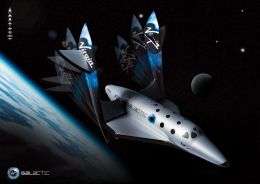
September 18, 2008 SpaceShipTwo

Enlarge

SpaceShipTwo.

Two University of Leicester scientists have recently been awarded 10,000 to design concepts for scientific experiments which would fly on the upcoming new generation of manned suborbital spacecraft, such as Virgin Galactic's SpaceShipTwo. Suborbital spacecraft are launched into space, but do not have enough speed to achieve orbit. They experience several minutes of microgravity ("free fall") and exposure to the environment of space before falling back to Earth.

Dr Duncan Law-Green and Mr David Boyce of the Department of Physics & Astronomy at the University of Leicester have each been awarded $5,000 by the Universities Space Research Association (USRA) to design microgravity experiments for submission to NASA. They are currently working with the Space Research Centre (SRC) at Leicester on the development of their proposals. The NASA programme was originally conceived by Dr. Alan Stern, former head of NASA's Science Mission Directorate. A successful submission may lead to a pilot programme of suborbital research flights sometime around 2011-2012.

The proposed Leicester experiments deal with the physical and chemical properties of regolith, or the powdery material found on the surface of the Moon and other rocky bodies in the solar system. Improved knowledge of the properties and potential uses of this material will be very important for when humans return to the Moon in around 2020.

Dr. Law-Green commented "Leicester has a long history of research with suborbital rockets. A Leicester experiment will shortly be flying on a Black Brant rocket from White Sands, New Mexico. The advantage of the new commercial suborbital spaceplanes like SpaceShipTwo, is that they will provide scientists with cheaper and more frequent access to space, as well as the ability to have a researcher in place to monitor an experiment in real-time. If we want to fly an experiment again the following day, we will be able to do that more easily with a spaceplane than with a conventional sounding rocket. The research potential of this new generation of commercial manned spacecraft is very exciting."

Source: University of Leicester


print this article email this article download pdf blog this article bookmark this article     Stumble it Digg this share on Facebook retweet share on Reddit add to delicious
Rate this story - 4.5 /5 (2 votes)


September 18, 2008 all stories

Comments: 0

4.5 /5 (2 votes)
  • Stumble this up

  • Digg this

  • share this

  • hide
  • Related Stories

  • Astronomers explore 'last blank space' on map of the Universe
    created Oct 28, 2009 | popularity not rated yet | comments 0
  • Scientists develop drug detection technology
    created Sep 08, 2009 | popularity not rated yet | comments 0
  • New class of black holes discovered
    created Jul 01, 2009 | popularity not rated yet | comments 0
  • Keck Study Sheds New Light on "Dark" Gamma-ray Bursts
    created Jun 08, 2009 | popularity not rated yet | comments 0
  • New research contributes to defense of Earth's technologies
    created Jun 03, 2009 | popularity not rated yet | comments 0


  • hide
  • Relevant PhysicsForums posts

  • Question about 2-body gravity
    created Nov 24, 2009
  • life on Mars
    created Nov 24, 2009
  • Semi-major axis from cartesian co-ordinates
    created Nov 23, 2009
  • Primary Mirror grinding
    created Nov 23, 2009
  • More from Physics Forums - General Astronomy

Other News

Gullies and Flow Features on Crater Wall

Gullies and Flow Features on Crater Wall

Space & Earth / Space Exploration

created 10 minutes ago | popularity not rated yet | comments 0

(PhysOrg.com) -- This image from the High Resolution Imaging Science Experiment (HiRISE) camera on NASA's Mars Reconnaissance Orbiter shows a sample of the variety and complexity of processes that may occur ...


Monster Waves on the Sun are Real

Monster Waves on the Sun are Real (w/ Video)

Space & Earth / Astronomy

created 16 hours ago | popularity 4.8 / 5 (13) | comments 2

Sometimes you really can believe your eyes. That's what NASA's STEREO (Solar Terrestrial Relations Observatory) spacecraft are telling researchers about a controversial phenomenon on the sun known as the "solar ...


Russia: no space for space tourists (AP)

Russia: no space for space tourists

Space & Earth / Space Exploration

created 4 hours ago | popularity 2.5 / 5 (2) | comments 2

(AP) -- A top Russian space official says there is no space for tourists wishing to fly to the International Space Station.


Climate experts debate strategies for reducing atmospheric carbon and future warming

Climate experts debate strategies for reducing atmospheric carbon and future warming

Space & Earth / Environment

created 17 hours ago | popularity 2.6 / 5 (7) | comments 10

(PhysOrg.com) -- Reducing carbon dioxide to safe levels may require extracting carbon from the air, says Cornell climate researcher.


Cosmic 'dig' reveals vestiges of the Milky Way's building blocks

Cosmic 'Dig' Reveals Vestiges of the Milky Way's Building Blocks

Space & Earth / Astronomy

created 21 hours ago | popularity 4.9 / 5 (15) | comments 1

(PhysOrg.com) -- Peering through the thick dust clouds of our galaxy's "bulge" (the myriads of stars surrounding its center), a team of astronomers has unveiled an unusual mix of stars in the stellar grouping ...