Water Hit With Young Star's Best Shot
September 18, 2008
Water Hit With Young Star's Best Shot

Enlarge

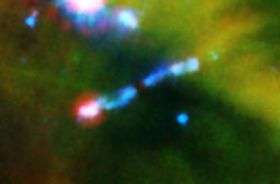
A jet of gas firing out of a very young star can be seen ramming into a wall of material in this infrared image from NASA's Spitzer Space Telescope. The young star, called HH 211-mm, is cloaked in dust and can't be seen. But streaming away from the star are bipolar jets, color-coded blue in this view. The pink blob at the end of the jet to the lower left shows where the jet is hitting a wall of material. The jet is hitting the wall so hard that shock waves are being generated, which causes ice to vaporize off dust grains. The shock waves are also heating material up, producing energetic ultraviolet radiation. The ultraviolet radiation then breaks the water vapor molecules apart. In this image, light with wavelengths of 3.6 and 4.5 microns is blue; 8-micron light is green; and 24-micron light is red. Credit: NASA/JPL-Caltech/Harvard-Smithsonian CfA

Water is being blasted to pieces by a young star's laser-like jets, according to new observations from NASA's Spitzer Space Telescope. The discovery provides a better understanding of how water -- an essential ingredient for life as we know it -- is processed in emerging solar systems.

"This is a truly unique observation that will provide important information about the chemistry occurring in planet-forming regions, and may give us insights into the chemical reactions that made water and even life possible in our own solar system," said Achim Tappe, of the Harvard-Smithsonian Center for Astrophysics (CfA).

A young star forms out of a thick, rotating cloud of gas and dust. Like the two ends of a spinning top, powerful jets of gas emerge from the top and bottom of the dusty cloud. As the cloud shrinks more and more under its own gravity, its star eventually ignites and the remaining dust and gas flatten into a pancake-like disk, from which planets will later form. By the time the star ignites and stops accumulating material from its cloud, the jets will have died out.

Tappe and his colleagues used Spitzer's infrared eyes to cut through the dust surrounding a nascent star, called HH 211-mm, and get a better look at its jets. These particular jets are exceptionally young at 1,000 years old, and they are some of the most collimated, or focused, known. An instrument on Spitzer called a spectrometer analyzed light from one of the jets, revealing information about its molecules.

To the astronomers' surprise, Spitzer picked up the signature of rapidly spinning fragments of water molecules, called hydroxyl or OH. In fact, the hydroxyl molecules have absorbed so much energy (through a process called excitation) that they are rotating around with energies equivalent to a temperature of 50,000 degrees Fahrenheit (27,700 degrees Celsius). This far exceeds normal expectations for gas streaming out of a stellar jet. (Water, which is abbreviated H2O, is made up of two oxygen atoms and one hydrogen; hydroxyl, or OH, contains one oxygen and one hydrogen atom.)

The results reveal that the jet is ramming its head into a wall of material, vaporizing ice right off the dust grains it normally coats. The jet is hitting the material so fast and hard that a shock wave is also being produced.

"The shock from colliding atoms and molecules generates ultraviolet radiation, which will break up water molecules, leaving extremely hot hydroxyl molecules," said Tappe.

Tappe said this same process of ice being vaporized off dust occurs in our own solar system, when the sun vaporizes ice in approaching comets. In addition, the water that now coats our world is thought to have come from icy comets that vaporized as they rained down on a young Earth.

Tappe is the lead author of a paper on this topic, which was published in a recent issue of the Astrophysical Journal. Co-authors on the paper include Charlie Lada, and August Muench, also of the CfA; and J. H. Black, of the Chalmers University of Technology, in Onsala, Sweden.

Source: Harvard-Smithsonian Center for Astrophysics

4.4 /5 (11 votes)  

Filter


Move the slider to adjust rank threshold, so that you can hide some of the comments.


Display comments: newest first

brant
Sep 18, 2008

Rank: 2 / 5 (1)
PLASMA
Rank 4.4 /5 (11 votes)
Tags

Related Stories
Relevant PhysicsForums posts
  • Never ending outer space.....
    created11 hours ago
  • Neutron Star fragments?
    created13 hours ago
  • stationary or not?
    created17 hours ago
  • Scale of the Universe
    createdFeb 10, 2012
  • Titan's lack of impact craters
    createdFeb 09, 2012
  • Real pictures of black hole eating a star?
    createdFeb 08, 2012
  • More from Physics Forums - General Astronomy

More news stories

Latin America mining boom clashes with conservation

Latin America is experiencing a mining boom as prices rise fuelled by a hike in global demand, but the region is also being hit by a wave of violent protests, strikes and rallies by environmentalists.

Space & Earth / Environment

created 4 hours ago | popularity not rated yet | comments 0

Europe stakes billion-dollar bet on new rocket

A pencil-slim rocket is scheduled to lift into space from South America on Monday, carrying a billion-dollar bet that Europe can grab a juicy slice of the market to place satellites in low orbit.

Space & Earth / Space Exploration

created 23 hours ago | popularity 4 / 5 (3) | comments 0

Political leaders play key role in how worried Americans are by climate change: study

More than extreme weather events and the work of scientists, it is national political leaders who influence how much Americans worry about the threat of climate change, new research finds.

Space & Earth / Environment

created Feb 06, 2012 | popularity 5 / 5 (6) | comments 72

NASA budget will axe Mars deal with Europe: scientists

US President Barack Obama's budget proposal to be submitted next week for 2013 will cut NASA's budget by 20 percent and eliminate a major partnership with Europe on Mars exploration, scientists said Thursday.

Space & Earth / Space Exploration

created Feb 10, 2012 | popularity 5 / 5 (3) | comments 55

Humans may have helped the decline of African rainforests 3000 years ago

(PhysOrg.com) -- Large areas of rainforests in Central Africa mysteriously disappeared over three thousand years ago, to be replaced by savannas. The prevailing theory has been that the cause was a change ...

Space & Earth / Environment

created Feb 10, 2012 | popularity 4.1 / 5 (14) | comments 20 | with audio podcast report


Google might launch Drive for cloud storage soon

(PhysOrg.com) -- Google's next big move, according to the Wall Street Journal, is a cloud storage service called Drive. Hardly first to the plate, Google is simply catching up to introducing its cloud reposi ...

Walney offshore wind farm is world's biggest (for now)

(PhysOrg.com) -- The Walney wind farm on the Irish Sea--characterized by high tides, waves and windy weather--officially opened this week. The farm is treated in the press as a very big deal as the Walney ...

Love a click away in Indonesia's Twitter Republic

He was a geeky kid from Yogyakarta, she a glamorous city girl in Jakarta. In a country with one of the world's most vibrant social networking scenes they fell in love on Twitter.

GPS court ruling leaves US phone tracking unclear

A US Supreme Court decision requiring a warrant to place a GPS device on the car of a criminal suspect leaves unresolved the bigger issue of police tracking using mobile phones, legal experts say.

Europeans protest controversial Internet pact

Tens of thousands of people marched in protests in more than a dozen European cities Saturday against a controversial anti-online piracy pact that critics say could curtail Internet freedom.

Study finds that anti-diabetic medication can prevent the long-term effects of maternal obesity

In a study to be presented today at the Society for Maternal-Fetal Medicine's annual meeting, The Pregnancy Meeting, in Dallas, Texas, researchers will report findings that show that short therapy with the anti-diabetic medication ...